



Craig
McCulloch Deputy Political Editor
Analysis
– National’s Christopher Luxon has called it an “MMP
special”, but a shambles might be more appropriate.
On
the preliminary results, New Zealand is looking at a
near-farcical 131-seat Parliament, thanks to a record
11-seat overhang.
National’s party vote entitles it to
35 MPs, but its lead in 42 electorates gives it an extra
seven “overhang” MPs.
Likewise, Te Pāti Māori has
won five electorates, despite a party vote worth only one
MP, adding another four seats to Parliament.
That
overhang has made all the difference – on a strictly
proportional basis, Parliament would be deadlocked at 60
seats apiece.
Instead, the existing coalition holds 67
of 131, just one more than the 66 needed to
govern.
Labour, the Greens, Te Pāti Māori and
Opportunity have 64 among them.
There is a reason,
though, that no-one is celebrating just yet, with an
estimated 399,000 special votes still to be counted, roughly
one vote in seven.
Historically, those votes have
tended to favour the left and several knife-edge electorate
races remain in play, but there’s a catch – the final count
could also alter the size of Parliament itself.
Here
are five ways the numbers could shift when the official
results are released on 27 November. Any combination of them
could happen at once.
Scenario one: National loses
electorates to Labour
Advertisement – scroll to continue reading
Two National MPs face
particularly nervous waits.
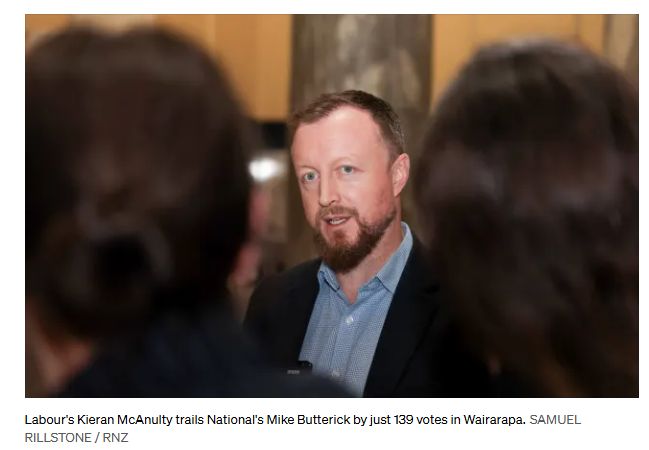
In Wairarapa, Mike
Butterick leads Labour’s Kieran McAnulty by just 139
votes.
In Hamilton East, Ryan Hamilton is 456 ahead of
Labour’s Georgie Dansey.
Either seat could yet change
hands, although the margins alone tell us little about how
the remaining voters have cast their ballots.
Because
National has more electorate MPs than its party vote affords
it, every electorate it loses also reduces the size of
Parliament, while Labour’s count remains
unchanged.
If
National loses Wairarapa alone, the coalition falls to 66
MPs in a 130-seat Parliament, still a majority.
If
Hamilton East flips too, the coalition drops to 65 in a
129-seat Parliament. Again, just enough.
Scenario
two: National takes electorates from Labour
The
reverse could also happen, strengthening Luxon’s
hand.
Labour’s Michael Wood leads National’s Carlos
Cheung by just 262 votes in Mt Roskill.
In Hutt South,
Labour’s Ginny Andersen is 889 ahead of National’s Chris
Bishop.
If National overturns either result, its
overhang grows, pushing up the size of
Parliament.
Labour would lose an electorate MP, but
bring in another from its list, leaving its total
unchanged.
For National, every additional electorate
victory is effectively a bonus seat.
Scenario three:
Greens win a Māori electorate
In one of the stranger
twists, a Green Party victory would actually hurt the left’s
chances.
In Te Tai Tokerau, Te Pāti Māori’s
Aperahama Edwards leads the Greens’ Hūhana Lyndon by 436
votes.
If Lyndon wins, she’ll take a seat already
included in the Greens’ proportional allocation, but Te
Pāti Māori would lose one of its four overhang seats,
shrinking Parliament to 130.
All else unchanged, the
coalition would keep its 67 seats, while the other parties
would fall to 63.
In other words, a victory for the
Greens would make Luxon’s majority safer.

Scenario
four: Some of National’s party vote shifts to the
left
Here’s another peculiarity – National could lose
party-vote support without losing a single MP.
If its
vote share drops enough to entitle it to just 34 MPs, it
still keeps all 42 of its electorate MPS and its overhang
simply grows from seven to eight.
That would free up
an extra proportional seat for another party, potentially
Labour, the Greens or Opportunity.
Parliament would
grow to 132 seats, but the coalition would still hold 67,
against the opposition’s 65.
Scenario five: Some of
ACT or New Zealand First’s party vote shifts to the
left
This is one of most dangerous possibilities for
Luxon. Unlike National, neither ACT nor NZ First has an
overhang protecting its numbers.
If either loses a
list MP to Labour, the Greens or Opportunity, the
coalition’s total falls without Parliament shrinking along
with it.
One lost seat would leave the coalition on 66
out of 131, just enough, but two would leave it on 65, with
the other four parties holding 66 between them.

Opportunity
would be kingmaker, in a position to deliver a majority to
either side.
Of course, any gains for the Greens or
Opportunity could come at Labour’s expense instead, leaving
the overall balance unchanged.
The 27 November
tangle
Remember, any combination of these scenarios
could happen at once.
Imagine National loses
Wairarapa, while NZ First loses a list seat to the
Greens.
That would leave National with 41 MPs, Labour
36, the Greens 17, ACT 13, New Zealand First 11, Opportunity
seven and Te Pāti Māori five.
The coalition would
hold 65 seats in a 130-seat Parliament. One short of a
majority.
Now imagine National’s party vote also falls
enough to increase its overhang, with Opportunity picking up
an extra list MP.
All of a sudden, we’re back to a
131-seat Parliament – but Luxon’s side would have only 65
MPs.
Labour, the Greens, Te Pāti Māori and
Opportunity would have 66 between them.
That is just
one hypothetical outcome, not a prediction, but it shows how
easily a handful of close electorate races and small shifts
in the party vote could overturn the election-night
result.
New Zealand’s public broadcaster, providing comprehensive NZ news and current affairs, specialist audio features and documentaries.
Radio New Zealand is a Crown entity established under the Radio New Zealand Act 1995. Radio New Zealand News are vital elements in our programming, providing impartial news and information to New Zealanders every day. Radio New Zealand (RNZ) provides listeners with exciting and independent radio programmes in accordance with the Radio New Zealand Charter.

