



Mary Argue
Reporter
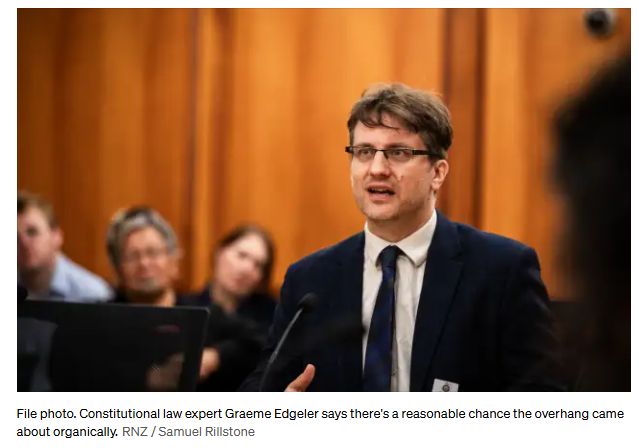
A constitutional law expert is not
convinced a billionaire’s vote-splitting campaign is behind
National’s historic election seat overhang.
On the
preliminary results, the typical 120-seat Parliament is
looking to swell by 11 MPs, with both National and Te Pāti
Māori winning more electorate seats than their party vote
entitles them to.
National has an extra seven
“overhang” MPs, while Te Pāti Māori has an extra four
after campaigning on an overhang strategy, asking supporters
for their candidate vote, but to vote Green or Labour for
the party.
Businessman Harry Mowbray also told
National supporters to give their electorate vote to
National but their party vote to ACT or NZ First.
But
lawyer Graeme Edgeler is questioning what has happened and
said there was a reasonable chance the overhang came about
organically.
“Was this something that was artificially
caused? Or was it just because, well, both National and
Labour were very unpopular going into this
election?
“And because of that, when major parties are
highly unpopular, this is a risk. This is something that can
happen.”
He said the Electoral Commission’s split-vote
analysis would shed more light on what happened and why, but
speculated that if the two main parties turned around
slumping support, the extent of the overhang could be a
one-off.
“Three or six years’ time, if the major
parties sort of pick up some support from their smaller
parties, it might not happen or might not happen to the same
extent in the future.”
Advertisement – scroll to continue reading
He said the result was not “a
mockery of a MMP”, but said it should prompt another review
of the MMP electoral system if a repeat looked
likely.
“If it looks like it might actually affect the
result of who can govern, then there are going to be
incentives in play to other parties to try things like
this.”
Parties
against vote-splitting campaign ‘benefiting the
most’
Mowbray said his campaign was designed to point
out the flaws of MMP, rather than engineer an election
result.
He told Morning Report on Monday if
every National voter had split their vote there would be 36
overhang seats.
“My whole aim here has never been to
engineer the voting system other than to actually point out
how bad it was,” he said.
“I believe that we need to
put a whole new structure in place.”
Mowbray said the
result would have been even stronger had National, ACT and
New Zealand First supported the campaign.
“It’s quite
an irony that all parties that didn’t support it, in actual
fact are the ones that are benefiting the
most.”
Mowbray said it is a travesty that a party’s
electorate success comes at the cost of the party vote under
MMP.
How other countries deal with the
overhang
Edgeler said countries had dealt with the
overhang problem in different ways, such as only giving one
vote, which elects the local MP, but is also the party
vote.
Germany “balanced” the overhang by giving
parties extra MPs for years until it became too unwieldly,
he said, and now give MPs seats in parliament based on the
party vote.
“You’ve got party votes for two MPs.
You’re getting two MPs, even though you won five
electorates. And that’s perhaps an extreme thing.”
The
way parliament operated could also change, Edgeler said,
such as limiting voting rights on bills to the party vote,
rather than giving a vote to each MP.
Under that
scenario, and based on current results, National would get
35 votes rather than 42, while Te Pāti Māori would have
one vote as opposed to five.
Edgeler said any rule
changes would have to signalled well in advance.
“We
voted under this election with the rules we have. And so for
the next three years, that’ll be what we’re looking
at.
“But beyond that, [it’s] certainly something we
should review.”
He said all the international
solutions could be all be on the table. “We could look at
all of them and see which one works out for New
Zealand.”
New Zealand’s public broadcaster, providing comprehensive NZ news and current affairs, specialist audio features and documentaries.
Radio New Zealand is a Crown entity established under the Radio New Zealand Act 1995. Radio New Zealand News are vital elements in our programming, providing impartial news and information to New Zealanders every day. Radio New Zealand (RNZ) provides listeners with exciting and independent radio programmes in accordance with the Radio New Zealand Charter.

