


Lauren
Crimp Political reporter
Enrolments have closed
and voting in the general election begins today, with party
leaders among those casting their ballot on day
one.
Candidates were
calling for last-minute enrolments on Sunday, while the
Electoral Commission acknowledged the Government’s changes
preventing enrolment right up until voting day would impact
numbers.
As of Friday – with two days remaining to
enrol – 92.4 percent of those eligible had done so. In the
2023 election 94.7 percent of eligible voters
enrolled.
Labour leader Chris Hipkins said the
Government was to blame if the 2023 enrolment figure was not
reached.
“If we do not have at least enrolment
equivalent to what we had at the last election, that will be
an indictment on this Government, who have deliberately
tried to disenfranchise people, particularly younger New
Zealanders, who are less likely to vote for them,” he
said.
The Greens’ co-leader Chlöe Swarbrick said the
Government knew that stopping people from enrolling to vote
in the two weeks leading up to election day would
disproportionately affect young people, renters, Māori,
Pasifika, and migrant communities.
“These are
structural barriers and it doesn’t have to be this way. No
politician and no government should ever make it harder for
anybody to engage in our democracy.”
Advertisement – scroll to continue reading
However, National
leader Christopher Luxon and ACT leader David Seymour
disagreed, saying enrolling was simple.
“You’ve seen
the Electoral Commission bombard everybody with advertising.
I think they’ve had almost a doubling of advertising around
voter turnout and voter enrolment. It’s pretty simple and
easy to do,” Luxon said.
Seymour added it was people’s
duty to enrol.
“If you take all the benefits of a free
and democratic society, but you’re not prepared to perform a
task simpler than ordering a pizza on Uber Eats to be part
of that society, I think that is dropkick behaviour,” he
said.
Seymour said low enrolment rates would be an
indictment on people who choose not to enrol, not the
Government, which had simply set a basic
expectation.
ACT and Labour respond to National’s
100-day plan
National on
Sunday released its 100-day plan, setting out the first
actions it would take if re-elected.
As a prospective
coalition partner, Seymour said he would not get into
pre-negotiations and detail what ACT would and would not
agree to.
“There are some things that will go ahead,
others that won’t. Just like the last three years,” he
said.
“What’s clear is that we can work constructively
together, and having the ACT Party there to curb some of the
National Party’s worst instincts, while also promoting
positive, practical solutions to New Zealanders’ problems,
is a good thing.”
Meanwhile, Hipkins dismissed the
plan as a reheat of previous announcements.
Talk of
boosting bipartisanship during leaders’ debates culminated
in a handshake between Hipkins and Luxon at one point, with
the pair agreeing to sit down together within the first 100
days of the next term and hash out what big things they
could work together on.
RNZ asked Hipkins whether
there was any part of National’s 100-day plan he could get
on board with.
He said National had shown no interest
in collaborating on things that matter.
“They’ve
shunned every overture from the Opposition in the last three
years to work constructively together on big issues. I think
that’s unlikely to change if they continue to be the
Government.”
Hipkins
doubts Opportunity’s Future Generations
Commissioner
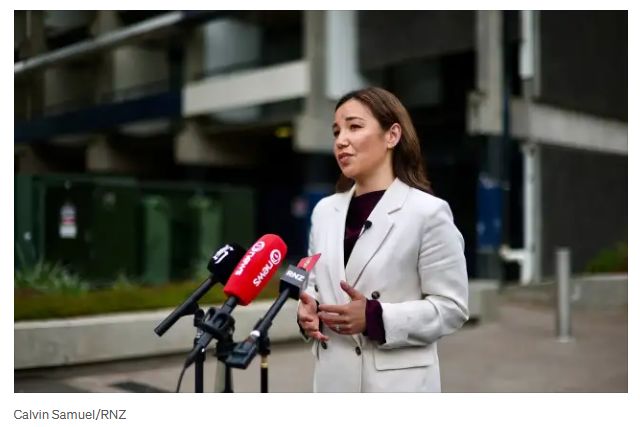
Opportunity leader Qiulae Wong on
Sunday announced her party would establish a Future
Generations Commissioner to hold governments to account
for the long-term impacts of their policies if
elected.
Wong said it would stop short-term thinking
and guide development of long-term national
goals.
Hipkins said he would be open to having a
conversation about it, but any commission must be more than
“just talk”.
He was sceptical of those sorts of
organisations – pointing to the Productivity Commission and
Families Commission – saying they came up with good ideas,
but those could not go anywhere without political
support.
“We have a history of setting up sort of
think tanks, advocacy groups that don’t really affect
positive, meaningful change.
“Fundamentally, democracy
is a contest of ideas. This is what we want people voting
on. If you want us to tackle the cost of living, if you want
us to tackle healthcare, get people back to work and create
a future that New Zealanders can be proud of and that our
kids want to be part of, you need to vote for
that.”
New Zealand’s public broadcaster, providing comprehensive NZ news and current affairs, specialist audio features and documentaries.
Radio New Zealand is a Crown entity established under the Radio New Zealand Act 1995. Radio New Zealand News are vital elements in our programming, providing impartial news and information to New Zealanders every day. Radio New Zealand (RNZ) provides listeners with exciting and independent radio programmes in accordance with the Radio New Zealand Charter.

