


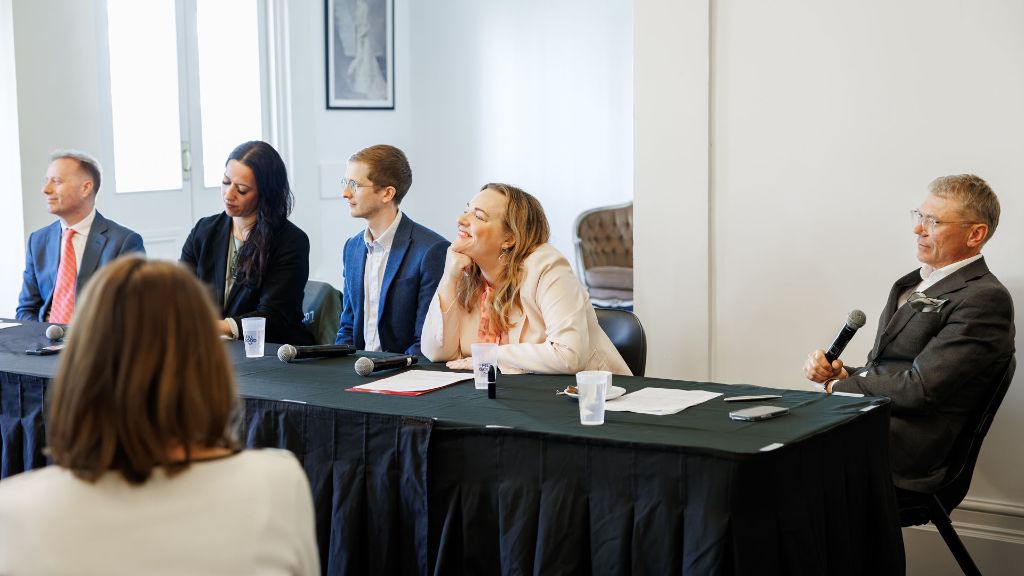
at the Toi o Taraika Arts Wellington General Election Forum,
from left: Gerald Warner (NZ First), Kahurangi Carter
(Greens), Luke Ross (Opportunity), Rachel Boyack (Labour)
and Paul Goldsmith (National). He is at a long table with
four other politicians. Image credit: Sophie Mac
Photography
Organisations –
businesses, large corporates, ministries, not for profits
– develop policies to guide their work, establish rules
and ensure their activities are aligned to their values and
legal obligations. Arts spokespeople for political parties
acknowledge the value of the arts but where are their
policies setting out where they’re heading and what
they’ll do to support them?
It requires more than
well-intentioned words. It requires clear commitments,
policies and actions that recognise the contribution the
arts make to our lives and communities.
The arts and
creative sector contributed $18.5 billion to New Zealand’s
GDP in the year to March 2025, representing 4.3 percent of
the economy. Of course, the arts contribute to more than the
economy: they also support our health and wellbeing, build
social connections, help us express our identities, and
encourage understanding and empathy.
So it’s
puzzling that most political parties don’t appear to take
the arts seriously. The Greens are the only political party
to have a written arts policy although Labour has several
policies on specific aspects of the arts.
Advertisement – scroll to continue reading
Read about
the Greens’
arts, culture and heritage policy
And this week,
Te Pāti Māori announced the establishment of an
independent Toi Māori Authority with a continuing, two-year
rotational income programme for Māori artists contributing
to mātauranga Māori.
The proposed authority would be
independent of Creative New Zealand, resourced at parity
with it, and governed by tohunga toi from across Māori
artforms and iwi. Read
more about the Toi Māori Authority
Arts Access
Aotearoa attended the Toi o Taraika Arts Wellington General
Election Forum in September. The five politicians who took
part acknowledged the value of the arts and their
contribution to health and wellbeing. But many people in the
arts community left the forum wanting more: practical
proposals, clear commitments and solutions to the challenges
facing the sector.
This is not a new concern. In March
2023, arts commentator John Daly-Peoples wrote
in NZ Arts Review that political parties had paid
little attention to arts policy at the 2020 election. He
argued that the arts often attracted worthy sentiments but
few realistic plans, and called on parties to develop arts
policies before the 2023 election.
In October 2023,
columnist Steve
Braunias also decried the lack of arts policies in
Newsroom and applauded Australia’s national cultural
policy, Revive, which was backed by $300 million
in funding supporting its arts and culture.
Three
years later, we’re asking the same old question in
Aotearoa New Zealand: where are the policies and practical
commitments that will support the arts sector to
thrive?
The coalition Government has developed Amplify:
A Creative and Cultural Strategy for New Zealand
2025–2030 but this is focused on economic growth,
productivity and international exports rather than on the
social and health benefits the arts bring.
In its
“Recognising the wellbeing value of arts and creativity”
policy, Labour says it will update the government’s
Amplify strategy to include a dedicated section on wellbeing
with a commitment to equitable access to the arts. It will
also set clear wellbeing and equity outcomes and ensure
these wider public benefits are considered in government
investment, partnerships and measures of
success.
What are the parties proposing?
Arts
Access Aotearoa asked the Greens, Labour, National,
Opportunity, ACT, New Zealand First and Te Pāti Māori two
questions:
- Does your party have a written arts
policy? - What does access to the arts for everyone in
New Zealand mean to your party?
Only two parties
responded to our questions. We will update this section if
further responses land in our inbox.
Romeo Tevaga,
Opportunity Party
Asked whether the party has a
written arts policy, the answer was: No.
On what
access to the arts means to the party, Romeo Tevaga
said:
“Opportunity sees the arts as benefiting
everyone. Ensuring accessibility means embedding the arts in
how it strengthens our approach to health, education and
justice, making the arts integral and
enduring.
Evidence shows arts-based initiatives
enhance services in primary health, disability and
restorative justice through healing, creative expression and
empowerment. Strengthening who we are and how we
connect.
We won’t treat arts and culture as a niche
policy attached to a funding pool. We want something bigger:
a country designed to enable art happening
everywhere!”
Rachel Boyack, Labour
Party
Asked whether the party has a written arts
policy, the answer was:
We’ve yet to release all of
our arts policies. To date, we have released the following
policies specific to the arts: Supporting New Zealand
artists alongside international acts; Protecting artists’
copyright in the age of AI; Protecting public funding for
arts and culture; and Recognising the wellbeing value of
arts and creativity.
On what access to the arts means
to the Labour Party, Rachel Boyack said:
Labour
believes everyone should be able to access and participate
in the arts. The arts help us tell our stories, strengthen
wellbeing and connection, and create opportunities through
education and good jobs. Building creativity among our young
people develops confidence, imagination and skills for the
future. Government should support equitable access to the
arts, particularly for regional communities, Māori, Pacific
and ethnic communities, and disabled people, while investing
in a thriving, inclusive creative sector.
A challenge
to political parties
We want political parties to
move beyond acknowledging the value of the arts and tell us
what they will do to support them.
That means setting
out clear and achievable commitments, backed by appropriate
investment, to support artists and arts organisations,
strengthen arts participation in communities and remove
barriers that prevent people from taking part.
Access
to arts and culture is a basic human right. It should not
depend on where you live, what your income is, or whether
you have a disability.
As the election approaches, we
urge all political parties to make their intentions clear. A
written arts policy is an important foundation from which to
build and take meaningful action supporting the arts sector
to thrive and contribute even more to the economic, social
and health sectors of
Aotearoa.

