

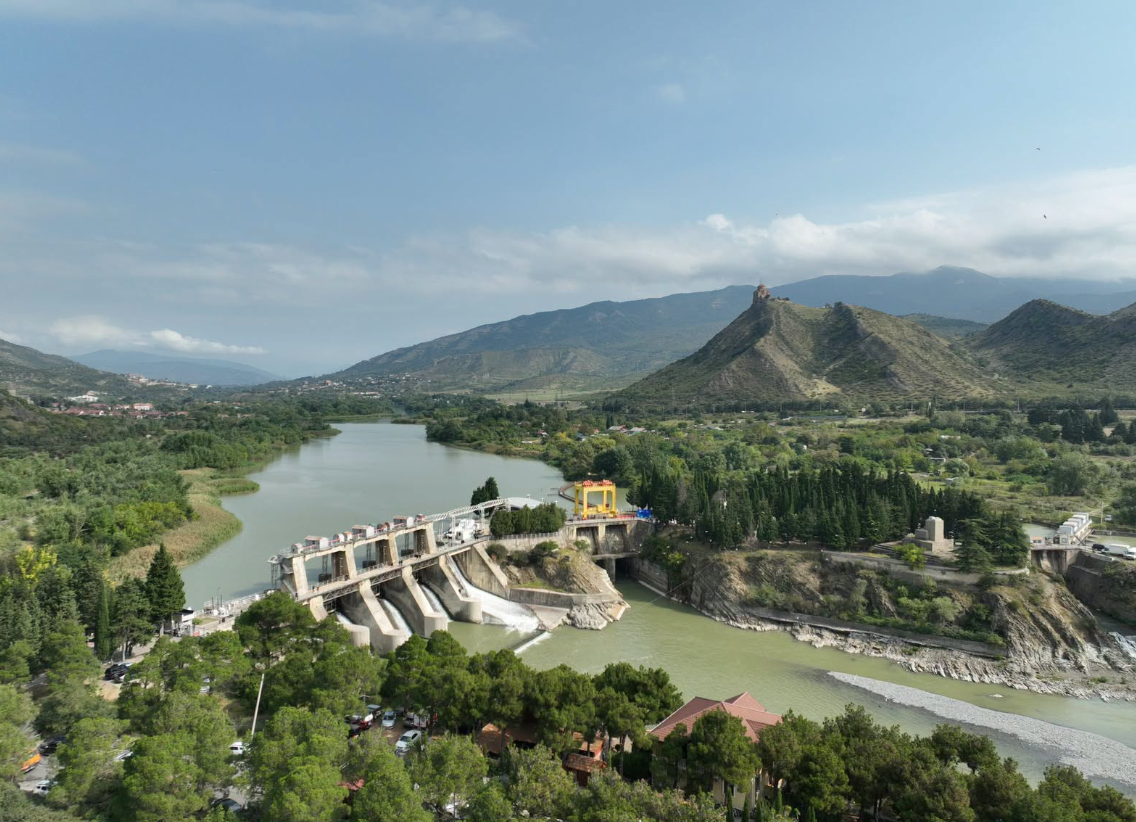
Georgian officials said they hope to increase power generation 2.5 times by 2036 through new investments, presenting a 10-year vision focused on “self-sufficiency,” expanded renewable generation, a greater role in energy transit, and an upgraded transmission grid.
The Georgian Dream officials, including Prime Minister Irakli Kobakhidze and Economy Minister Mariam Kvrivishvili, revealed their plans as they marked Energy Workers’ Day on September 17, stressing the goals for Georgia to become “fully self-sufficient in electricity by 2036” while linking the Caspian region, the Black Sea, and Europe in “a single energy space.”
According to Kvirishvili, the vision also envisages developing the Black Sea Submarine Cable, which received “Project of Mutual Interest” status from the European Union this year, as well as the broader “Green Corridor” project linking Georgia with Azerbaijan, Turkey, Bulgaria and Romania.
‘Ambitious’ 2036 Plan
Speaking at an event taking place near the Zemo Avchala Hydroelectric Power Plant, commonly known as Zahesi, Kobakhidze said that over the past year, the government had “carried out optimization in many directions” and laid the foundation for a “new vision” according to which Georgia’s energy system would develop over the next 10 years.
According to Kobakhidze, the government has a “very ambitious plan,” under which “power generation in Georgia must increase 2.5 times by 2036.”
“This is an ambitious plan, but its implementation is entirely realistic, and of course, our entire team will spare no effort to achieve it,” he said.
Kobakhidze said the government would make maximum efforts to use Georgia’s energy resources and potential “as wisely and rationally as possible,” attract new investment into the energy sector, strengthen infrastructure and support the development of modern technologies.
Kvrivishvili, for her part, said that energy security is a “national goal,” noting that “energy is one of those fields whose smooth operation is often invisible, but even one small disruption in it instantly becomes visible to the entire country.”
She stressed that people remember well, “what it meant to have an energy-weak Georgia,” where “electricity shortages were a standard everyday problem,” arguing that Georgia must no longer become “an energy-vulnerable country” and should instead be “an energy-strong, self-sufficient state of regional importance.”
As Kvrivishvili noted, over the past year, “the strong sides of the energy system, its weaknesses, opportunities, and the challenges that the state must address in advance became more clearly apparent.”
She then highlighted several completed, ongoing, and planned projects in the energy sector.
Kvrivishvili said that three hydropower plants and one wind project had already been constructed in 2026 and by the end of the year, the construction of another hydropower plant, two wind projects and three solar projects would be completed.
“This year, more than 300 megawatts of new renewable capacity will be added to Georgia’s energy system,” she said. “In 2027, with nearly USD 100 million in investment, 12 power plant projects totaling more than 70 megawatts will come into operation.”
Kvrivishvili said that in 2026, with the support of the Asian Development Bank, the government completed the procurement of 250 megawatts of energy storage batteries. Work will begin in 2026 and is expected to be completed by 2029, with Kvrivishvili arguing that it “will ensure the stable and secure functioning of the system, as well as expand the limits for integrating renewable energy.”
The minister also highlighted the authorities’ efforts to revive energy projects that had been stalled for years.
She said fines and penalties on energy projects had exceeded GEL 1 billion in 2026, prompting them to give viable projects “a new opportunity for development.” As a result, she said, contracts for 111 projects with a total installed capacity of up to 1,600 MW were extended based on the conditional forgiveness of fines.
Kvrivishvili also said bank lending to the energy sector had reached a record GEL 3.2 billion as of July 2026, 30% higher year-on-year. “This data shows that investors’ confidence has returned regarding the transparency, reliability, and fairness of processes in the energy sector, and the sector’s development prospects,” she said.
The minister then noted that the construction is underway on 14 transmission lines and four substations, covering more than 587 km of transmission lines. “This is the part of the energy sector that may be less visible to the public, but it is actually here that it is decided how quickly and how reliably the entire system will develop.”
Kvirvishvili said that the government’s task is for Georgia to “become a state that produces, transmits, and connects energy, a country that links the Caspian region, the Black Sea, and Europe in a single energy space”
Kvrivishvili also highlighted the Black Sea Submarine Cable, calling it “one of the most strategic projects for Georgia.”
“This year the project was granted Project of Mutual Interest status by the European Union. By the end of the year, a tender will be announced for a study of the Black Sea seabed. But our vision is not only about one cable. We are working on a bigger picture – we are working on the ‘Green Corridor’ project,” she noted.
In this context, she said Georgia is strengthening cooperation with Azerbaijan, Turkey, Bulgaria and Romania as part of these efforts, describing this as part of Georgia’s “new energy role.”
Kvrivishvili also pointed to the oil and gas sector as part of the same strategy, saying that following months of negotiations with Azerbaijan’s government, Georgia had reached an agreement this year on the full-capacity operation of the Baku-Supsa oil pipeline.
“Our goal is clear: by 2036, Georgia’s electricity sector must become fully self-sufficient. This is an ambitious goal, but ambition is valuable when it is accompanied by a plan, resources, and professionals,” she said.
Also Read:

