

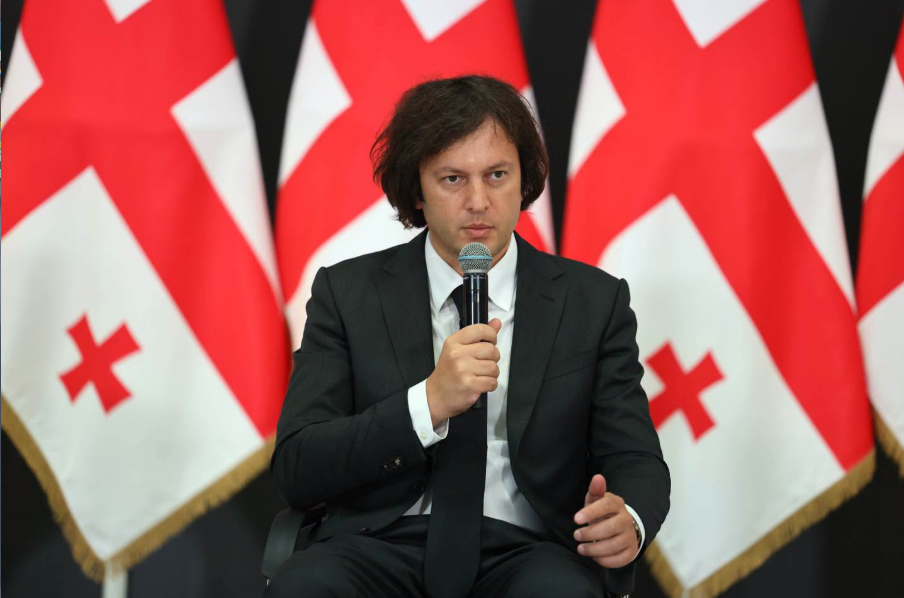
Georgian Dream Prime Minister Irakli Kobakhidze said the State Grant Management Agency, created last year as part of the civil society crackdown, is “phasing out” and will close by the end of the year, in media remarks where he also described NGOs as an “artificial phenomenon” created as a foreign meddling tool.
“The [State] Grant Management Agency is phasing out and will be closed by the end of the year,” Kobakhidze told reporters in September 17 media remarks following the event marking Energy Worker Day in Georgia.
The GD Prime Minister explained the planned closure by claiming NGOs were designed to serve as instruments of foreign political intervention.
“An NGO is an artificial phenomenon that was invented artificially for the purpose of foreign political intervention,” he said, arguing that the “only purpose” of NGOs could be “for one state to intervene in another state.”
“A century ago, NGOs did not exist. They were subsequently invented, and NGOs were used as the principal instrument of foreign political intervention,” Kobakhidze said, adding, “we have seen numerous examples of this in Georgia.”
“Accordingly, for us to create NGOs ourselves and fund such things would be wrong. Therefore, we made this decision,” he said.
The Georgian Dream government established the State Grant Management Agency, a public entity, on April 15, 2025, to distribute state-funded grants to civil society organizations. The agency has been initially headed by Tamar Zodelava, an official with an extensive background in working with European funds and projects, including as regional project manager for the German Society for International Cooperation (GIZ).
The creation came as part of the broader measures by Georgia’s ruling party to crack down on civil society and independent media by introducing a series of laws and amendments directed at restricting foreign funding.
Critics argued at the time that the establishment of the agency was a means to fund loyal organizations – so-called government-organized non-governmental organizations (GONGOs), while continuing to cut Western funding to independent civil society groups.
“The establishment of the agency was, at the time, a step taken for appearances’ sake, intended to somewhat soften the optics of the unprecedented scale of restrictions on foreign funding,” Nona Kurdovanidze, the former head of the Georgian Young Lawyers Association (GYLA), a local human rights group, wrote on Facebook, commenting on Kobakhidze’s announcement. “Now, it appears, there is no longer any need even for that.”
Citing public data, Kurdovanidze said that the agency has since funded 17 projects under a small grants competition announced in July 2025, with a total budget of GEL 1,657,775 [USD 635,000]. According to her, “funding was awarded to organizations, some of which had been established only shortly before the competition and appear to have been registered specifically for this purpose.”
Kobakhidze has repeatedly accused foreign-funded NGOs of serving outside political interests. He repeated those claims on September 17 while commenting on the dispute regarding the Namakhvani Hydropower Plant, a major energy project in Western Georgia that was halted amid mass protests in 2021, with the state now facing a payment of more than USD 400 million after losing an arbitration case. Georgian Dream has continued to advocate for the project while blaming its failure on civil society groups, or what it called “foreign agents.”
Kobakhidze described the protests against the HPP as “outright sabotage” and linked them to what he called a stronger “foreign agentura” – a term denoting a foreign spy network – operating in Georgia at the time.
“At that time, the foreign agentura was much stronger, and the state was much weaker,” Kobakhidze said. “Today, however, the situation is radically different.”
He said the “agentura” had since been “significantly weakened,” while the state had become “much stronger,” and pledged that what happened several years ago “will not happen again today or tomorrow.”
Also Read:

