

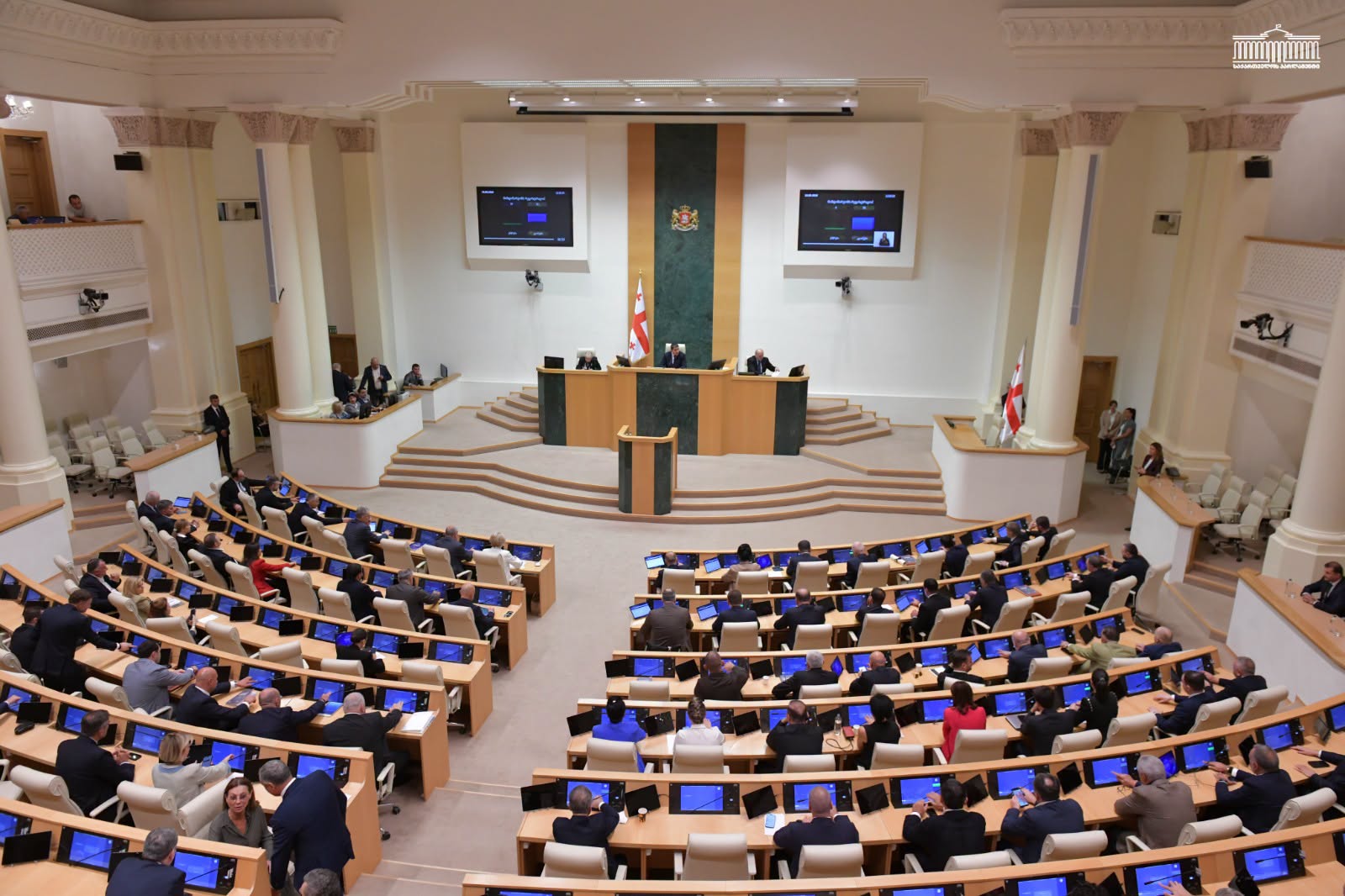
Georgian Dream MPs blamed “inertia” and “technical error” after several MPs from the parliamentary majority voted during a September 15 parliamentary hearing in favor of an opposition-tabled legislative proposal seeking to scrap protest-related changes adopted since the 2024 disputed elections.
The proposed amendments to the Law on Assemblies and Demonstrations, tabled by the opposition For Georgia party, sought to reverse GD’s controversial changes including restrictions on rallying on sidewalks, an expanded list of items prohibited at rallies, and the requirement to submit advance notices of gatherings to the police, a procedure that gave the Interior Ministry a broader mandate to prevent gatherings it deemed undesirable in specific locations.
The proposal did not foresee withdrawing restrictions on the freedom of assembly related to queer-related events, introduced through the anti-LGBT laws which were adopted weeks before the 2024 vote and took effect in December 2024.
The proposal ultimately failed to clear the first hearing, receiving 28 votes in favor — 16 from the parliamentary majority, including 14 Georgian Dream MPs and two members of its offshoot People’s Power, and 12 from For Georgia — falling short of the required threshold.
Notably, those voting in favor included several prominent figures from Georgian Dream and People’s Power, among them GD parliamentary majority leader Irakli Kirtskhalia, Parliament Vice Speaker Tea Tsulukiani, Foreign Relations Committee Chair Nikoloz Samkharadze, as well as Guram Macharashvili and Eka Sepashvili of People’s Power.
Other majority MPs who backed the proposal included Tornike Berekashvili, Isko Daseni, Zaal Dugladze, Vakhtang Turnava, Samvel Manukian, Anton Obolashvili, Aluda Ghudushauri, Goderdzi Chankseliani, Vasil Chigogidze, Givi Chichinadze, and Giorgi Chkonia.
“They probably pressed [the yes button] out of inertia,” Gia Volski, the deputy speaker of the disputed parliament who didn’t vote for the proposed amendments, commented when asked by TV Pirveli journalists about his party colleagues voting in favor.
Kirtskhalia, the parliamentary majority leader who had earlier been the one to unveil some of the GD’s controversial restrictions on freedom of assembly and whose “yes” vote was registered on the opposition bill, blamed his vote on a “technical error,” after journalists alleged he himself was not present in the room during the vote.
Georgian Dream’s Crackdown on Freedom of Assembly
Georgian Dream has tightened the freedom of assembly laws in a series of amendments over the past two years, largely in response to the protests that erupted in November 2024.
The ruling party first introduced heavy GEL 5,000 fines for protest-related offenses, including “blocking roads,” in late 2024. Another series of amendments followed in October 2025, making offenses such as “blocking roads” and “covering faces,” along with other protest-related administrative violations, punishable by immediate detention, while repeat offenses were reclassified as criminal violations, carrying potential sentences of up to one year in prison.
In the initial weeks of enforcing the new laws since October, over a hundred people were arrested, many of whom were sent to administrative detention, while one was charged criminally and eventually convicted for a “repeated act.”
Protest regulations were further tightened in December, after police had effectively ended daily road-blocking protests by physically pushing protesters onto the sidewalks. The December changes extended assembly restrictions to pedestrian zones and required organizers to submit advance notice of gatherings to the police, with police allowed to order the change of route or locations and protesters facing further penalties in case of non-compliance.
Also Read:
This post is also available in:

