

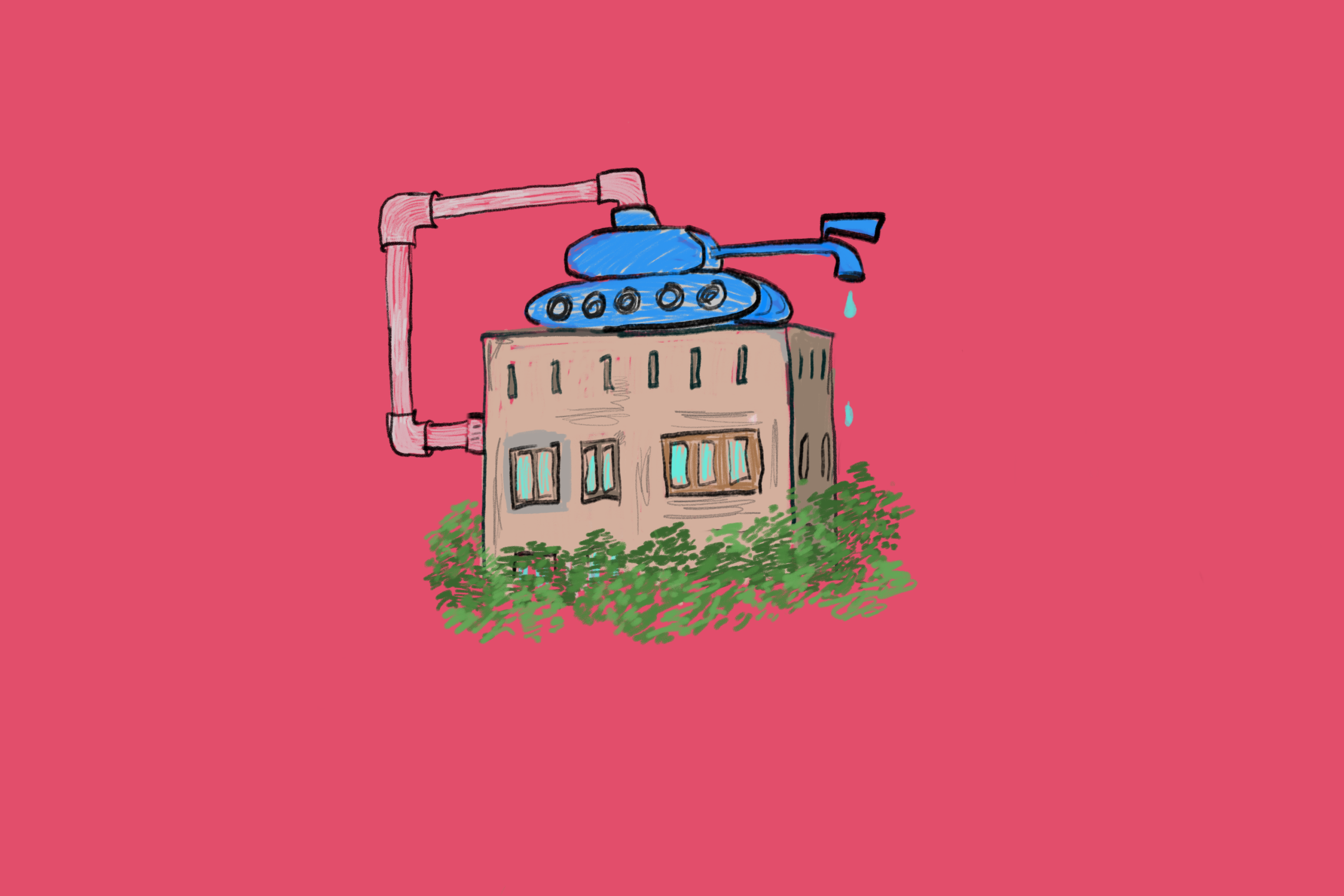
Telling someone that the water in my town only comes in specific, pre-defined hours every day has caught me in a trap of self-gaslighting. You’d think it’s common knowledge, but apparently, outsiders are quite unaware of it. Googling makes it worse: the latest search results about Georgian towns experiencing similar problems appear to be from some five years ago, and the coverage is naturally dominated by concerns about when Tbilisi residents had to go through it – for only a few days, obviously.
On the internet, the problem does not seem to exist. Asking around in a small circle of social media friends did not help either. The problem is so absent from public knowledge that you’d think it’s only in your house, or worse, in your head. One can be easily prompted to obsessively double-check the taps to see whether the water, indeed, comes at 8 every morning, disappears at 11 am, comes back at 5 in the evening, and disappears again at 11 pm until the morning hours.
But then I have witnesses: the blue tanks. The blue tanks have been deployed in the town for many years now, stationed on the roofs of the apartment blocks, occupying neighborhoods, shutting out the communities and, what’s worse, destroying: destroying the politics.
Here is Nini and the Dispatch newsletter to tell about the blue tanks of adaptation.
There is no memory of a round-the-clock water supply in my town, despite it being one of the key industrial centers in Western Georgia for more than a century and producing one of Georgia’s main export products – ferroalloys.
I am told that water was only supplied at scheduled hours during good old Soviet times, and the issue was clearly not fixed in the dark years of disruptions that followed. It wasn’t resolved under United National Movement rule either, when everything else was being fixed in the country, and the successive Georgian Dream governments that came afterward obviously felt no pressure to address it: they could always brush off responsibility by arguing that the issue was already present under UNM.
It was sometime decades ago that the first tanks started appearing, the blue ones. Having lost all hope that the authorities would ever solve the problem, the locals came up with their own bit of smart engineering: they started installing water tanks, mostly blue and plastic, on or under roofs, on balconies, or wherever else they could place them. Whenever water bothers to come, it automatically fills the tank, which is now connected to the taps and keeps the water flowing even after the central supply stops.
The solution has offered great comfort to those who need a 24-hour water supply and know how to use it wisely, not counting the occasional inconvenience of flooding thy neighbors whenever the automatic shut-off system malfunctions and fails to stop the water once the tank is full. Other households eventually copied the practice, and over the years, the blue tanks came to increasingly occupy the roofs of local residential buildings, adding some color to grey Soviet-era aesthetics.
Unsolved Problem (That Does Not Exist)
Not every family installed tanks, even if many did. Some must have adapted their daily habits and routines, others settled for smaller, in-house containers to store water, and there must have been a small share of residents who never lost hope and thus doomed themselves to constant frustration.
Every town needs one or two frustrated residents you can show on TV. But how can you show them if they are frustrated about a problem that does not exist? At that point, acknowledging that you don’t have a permanent water supply would mean admitting you weren’t clever enough to get yourself a blue tank. A public humiliation.
As I did more research, I finally found a relatively new special report by the Public Defender’s Office which specifically addressed the exercise of “the right to water” in Georgia. In the report, I could find that the right to water existed, but not that it didn’t exist in my town: the agency largely skipped the cities, apparently convinced that they were fine, and headed to villages, where the problems with water supply are more or less well known.
The report described how rural communities dealt with the issue: by sourcing water from local springs, wells, rainwater, rivers, and whatever else produces liquid under the ground, on the surface, or in the sky — a flexibility town residents could never afford.
But then, by some lucky, or rather unlucky, accident, I found a fellow gaslightee in a nearby municipality.
I was covering the flooding in that town and, to learn more about the situation, I was doing the most rigorous kind of research, which was stalking some stranger’s comment section. That’s where I found a woman who complained about how the locals didn’t have access to water, even as water was flooding everything around them. Of course, some good man tried to educate her, explaining that the supply had probably been temporarily suspended while the authorities dealt with the disaster. The woman had to explain back that no, the municipality never really had a round-the-clock water supply.
Solving Problem (That Does Not Exist)
It was her comments that opened a new portal for me, and using alternative search terms, I did find indirect reports that the issue persisted in other places as well.
Those were the press releases by authorities and companies from the past two years, announcing new infrastructure projects to ensure a 24-hour water supply in those towns. While there was, again, no direct mention that the towns had a water problem, the (absent) problem was still being solved. They are also working to fix it in my town, so I am told.
Very soon, or maybe less soon — for there is clearly no rush — officials would inaugurate the new water infrastructure and take all the credit and praise for fixing the nonexistent problem, without ever paying the political price for not doing it earlier. Blame the government as much as you want: in the end, it will be the same government that gets to benefit from its own flaws.
But one must be fair: my research showed that the problem was still not as widespread as I initially thought in other urban areas. Apparently, not every residential block in Georgia is decorated with blue plastic tanks.
But this still does not mean that other towns, communities, and families haven’t built blue tanks of their own to hide all of their unresolved disappointments and struggles inside. Once the hope is lost, one can always find ways to adapt: when poverty strikes, you can emigrate; if disease hits, you can try to crowdfund medical bills; you can deal with insecurity by seeking protection from local informal networks, and you can try to avoid injustice by simply staying silent.
The problems never truly leave, but with time, more families get inside their blue tanks and leave the political realm.
The only remaining political issue now is avoiding disruption big enough to threaten the stability of your existing blue tanks.
And the only politics that remains is occasional exchanges in somebody’s comment sections.


