

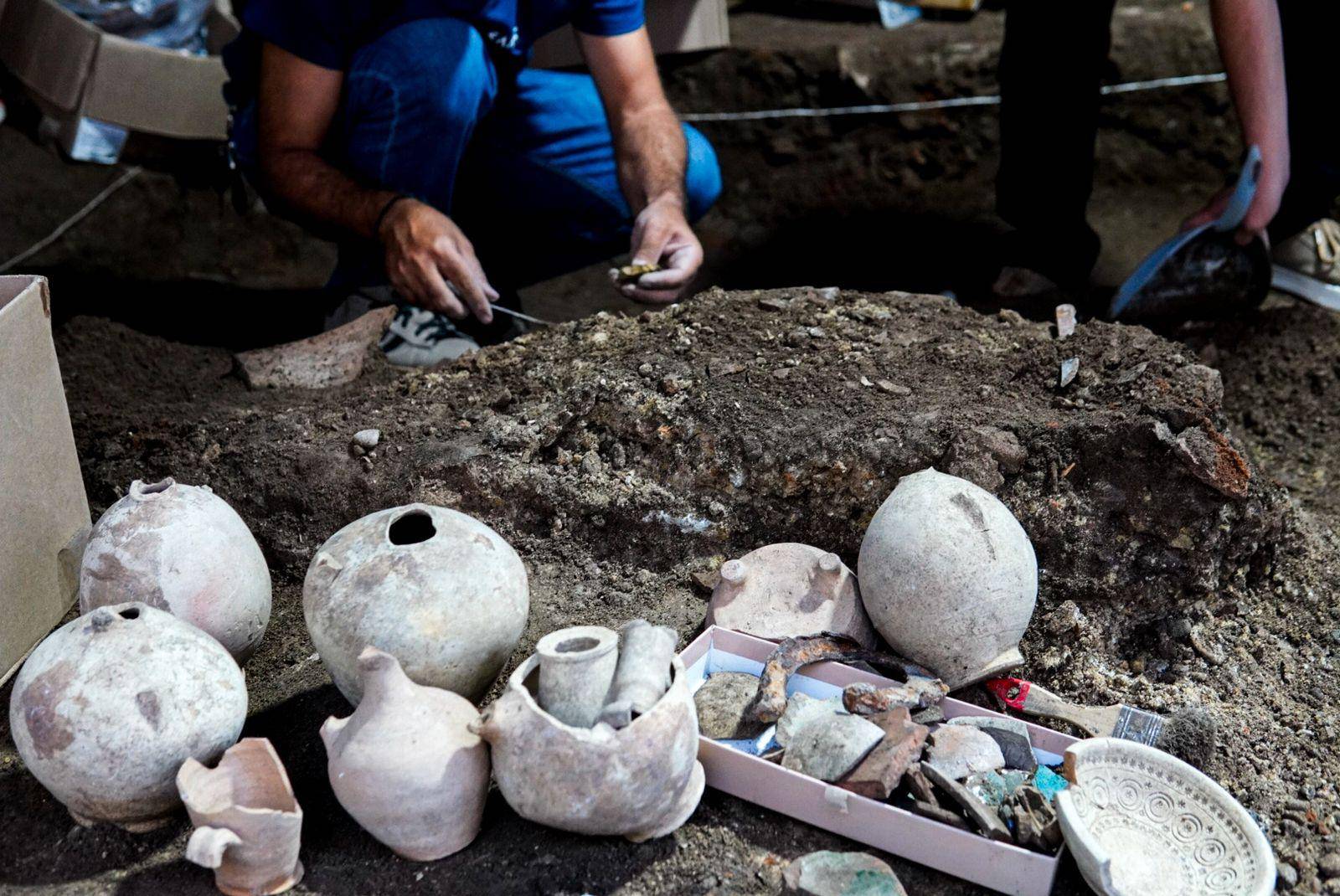
Archaeological work is underway on Tbilisi’s Rustaveli Avenue after full-scale rehabilitation works uncovered ceramic artifacts and what experts believe to be the remains of a ceramic workshop dating to the 10th–12th centuries.
The discovery was made in the area between the Georgian National Museum and the Youth Palace, where archaeologists have found clay vessels and other objects believed to have been part of everyday life in medieval Tbilisi.

The artifacts are now being studied by a team led by Merab Dzneladze, chief archaeologist of the Georgian National Museum, with the works also involving students from Georgian Technical University.
According to Dzneladze, the findings likely date back to years when Tbilisi was still under Arabic influence, before it was liberated by King Davit Agmashenebeli in the 12th century. The pottery, he said, bears clear Eastern cultural features characteristic for Tbilisi of that era.

Dzneladze believes the site may have been a workshop that was abruptly abandoned. “This appears to be a workshop that ceased operating due to some circumstances, either an enemy attacked, or someone destroyed it,” he told RFE/RL’s Georgian service.
In his estimation, the site may be considered a suburb of 12th-century Tbilisi, or “Garetubani,” located outside the city center enclosed by the fortress walls.

According to Dzneladze, present-day Rustaveli Avenue served as a transit route for caravans at the time, forming part of the Silk Road, a network of trade routes connecting East and West.
The Ministry of Culture said that the artifacts “will be transferred to the Georgian National Museum, where scientific research on them will continue,” and afterward they will be displayed in the museum’s exhibition spaces. On September 2, Government officials arrived at the scene to observe the work.

In August, brick structures and ceramic vessels were uncovered between Liberty Square metro station and the Georgian National Museum. The brick structures are believed to be presumably part of the old 19th-century ‘Garetubani’ collector system.
The full-scale rehabilitation of Rustaveli Avenue, Tbilisi’s main thoroughfare, which hosts the Parliament building and has also served as a traditional protest site, began on July 23 and is expected to continue until the end of November. The works have been suspended in the area where archaeologists are currently studying the findings.


