



Jo Moir
Political editor
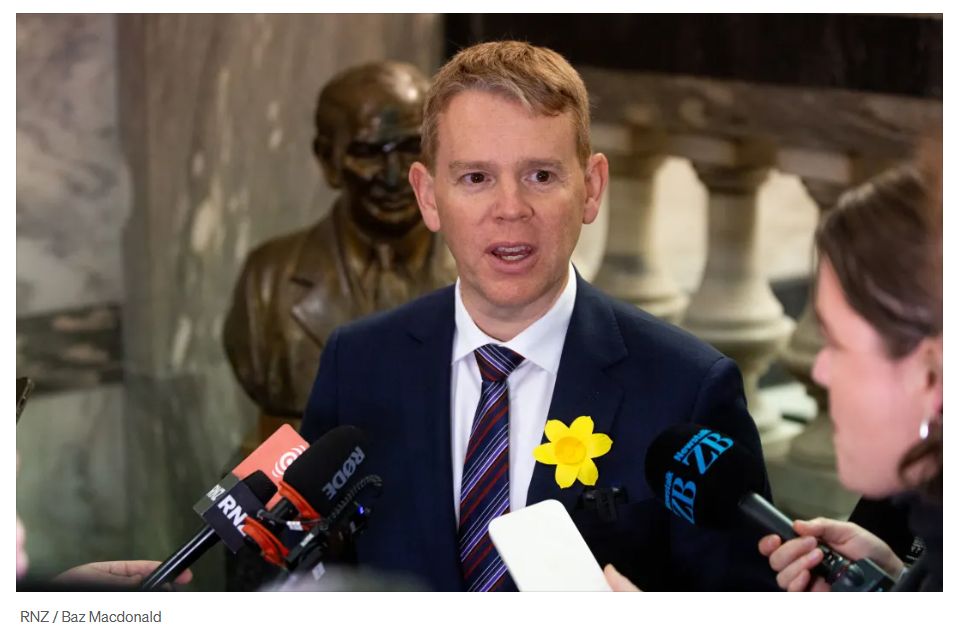
Chris
Hipkins won’t rule out borrowing more to pay for the
shortfall in the country’s land transport fund after Labour
announced it would freeze fuel tax increases for the next
three years.
The Labour leader was
firm on Thursday when he announced the policy that it
would have to “scale” investments under the National Land
Transport Fund to make sure any projects fitted within the
funding that was available.
“That happens every three
years when the when the new GPS (Government Policy
Statement) on land transport is set out,” he said last
week.
“This is a government that’s telling councils
they’ve got to scale their ambitions to fit within a rates
cap, that every other government agency has to scale to fit
within it, so will the National Land Transport
Fund.”
By Monday Hipkins wouldn’t rule out needing to
borrow more to fill the shortfall in the transport fund as a
result of halting any increases to fuel tax.
Asked
multiple times by RNZ if he would commit to not borrowing
more to top up the transport fund, Hipkins repeated he
wasn’t announcing the party’s fiscal policy.
Advertisement – scroll to continue reading
“We’ll
set out in our own fiscal plan different spending choices to
the current government. So I’m not going to set out our
fiscal plan today.”
On Tuesday morning Hipkins was
again questioned on his way into caucus about how Labour
would deal with the shortfall, and what would be cut to pay
for it.
He confirmed he wouldn’t be reversing “the
top-ups that the government announced yesterday”, which was
roughly $1.5 billion worth.
Fuel excise taxes were due
to be increased by 12 cents from 1 January 2027, then
increase annually by 6 cents and 4 cents heading into 2029 –
a total increase of 22 cents.
Instead, the
tax will go up by 5 cents every six months, beginning in
2028 through the end of 2029 – a total increase of 20 cents,
which the prime minister announced on
Monday.
Transport Minister Chris Bishop confirmed of
the $1.5b needed to keep up with the required work, half a
million dollars of that would come from the rainy day fund
previously set aside in this year’s Budget for the fuel
crisis.
The other $1b would be outlined once the
government had seen the pre-election fiscal update from
Treasury, he said.
Bishop says the shortfall for
Labour is much larger, however, and put a price tag of $4.6b
on the cost of not doing any fuel tax increases for three
years.
Hipkins disagrees it would be that much and
while he says he has an idea of what it might be, he
wasn’t prepared to share it.
He told RNZ on
Tuesday he would look very closely at whether he needed to
find any other funding streams, outside of the government’s
top-up and the scaling back of investments in the transport
fund, to pay for the shortfall.
“There are some things
that we won’t do. You know, we won’t be shovelling money
into a gondola that the current government can’t answer
questions about.
“We won’t be spending $300 million on
roads of national significance that then get cancelled,” he
said.
“Every government should prioritise within the
National Land Transport Fund – that is what we will
do.”
Hipkins has also ruled out raising the price of
RUCs (road user charges) over the next three years and is
supportive of moving all vehicles to a universal e-RUC
model, which the government is still working
on.
New Zealand’s public broadcaster, providing comprehensive NZ news and current affairs, specialist audio features and documentaries.
Radio New Zealand is a Crown entity established under the Radio New Zealand Act 1995. Radio New Zealand News are vital elements in our programming, providing impartial news and information to New Zealanders every day. Radio New Zealand (RNZ) provides listeners with exciting and independent radio programmes in accordance with the Radio New Zealand Charter.

