



Auckland Council’s economic agency Tātaki Auckland Unlimited questioned National’s commitment to the tourism industry after being “dumbfounded” by National’s announcement on Sunday ruling out a bed tax.
On Sunday the National Party ruled out the idea of a bed tax, promising that there will be “no new taxes” if it’s re-elected.
It comes a fortnight after Prime Minister Christopher Luxon spoke publicly about the possibility of three new taxes under National – a bed tax, a bank tax and a fuel excise increase.
Director of destination Annie Dundas described National’s move as a backwards step that put the city’s major events and business pipeline at risk.
She said the industry had spent years working towards a sustainable funding solution, and the decision was at odds with the government’s push to double the value of tourism exports by 2034.
“The big question is how committed is the government to supporting tourism?” she said.
Advertisement – scroll to continue reading
Dundas said an accommodation levy let visitors contribute to the places they enjoyed and reduced the burden on ratepayers by returning funds to the regions where they were collected.
She said the country risked undermining popular destinations without sustainable tourism funding, with Auckland investing in an “astronomical” amount of hotel infrastructure over the past five years.
“If we can’t demonstrate that we want visitors because we can’t help market and fund and attract events, all of that investment is in jeopardy.”
Dundas also questioned why anyone would want to spend on new tourism attractions and offerings when there was “no confidence” from the government to invest.
She said the international visitor levy did not give Auckland enough funding to attract major events, and a user-pays levy could have made a difference to regions across the country.
“We’re just shortchanging ourselves and we want to protect our environment. We want to build great infrastructure. We want to host visitors, but we’re just not funding things appropriately to do that as well as we should.”
Regional Tourism New Zealand has called for political parties to back a nationwide accommodation levy ahead of this year’s election to help cover costs and ease the pressure on ratepayers in popular destinations.
Mayors upset
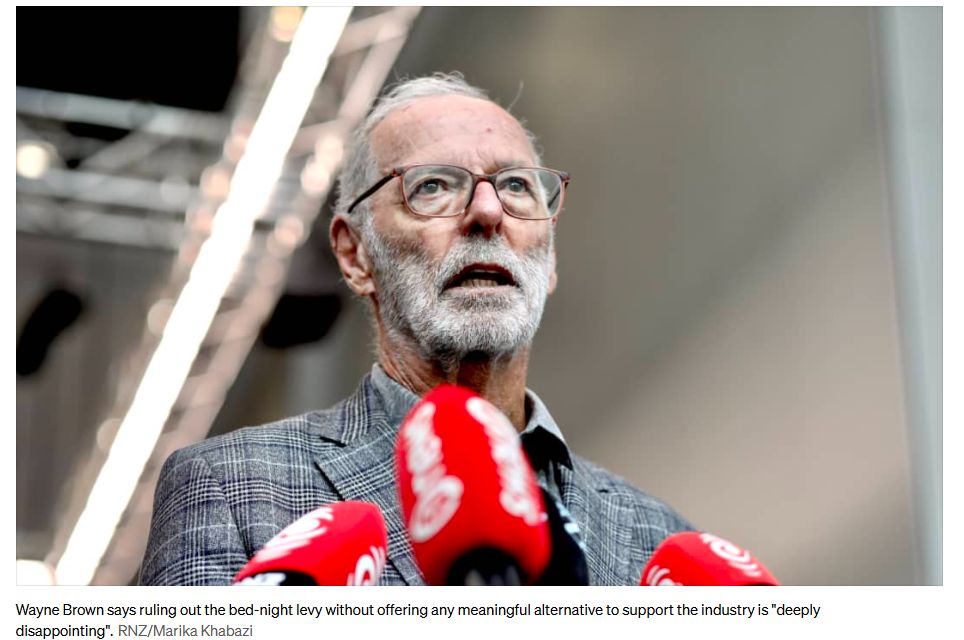
The Auckland and Queenstown Lakes District mayors were both disappointed with National’s announcement, with Auckland Mayor Wayne Brown hitting out at National for “walking away” from its commitment to the Auckland Regional Deal.
Brown said in a statement that Sunday’s announcement raised serious questions about the government’s commitment to the regional deal.
“The deal is meaningless if the government cannot honour even a relatively modest commitment to explore an agreed proposal.
“Ruling out the bed-night levy without offering any meaningful alternative to support the industry is deeply disappointing,” he said.
The regional deal, signed in April this year, included the government committing to considering the accommodation levy policy in 2027.
Brown said the bed-night levy was a user charge, not a general tax.
“Taxes are unavoidable – you can avoid this by just not staying in a hotel.
“It would result in no additional rates or taxes on Aucklanders, while enabling Auckland to attract more events, support local businesses and grow the regional economy,” he said.
Brown said the regional deal was an agreement between the Crown and the council.
“It should not be something one party can simply disregard.”
Brown said he looked forward to discussing the issue with ministers responsible for the regional deal – Infrastructure Minister Chris Bishop and Local Government Minister Simon Watts – at the next quarterly review of progress in September.
Luxon looking at ‘other options’
Speaking to Morning Report on Monday, Luxon denied reneging on both the signed deal with Auckland and the as-yet-unsigned one with Queenstown Lakes just for a clearer tax policy position.
“We were talking about exploring an accommodation levy to deal with the pressures and the costs associated with tourism in those regions…. we need to deal with it. We will deal with it, but we’ll deal about it in a different way.”
He said National had looked at the bed tax idea, but “there’s just no other way that… a couple setting off for a weekend in Queenstown or Auckland are not going to end up paying that bed tax.
“We’re not the party that wants to chuck taxes or costs, unnecessary costs, on New Zealanders – and so that’s why we say no new taxes.”
Host Ingrid Hipkiss pressed Luxon on why he had reneged on the deal with Auckland.
“Because as part of exploring an accommodation levy, there’s lots of other options that you would be exploring at the same time as well,” he said.
Hipkiss replied: “Well, put those in the deal as well, put those in the agreement as well.”
Luxon said that “as part of an exploration process, that’s what we would be doing”.
He would not say what other options National would consider, saying he did not want to “predetermine outcomes”, but there were several options.
“We’ll work with the councils and the mayors on that, but what we’re not going to do – not going to do – is actually introduce a cost and a tax on New Zealanders that actually they end up paying rather than the tourists.
“We’re very committed to finding the solution through that, and we need to do that because we’ve got some real pressure from tourism in some parts of the country – we’re deeply, deeply committed to it, but we’re also deeply committed to not having Kiwis pay a tax.”
A ‘complete u-turn’
Queenstown Lakes District Mayor John Glover told RNZ it appeared to be a “complete u-turn”, after the government agreed to consider the accommodation levy for visitors in both the already-signed Auckland Regional Deal, and the deal for his region, which was almost signed a week-and-a-half ago – but had to be rescheduled due to National’s crisis talks on the same day.
“It feels like policy making in a state of panic. I appreciate there’s a campaign message about no new taxes, but the government particularly says it doesn’t want to tax Kiwis for a weekend away.
“Well, what we just need to be clear about is that Kiwis are already being heavily taxed across the country, because every ratepayer that’s in a tourism town is already having to pay for the cost of tourism, so to say they don’t want Kiwis to be taxed is a bit of a rabbit hole to be going down,” he said.
Glover said not being able to implement a bed tax would be “significant” for his region, where infrastructure was strained by the number of visitors each year – doubling the population during peaks.
“Things like car parks or waste collection, you know we’ve got some really expensive roads that go to the likes of the Routeburn track or Skippers Canyon, there might be five ratepayers live down there, but tens of thousands of visitors go there every year,” he said.
“You would think we deserve governments that support tourism in this country, and they need to give council the tools to do that,” Glover added.
Rotorua Mayor Tania Tapsell said she was “surprised” with the announcement, considering that the bed tax formed part of the Auckland Regional Deal.
“We’re definitely sad to hear that because there’s been so much hard work behind the scenes,” she said.
“Councils without any alternative will have to continue to use ratepayer funds to invest in tourism offering,” she added.
Tapsell said she and other mayors had also been pushing hard for more fair distribution of the International Visitors’ Levy back to the regions, like Rotorua.
Deals now ‘worthless’
Mat Woods, chief executive of Destination Queenstown, said it would be an understatement to call the National Party’s decision a “massive blow”.
He said “years of hard work” getting ready to implement the levy in 2027 had been rendered “worthless”.
It was due to be signed the day National had its emergency caucus meeting to vote on Luxon’s continued leadership and “would have been signed”, Woods said.
“Districts like Queenstown and Wanaka, we desperately need an accommodation levy. And look, whether it’s a tax or a levy, it is a user-pays charge. No one is forcing you to go on a holiday. But when you do go on a holiday, you do actually leave impacts on that district. And so that’s where an accommodation levy is a fair way of actually looking at, how do we recoup some of those charges?
“Because the reality is we are already taxing people – we’re taxing the local ratepayer for the impacts of tourism. So an accommodation levy is a fair way to actually apportion back some of that cost to the region.”
He said a $200 stay would have cost an extra $6, which in his words was “not a dealbreaker” for any tourist.
“They need to come back with something that actually will enable the regions to be able to cover this infrastructure to ensure that these are great places to live and great places to visit. At the moment, the only thing we actually have in place is the international visitor levy at the border – dollars that international visitors pay, excluding Australia. Now, Australia is our largest international market, so there is a big chunk of international market not paying at the border for that.”
Woods was not sure what other options the government might suggest.
“I think if we looked at congestion charges, that’s probably an indication of where we could look… I don’t think there’s been any discussions on that to date.
“You know, the only other charge that I could see is something like a departure tax for the airports as well, which would actually then impact international departures.”
New Zealand’s public broadcaster, providing comprehensive NZ news and current affairs, specialist audio features and documentaries.
Radio New Zealand is a Crown entity established under the Radio New Zealand Act 1995. Radio New Zealand News are vital elements in our programming, providing impartial news and information to New Zealanders every day. Radio New Zealand (RNZ) provides listeners with exciting and independent radio programmes in accordance with the Radio New Zealand Charter.

