



Iliesa Tora
RNZ Pacific senior sports journalist
The Fiji
government’s new five percent Tourism Services Tax (TST) has
been criticised by international travel
associations.
The Australian Travel Industry
Association (ATIA) and the Travel Agents’ Association of New
Zealand (TAANZ) say the tax will penalise visitors who have
already booked their travels to Fiji.
ATIA and TAANZ
have called on the Fijian government to withhold
implementing the new tax, scheduled to be effective to take
effect from 1 September.
ATIA chief executive Dean
Long said the tax would mean a Fiji holiday could become
more expensive for Aussie travellers.
The new tax will
be in place for large-scale tourism operators and travel
industry experts are warning the costs are likely to be
passed on to customers.
“The design and rollout
reflect a complete lack of understanding of how the travel
booking ecosystem works, and it is travellers and travel
businesses who will pay the price for that failure,” Long
said in a statement.
“Retrospective application is an
absolute no-go. Once a customer has paid, that price is
locked in. Sending a fresh bill after the fact is not tax
collection, it is a broken promise dressed up as
policy.”
He said many travellers are being asked to
find extra money for a holiday they thought was settled
months ago.
“That is not how you treat people who
chose Fiji in good faith,” he said.
Advertisement – scroll to continue reading
Fiji remains a
popular travel destination for Aussies and New Zealanders,
but a new tax could threaten that.
TAANZ chief
executive Julie White said travel was routinely booked,
contracted and paid for many months in advance and the
sudden announcement puts all that into chaos.
“Our
concern is simple: travellers who booked and agreed a price
before 1 September should not be hit with an additional tax
simply because they are travelling after that date,” White
said.
“There is a significant volume of existing Fiji
bookings where the price has already been agreed, and in
many cases the customer has paid in full. Those travellers
have every reasonable expectation that their holiday is paid
for.
“They should not suddenly be faced with an
additional cost because a new tax has been introduced after
they made their booking.”
White said the timing is
particularly concerning as it comes immediately before the
busy September and October school holiday travel
period.
“Families have planned and budgeted for these
holidays months in advance. There are also group, wedding,
corporate and other large bookings where contracts and
pricing have already been finalised,” White
stated.
“Reopening those arrangements creates
uncertainty for travellers. Travel agents, wholesalers and
tour operators are stuck in the middle. They are being asked
to explain and potentially administer a cost they did not
create, could not have anticipated and have no control
over.
“At the same time, basic practicalities remain
unclear, including who is responsible for collecting the
tax, how it applies to net rates and existing contracts, and
where a supplier ends and an agent begins. These questions
need clarity not only for existing bookings, but for new
bookings from 1 September as well.”
TAANZ said the
issue is compounded by a lack of clarity around the
practical implementation of the tax, including how it will
be treated across different types of bookings and existing
contractual arrangements
The new tax will apply to
tourism operators, including hotels, tour operators and
cruise businesses, with an annual turnover above FJ$2
million (NZ$1.4m).
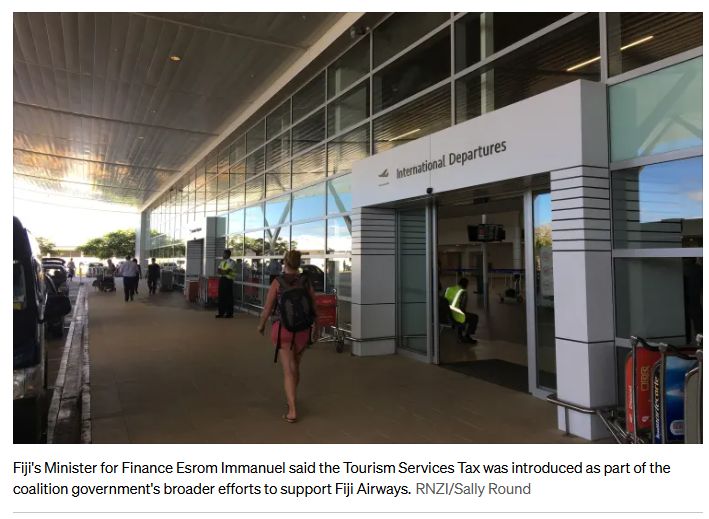
Local
concerns
The new tax has also raised concerns
locally, with members of the business community also voicing
their disappointment.
J Hunter Pearls boss Justin
Hunter said the government’s decision showed a lack of
understanding.
“One really has to question the
economic brain trust behind this,” he said in a Facebook
comment on the issue.
“It shows remarkably little
understanding of how the international tourism wholesale
mechanism actually works. Product is contracted, priced and
sold months in advance. You cannot simply change the cost
retrospectively and assume somebody in the supply chain will
absorb it.
“Fiji doesn’t have that sort of leverage.
If Fiji becomes too expensive, unpredictable or difficult
for wholesalers to sell, they won’t argue with us forever.
They’ll simply remove Fiji from the menu.”
Tony
Whitton, the managing director at Rosie Holidays and Ahura
Resorts Fiji, said they had been in discussions with
government line ministries about repealing or delaying the
tax to cover those bookings made later in the
year.
“The tourism industry (hotels, tour operators,
activity companies, marine) have been in discussion with our
line Ministry and the tax office for over 6 weeks to either
repeal or at least apply the new tax to only new bookings
made after 01 September 2026, warning that retroactively
applying a tax on an existing contract that is already in
place is a breach and there will be push back,” Whitton
said.
“So here we are 10 days before
implementation.”
Businessman Grahame Southwick
questioned the tax idea.
“One wonders if these
economic ” super brains ” in Govt even realize that this 5%
tax on GROSS turnover can easily represent 20-50% of the
profit ??? Am I missing something here?
“What that can
translate to is closing the doors for properties than are
currently marginal. As for retro charging.. are they serious
??
“Words fail me.”
The Fiji Hotel and Tourism
Association (FHTA) said businesses remained unclear about
how the new TST would work, with concerns that taxing
turnover rather than profit could significantly increase the
tax burden on tourism operators, particularly those with
smaller profit margins.
FHTA chief executive Fantasha
Lockington told fjivillage.com they continue to
receive thousands of questions from businesses in Fiji and
abroad about how the levy would apply to existing bookings,
deposits and transactions through wholesalers and
agents.
She said that a resort in the Yasawas had
asked whether a booking paid in full in April for travel in
October would be subject to the new levy, while a
Sydney-based wholesaler wanted to know whether it needed to
return to clients who paid deposits months ago and ask for
an additional 5 percent.
“The concern is not simply
about the additional cost, but how the tax is calculated,”
she told fijivillage.com.
Lockington explained
that a business retaining 25 percent of its revenue as
profit would see the 5 percent turnover tax take a
significant share of its actual profit when combined with
the existing 25 percent corporate income tax, while an
operator retaining 15 percent of revenue as profit, the 5
percent turnover tax would consume a third of its profit,
resulting in a total tax burden equivalent to 58 percent of
its income.
Government stand
In a statement,
Finance Minister Esrom Immanuel said the government was
concerned by the continued delaying tactics being employed
by the FHTA and a number of industry players in relation to
the implementation of the tax.
He said government had
engaged with the FHTA and key tourism industry stakeholders
since June to discuss the introduction, application and
implementation of the new tax.
According to the
government, it had also provided the industry with
additional time to prepare for the new measure, with the
implementation date adjusted from 1 July, to 1 August, and
subsequently to 1 September.
“These extensions were
provided in good faith to allow the industry sufficient time
to prepare its systems, communicate with customers and
ensure compliance. Despite this, government is concerned
that some industry players, with the support of the FHTA,
continue to create negative publicity around the TST and its
implementation,” he said.
He said the industry should
recognise that protecting Fiji Airways meant protecting the
connectivity on which hotels, resorts, tour operators,
restaurants, transport operators, cruise services and
thousands of other tourism-related businesses
depend.
He added, for many years, the tourism industry
had benefited from significant tax holidays, duty
concessions and other incentives designed to encourage
investment and support the development of the
sector.
“Many hotels and tourism service providers
have received tax holidays ranging from 13 to 20 years,
together with various duty concessions and other forms of
government support.
“The industry also benefits from
taxpayer-funded tourism marketing and other public
investments that help promote Fiji as a destination and
support visitor arrivals.
“Today, the entire tourism
industry contributes only around 5 percent of the total
corporate taxes collected by government. The other 95
percent is paid by non-tourism sectors.
“Government
recognises the importance of tourism and the investment that
the industry brings to Fiji. However, the industry must also
recognise that it has a responsibility to contribute to the
wider national effort when the country and its critical
tourism infrastructure require support.”
He also
claimed that under the previous Government, the tourism
sector was subject to a combined 16 percent turnover-based
tax through the 10 percent ECAL and 6 percent STT, which
remained in place for a number of years.
He said the
current measure is significantly lower than the previous
combined tourism turnover taxes, and it is
temporary.
New Zealand’s public broadcaster, providing comprehensive NZ news and current affairs, specialist audio features and documentaries.
Radio New Zealand is a Crown entity established under the Radio New Zealand Act 1995. Radio New Zealand News are vital elements in our programming, providing impartial news and information to New Zealanders every day. Radio New Zealand (RNZ) provides listeners with exciting and independent radio programmes in accordance with the Radio New Zealand Charter.

