

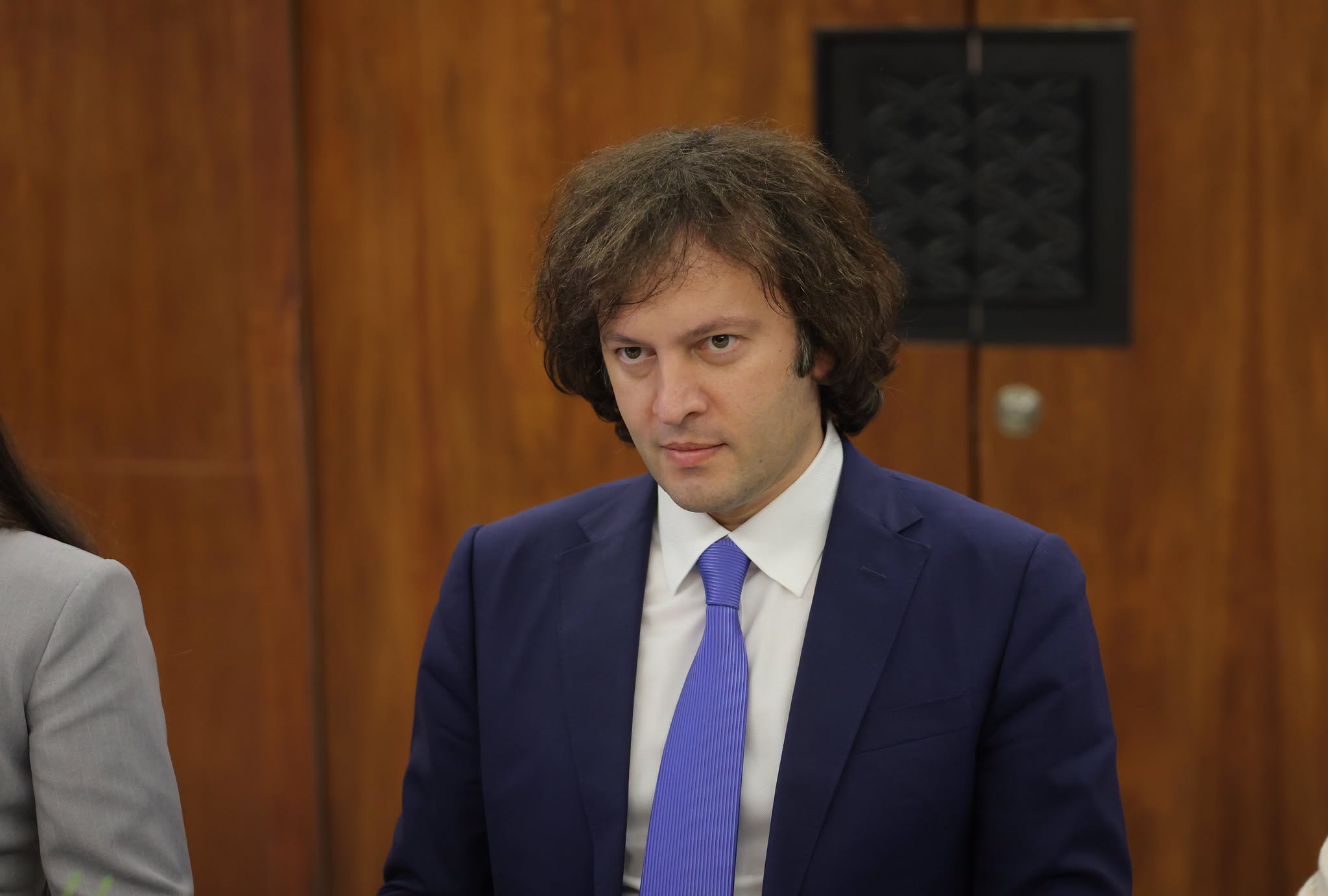
Georgian Dream Prime Minister Irakli Kobakhidze held a briefing on August 18 to defend King Erekle II’s decision to sign the Treaty of Georgievsk with the Russian Empire in 1783, calling it the “only correct and unavoidable decision” in light of Georgia’s “national interests” at the time.
Kobakhidze opened the briefing with a brief lecture on the role of national interests in international relations, arguing that states primarily act in accordance with their own interests. “Therefore, no one should have the illusion that one state works for the benefit of another and sacrifices its own interests for it. This is the reality underlying international politics,” he said.
The GD prime minister then discussed the circumstances surrounding Erekle II’s decision to enter into the treaty with Russia.
Signed in 1783, the Treaty of Georgievsk placed the eastern Georgian Kingdom of Kartli-Kakheti under Russian protection, with Russia pledging to defend the kingdom and preserve its sovereignty and ruling dynasty. In return, Erekle II accepted Russian control over Kartli-Kakheti’s foreign relations. The treaty reflected Erekle II’s search for a powerful ally amid persistent threats from the Persian and Ottoman empires.
Russia failed to protect the kingdom when Persian forces invaded and sacked Tbilisi in 1795. Following Erekle II’s death, Russia abolished the Kartli-Kakheti monarchy and annexed the kingdom in 1801, in violation of the treaty’s guarantees. The decision to seek Russian protection has remained a subject of historical debate in Georgia.
Kobakhidze said Erekle II’s decision was not only justified but the “only correct and unavoidable decision.”
“Although every state, including the Russian Empire, acted based on its own interests, and saving Georgia was certainly not their starting point, by signing the treaty, whether the Russian Empire wanted it or not, Georgia still received a fundamental benefit,” Kobakhidze said, citing Christianity and “demographic factors,” among others.
“When we were on the brink of survival and extinction, through this step by Erekle II, we not only survived as a nation, but ultimately won as well,” he said, pointing to what he described as Georgia’s survival as a country based on “Christian values, national roots and traditional European culture.”
He said criticism of Erekle II’s decision from today’s perspective was “baseless,” arguing that the king had acted “with the sole motivation of saving the country, its statehood and its future.”
Kobakhidze also criticized government opponents who have condemned Erekle II’s decision.
“It is particularly paradoxical when pseudo-liberals today criticize Erekle II for the decision that preserved Georgia’s historical existence and the possibility of its subsequent state development, including the possibility of integration into the European space,” he said.
The briefing followed controversy over Kobakhidze’s August 12 remarks, in which he argued that the treaty “saved” Georgia, noting that nearly 20 years passed between its signing and Russia’s annexation of Kartli-Kakheti.
In the latest briefing, Kobakhidze also drew parallels with Georgia’s current foreign relations, criticizing the previous U.S. administration and the EU for what he described as political and diplomatic pressure on Georgia.
He said the previous U.S. administration under President Joe Biden had “often acted completely unfairly and extremely harshly” toward Georgia, “despite calling it a strategic partner,” and had used “various mechanisms of political pressure.”
Kobakhidze said the pressure was particularly evident on issues concerning Georgia’s sovereignty, legislation, transparency and “societal values,” adding that attempts by the Georgian government to defend its positions and make independent decisions had been met with political and diplomatic pressure.
On Garibashvili
Following the briefing, Kobakhidze commented on a Facebook post published a day earlier by jailed former Prime Minister Irakli Garibashvili, who hinted at pressure to confess or “take blame” in a new corruption case and referred to a letter allegedly sent to him “on [Bidzina] Ivanishvili’s instructions.”
“I saw the statement. I do not know what it is about. I know one thing: there is a specific court ruling. The rest is entirely a matter for law enforcement agencies,” Kobakhidze said in response to a question from TV Pirveli.
Pressed on the issue, Kobakhidze called Garibashvili’s statement “very problematic,” but said it was problematic “not for us, but for him.”
Kobakhidze also said he had spoken with Ivanishvili the previous day, adding that he could not recall whether the conversation took place before or after Garibashvili’s letter was published. He said the letter was not among the issues discussed during their communication
Kobakhidze added that he could “guarantee” the safety of Garibashvili and his family, saying, “It is the state’s responsibility.”
“Why should [his] family’s safety be at risk? Can you imagine any theoretical scenario in which Irakli Garibashvili’s family could face a threat? I cannot even theoretically imagine what risk there could be…It is absurd,” he said.
He also said he was unaware of any new corruption allegations referred to by Garibashvili in his post. “This is a matter for law enforcement agencies. They will provide you with answers on all of this,” Kobakhidze said.
Also Read:

