



Russell
Palmer Political reporter
Local Government
Minister Simon Watts says policy on amalgamation has not
changed, after one mayor indicated a softening of the
government’s position.
Watts, alongside RMA Reform
Minister Chris Bishop, announced in May that councils would
have three months to come up with plans for reorganising
council boundaries, with a focus on abolishing regional
councils and creating larger unitary authorities.
“Our
message to councils is simple: lead your own reform or we
will do it for you. Either way, change is coming,” Bishop
said at the time.
That 9 August deadline – pitched as
giving councils a “head start” on amalgamation discussions –
is fast approaching.
Councils have been consulting and
discussing their options but few have come up with firm
plans.
Tararua mayor Scott Gilmore spoke to Morning
Report on Thursday about how those discussions were
going, saying they had great relationships with all their
neighbours but “definitely not to a point where there’d be
any meaningful proposal being ready to be put
forward”.
“It’s not just amalgamation, and I think
that’s the problem with the government’s head-start proposal
is amalgamation is the only option within that
process.
Advertisement – scroll to continue reading
“We think that there’s other options, like
the government first signalled late last year – shared
services, other collaboration, other
efficiencies.”
Discussions had started with Horizons
Regional Council, covering Manawatū-Whanganui, but Tararua
covered a “massive, massive” area already and regional
council areas were based on water catchments, Gilmore
said.
As a result, the council was not planning to
submit a proposal.
“People are really conscious of
their local voice, and I actually think not that we should
lose it.
“Our council sees much more risk for us
taking part in the head start … we wouldn’t have time to
have a good proposal but we might get locked into something
that would be really undesirable for our communities, and
we’re just not willing to do that. And our community told us
they don’t want us to.
“The way that local government
works best is when the people that are close to the action
are participating in the decision-making. And you know, when
you look at having a huge geographical area, a mass
amalgamation, it’s going to be really difficult to put that
in there.”
However, the rhetoric from the government
on amalgamation “has changed and has softened”, he
said.
“I’m really grateful to the minister. I’ve
spoken to him directly a couple of times.
“We’ve had
clarified that the back-stop process will be a collaborative
process and it’ll be run in a similar way to what they
consulted on late last year before all of this head-start
bombshell dropped.
“That will give us an opportunity
to help us lead our own reforms.”
Gilmore criticised
the approach taken, saying the “language of ‘do it or we’ll
do it to you’ … was really unhelpful”.
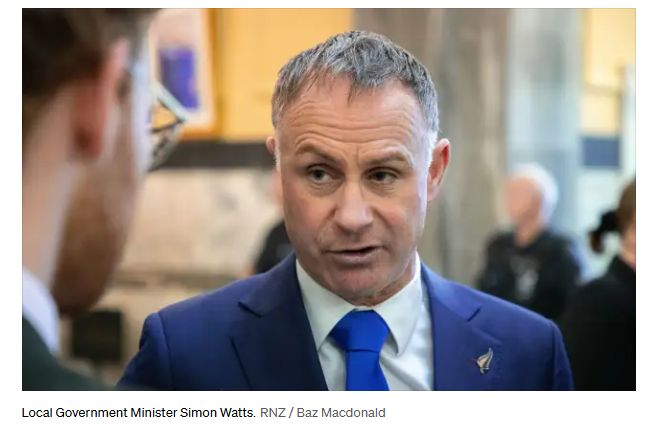
Watts
rejected the suggestion of a softening.
“There’s been
no change in government policy,” the minister said in a
statement.
He indicated that what would happen to
councils afterwards – the “back-stop” option – would take
council feedback into account but that ultimately the
government would decide the way forward.
“Our position
is and has always been that we will work with councils –
head start was specifically designed to give councils
control over their plans.
“Change is coming and the
government will progress with the back stop for councils not
in the head start. But we’ve also been clear from the
beginning that we want to learn from the councils going
through the process before making final decisions on what
that back stop looks like.”
Councils have until 9
August to submit
proposals.
New Zealand’s public broadcaster, providing comprehensive NZ news and current affairs, specialist audio features and documentaries.
Radio New Zealand is a Crown entity established under the Radio New Zealand Act 1995. Radio New Zealand News are vital elements in our programming, providing impartial news and information to New Zealanders every day. Radio New Zealand (RNZ) provides listeners with exciting and independent radio programmes in accordance with the Radio New Zealand Charter.

