



Kaya Selby
RNZ Pacific journalist
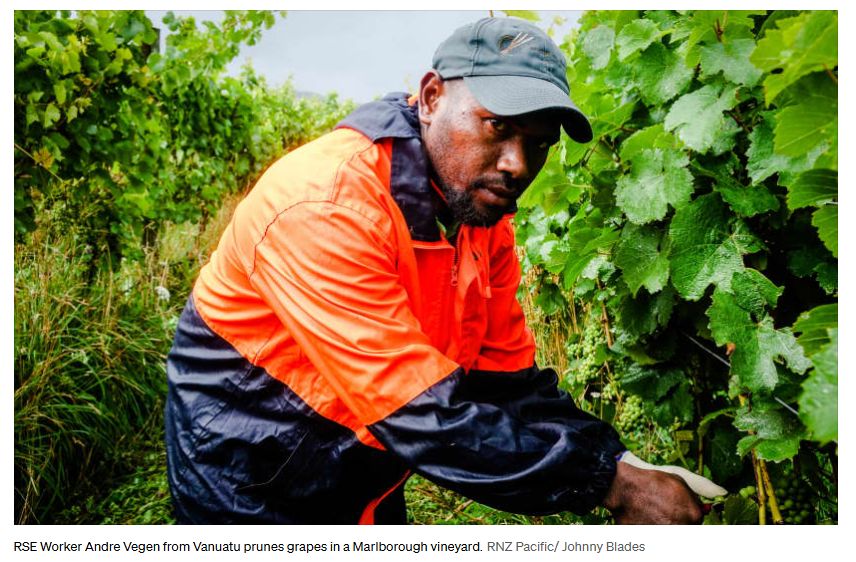
The
government is promising stronger and clearer accommodation
standards for Recognised Seasonal Employment (RSE) scheme
workers, though a landmark court case remains
undecided.
Immigration Minister Erica Stanford
announced on Tuesday that various rule changes will be
phased in over the next two years, promising stronger
protections for workers.
Among them, RSE workers will
soon be able to apply for a migrant exploitation protection
visa, allowing them to break contract and stay in the
country for up to six months. Others aim to “simplify” wage
deductions, while extending accreditation time for
“exemplary” growers to six years.
Speaking at a
Horticulture NZ industry conference, Stanford said workers
will have greater flexibility to move between employers
during their time in Aotearoa.
“Workers will be able
to remove themselves … and access the same protection
mechanism available to temporary workers in New Zealand,”
she said.
“That gives workers the same protection
without compromising the core purpose of the RSE
scheme.”
With those changes due for next year,
Stanford told a room full of RSE employers they had yet to
make decisions on accommodation – but she emphasised that
bad actors would be punished.
Advertisement – scroll to continue reading
The quality and cost of
housing for RSE workers has drawn serious criticism for the
scheme’s 20 year lifetime. Workers are contracted typically
for 6-7 months and live in housing provided by their
employer.

Stanford
said “exemplary” workers would be rewarded with six years
accreditation before renewal. Those with compliance issues
would have three years, and all first-time employers one
year.
“When employers have demonstrated a really
strong record of compliance, the system should recognise
that.
“We also need to make sure that we are clear
that there are consequences for those who
don’t.”
Decisions on accommodation standards will be
made in September, she noted.
Soapi v Pick Hawkes
Bay
Since 2024, the Ministry of Business, Innovation
and Employment has been reviewing the RSE scheme, attempting
to strike their “triple win” objective – the industry, the
workers, and their Pacific home countries.
A landmark
Employment Court case from October 2025 appears to have
shaped the review, framing key Pacific concerns – and
problems for the industry that could arise.
Speakers
at the Horticulture NZ event regarded it as an elephant in
the room.
In Soapi v Pick Hawkes’ Bay Inc, three
workers from the Solomon Islands claimed that their employer
had made unlawful deductions from their pay, including that
they had exaggerated the value of the
accommodation.
As a result, they claimed, they had
been paid below the minimum wage.
It was ultimately
found that the employer had made a number of frivalous
deductions – including the value of PPE and missing cutlery,
deferred from week to week – that had not been approved by
Immigration New Zealand.
On accommodation, the Court
held that the employer was only entitled to deduct around 5
percent of wages for accommodation costs – the workers
claimed they had deducted as much as 15
percent.
Documents released to RNZ Pacific under the
Official Information Act showed that in December 2023,
nearly two years before the Soapi ruling, Horticulture NZ
sent an email warning Minister Stanford about “the potential
consequences of any adverse findings in the
case”.
Noting the accommodation cost deduction claims,
advice noted that this would differ from how MBIE currently
interpreted the Act. It was flagged that it would
significantly increase costs on the employer side.
“If
the Employment Court (EC) adopts a different
interpretation… there could be significant implications
not only for the operation of the RSE scheme but also other
employment arrangements where accommodation is provided such
as dairy workers,” it read.
Within the next two years,
MBIE had presented options for a system overhaul. A range of
weekly rent caps were decided, between $150 to $211 per week
per person, with employers only allowed to recover the
actual cost. The new system came into effect in April
2026.
In the meantime, Pick Hawkes Bay have appealed
the EC ruling, and the case was heard in the Court of Appeal
on the 22nd and 23rd April. A decision had not yet been
made.
Lower cost option
During that time,
documents show Minister Stanford went against the advice of
officials in removing the requirement for new RSE workers to
be paid a wage ten percent higher than the minimum
wage.
The option was presented as a compromise between
retaining the ten percent rule for all RSE workers, and
removing it altogether at the behest of
employers.
Advice noted that RSE employers had
“expressed concern” to the government, “citing the financial
impact and inequities between the wages for New Zealand and
RSE workers”.
Minister Stanford was “interested” in
removing this requirement altogether, advice noted. If it
were, it was recommended that it be done overtime “to reduce
impacts on returning workers,” For workers below the 2 year
experience mark, it was removed
immeditately.
“Research shows 54% of workers work for
2-3 seasons, and 22.8% for 4-5 seasons,” advice
noted.
Officials
said the experience requirement “would be somewhat more
complex for INZ to administer” because returning workers
“would need to be identified and the different wages would
need to be reflected and verified) in employment
agreements.”
Within the next two years, MBIE had
presented options for a system overhaul. A range of weekly
rent caps were decided, between $150 to $211 per week per
person, with employers only allowed to recover the actual
cost.
During its term, the current government has also
increased the annual minimum cap on RSE workers by 1250, per
their coalition agreement with the ACT
Party.
Likewise, it has brought in Timor-Leste, taken
away a requirement to be screened for HIV, and enabled
employers to average a 30-hour minimum weekly work
requirement over four
weeks.
New Zealand’s public broadcaster, providing comprehensive NZ news and current affairs, specialist audio features and documentaries.
Radio New Zealand is a Crown entity established under the Radio New Zealand Act 1995. Radio New Zealand News are vital elements in our programming, providing impartial news and information to New Zealanders every day. Radio New Zealand (RNZ) provides listeners with exciting and independent radio programmes in accordance with the Radio New Zealand Charter.

