

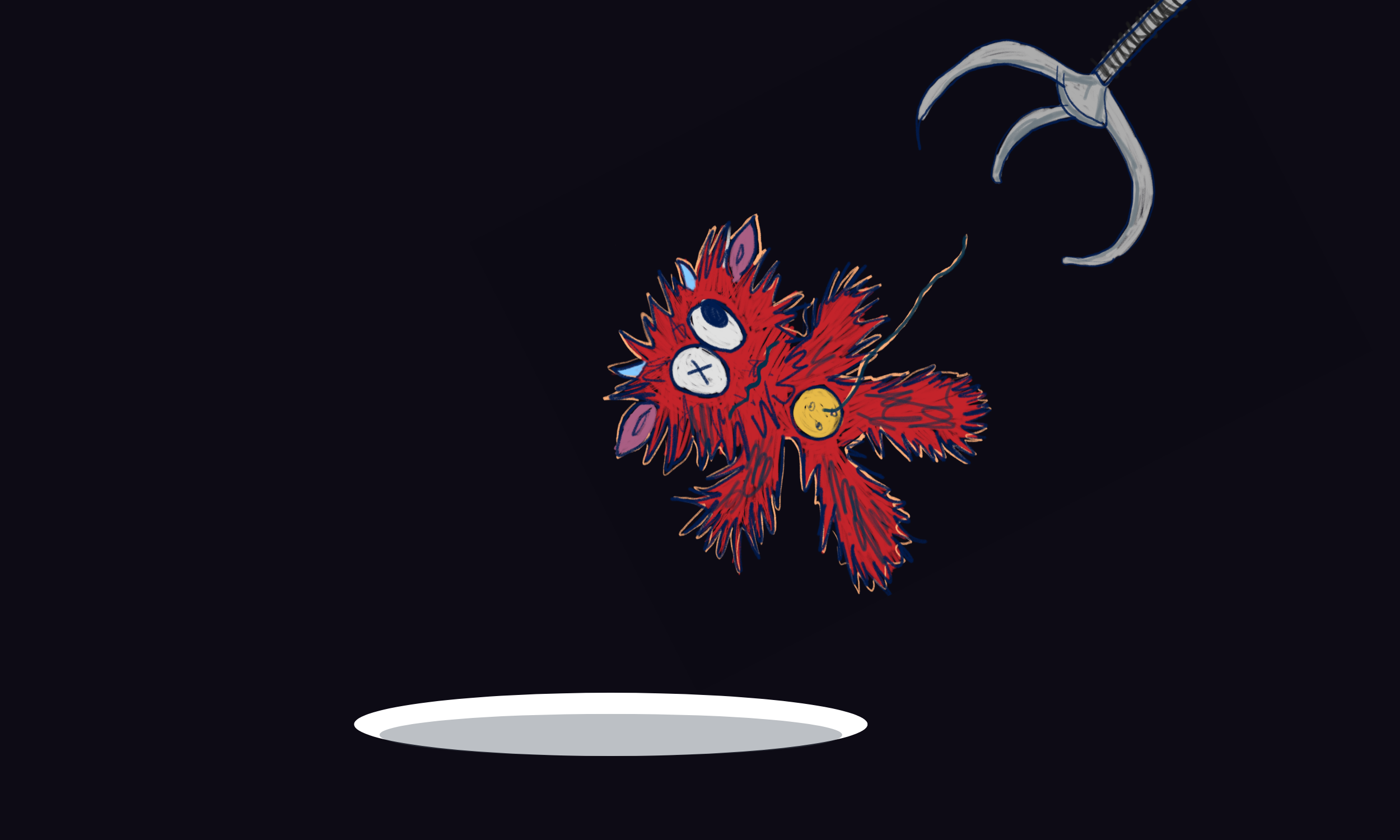
You may not notice them at first, but once you’re aware of their presence, you’ll start spotting claw machines on every corner in Tbilisi. They’ve been everywhere on the city’s outskirts, where it’s apparently easier to obtain a permit. And they’ve been especially everywhere at night, lighting up dark, lonely streets in neon colors like some monuments to forgotten joy. Wong Kar-Wai meets horror.
Claw machines, or crane game machines, are those devices with a glass box full of stuffed toys where you insert a coin, move a claw with a joystick, drop the claw, grab a prize, lift the prize, prematurely drop the prize, and lose. It’s hard to say exactly when they started proliferating in Tbilisi, or at what point they eclipsed the boxing machines, the ones you punch to measure your strength.
What one rarely sees, however, is someone actually playing them. The claw machines usually stand neglected, and it takes some waiting and stalking to catch a human being anywhere near them. And then, too, it could be some grown man hunting for toys, perhaps for a kid in the family, perhaps also not. It’s important to respect their privacy when they do it, because no man ever wants to be caught playing with toys, and no man ever wants to be caught losing.
Here is Nini and the Dispatch newsletter to tell about Georgia’s crane game conspiracy.
There are at least seven claw machines within walking distance of my home, and there are more if you keep walking. I’ve tried to avoid the gaze of the nearest one — it has its back mirror shattered, and I don’t want to invite any more bad luck into my life. Nor does the second-closest, pink one, covered in jail-like metal bars, evoke the most pleasant associations. But there is still plenty of choice farther away: the machines vary in colour, age, manufacturer, and design. The toys inside rarely repeat, and some machines even have video surveillance for those who love the spotlight.
At first, they don’t seem that tempting. The toys look like they’ve seen better days, possibly somewhere in the Western welfare world, before heading here to explore trouble, and the first two games I played — for research purposes, of course — I lost, with the losses coming so fast that I never had time to develop any emotional attachment. If disappointment is addictive, then I’ve already been addicted enough, and my quota has been full.
Then you also need coins.
A single game costs a 1-lari coin, and for a 2-lari coin, you can play three. Most machines don’t accept card or banknote payments, and small Georgian businesses have historically suffered from shortages of metal change, so they obsessively guard their reserves. In fact, the real gamble is finding a proper coin: if you approach a nearby vendor or shop to break a bill, you’d better convince them it’s for a life-or-death emergency, not some second-hand plushie that you probably won’t win anyway.
Which adds to the mystery: why are there so many of these machines around?

It would be easy to think the machines are part of some bigger financial scam, but a quick internet search shows that at least part of the boom follows a very trivial business logic in Georgia: someone did it first, and now others also want to try it.
You can see users on social media forums asking about those machines and the legal procedures for putting them out on the street. Others readily offer to import and/or sell the machines, which usually cost around $1,500, with China indicated as one source. There is a separate market for second-hand stuffed toys, most of which must be coming from the UK — as the official data suggests — which you can buy by the kilogram.
Some wonder whether those devices ever truly let you win. Such machines indeed exist, others respond, without disclosing their location.
But the question left most often unanswered is how much cash a single machine can make. Still, there are occasional hints that, if placed in the right location, it can generate enough income for a small business owner to feed a family. And if it indeed is a profitable business, and people still secretly play it when nobody’s watching, then the real question is: what drives the quiet demand?
Conspiracy of Loss
The early-day claw crane machines are said to have been inspired by giant steam shovels, or coal-powered excavators, introduced for use in the construction of the Panama Canal in the late 19th and early 20th centuries. Georgia’s claw machine boom, too, appears to be coinciding with its crane boom. We are a crane country now.
Turn on the news, and hardly a day passes without Georgian officials launching yet another major infrastructure project, which, naturally, will boost the country’s Middle Corridor potential, as they promise. Then the cameras switch to the construction site, and all you see are cranes and excavators hustling around. We are invited to embrace our newfound connectivity identity, and those claw machines in the streets are perhaps there to help us along that journey: in times of peace, a militant man becomes a corridor man. After all, with some of those big infrastructure projects, the games the authorities have been playing aren’t much different from the average claw-machine experience — an endless cycle of grabbing things and then prematurely dropping them and then grabbing them again.
But there is, of course, an economic explanation. When South Korea saw a similar claw machine boom in the 2010s, experts tried to link it to the economic recession. They said that consumers turned to cheaper products whenever the economy underperformed, “so that they can still have a small treat.”

Neither is the Georgian economy performing at its best, but it never was.
So, perhaps, some parallel frustrations are to blame, and what Georgians are trying to do isn’t necessarily to trade bigger joys for smaller ones, but rather to trade greater disappointments for minor ones. If there is indeed a conspiracy behind this sudden claw machine boom, maybe it is to train us all in accepting losses. Perhaps that’s what the peace is about anyway — a defeat one has to embrace. And maybe all this age-old talk of “geopolitical significance”, too, is a talk of surrender, and we are trying to define our worth by our usefulness to someone else precisely because we’ve lost faith in our true selves. “Just use me as your road for I don’t know who I am anymore.”
Oh, but then I won.
Face Your Monsters
It happened during another evening of exploring my neighborhood’s crane game culture. I had lost a few more games and was ready to call it a day, but then I saw another claw machine, and I still had a single 1-lari coin in my pocket from a small research grant I had disbursed to myself to study the phenomenon.
I went for a red plushie, because it was red and I liked it. On my first try, I managed to move it a little before the claw released it close to the prize chute. It looked like another attempt would seal it. Well, it took two more attempts, which meant two more 1-lari coins, which meant four more runs to nearby shops to get them, and which meant me stimulating the entire neighbourhood economy by buying chewing gums, medical bandages, and instant coffee packets I didn’t need.
But the determination paid off.
I hadn’t won anything in a while, and when, on the third try, I got the red plush toy — which turned out to be a monster, but a cute one, even making squeaky sounds when you squeeze its limbs, all four of them — I felt happy. The claw machine, too, was called “Happy Moment” — apparently the most common one in Tbilisi. I think the machine had been imported from China, and I hope this second-hand plush monster was shipped from somewhere in the West, so that I can take full pride in my new Georgia-is-at-a-crossroads self. A double win.

That monster lives with me now, and whenever I face it in those quiet moments, whenever the excitement briefly wanes, I can’t help but ask myself:
Was I ever meant to win, or was I meant to keep losing?
Was the win meant to distract me from greater battles, or was the intended loss meant to distract me from greater discontent?
Am I meant to get addicted to these small plushie wins, or might I eventually gamble for greater victories?
Did I crack the system, or did the system crack me?
***


