

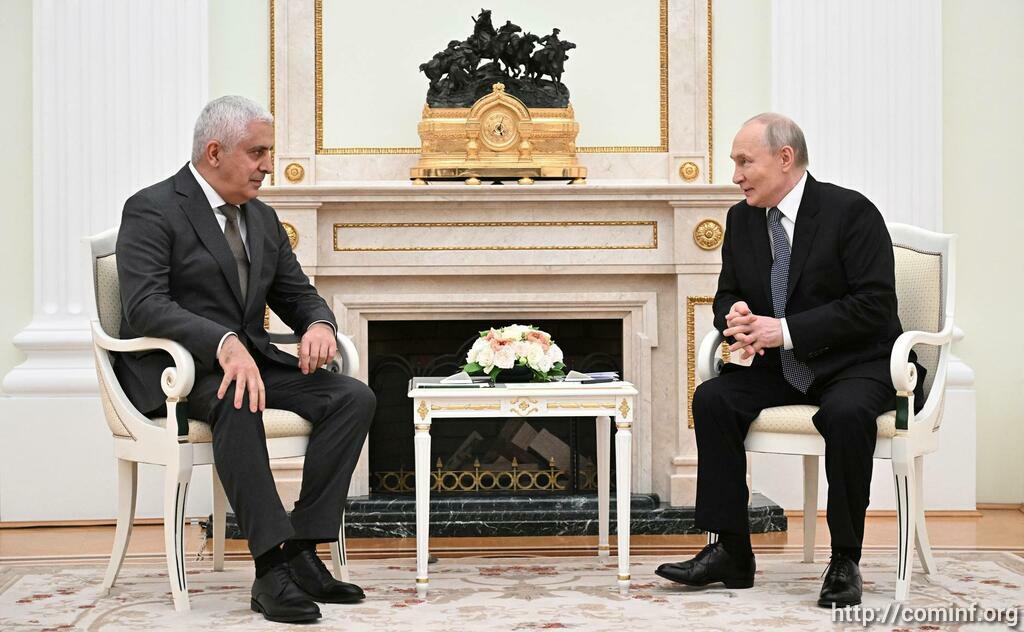
The dispatching of Marat Kambolov, a federal administrator with no prior connection to Tskhinvali Region/South Ossetia, as the new leader of the Russian-occupied region marks a new phase in the Kremlin’s management of Tskhinvali and suggests that Moscow may have broader strategic plans in the pipeline.
Tornike Zurabashvili is an independent researcher from Tbilisi, Georgia. He is a former editor of Civil.Ge.
The nomination of Marat Kambolov, an experienced federal administrator with personal links to Vladimir Putin, as the new ‘president’ of Tskhinvali Region/South Ossetia has sparked a range of reactions in Tbilisi. Some saw it as a prelude to the region’s final annexation by Russia, while others dismissed it as little more than routine bureaucratic reshuffling. Many, however, are simply unsure what to make of it.
The confusion is hardly surprising. Tskhinvali rarely makes headlines in Russia. With public attention firmly fixed on Ukraine, it has largely slipped off the radar of mainstream media. No less important is that there is simply little happening there; as a quasi-state with barely 35,000 residents, where the security situation has remained unchanged for years, except for occasional incidents across the line of contact with Georgia proper, the region has remained largely static, generating little political interest from the Kremlin.
On the Tbilisi side, too, official statements and public debate about the region have become increasingly rare in recent years, especially against the backdrop of the Georgian Dream authorities’ warming with Moscow. These factors, taken together, have made the Kremlin’s decision stand out even more.
Indeed, one cannot help but ask: if the region is already tightly controlled by the Kremlin, what prompted Moscow to take matters further into its hands? Or, on the other hand, if Moscow is on good terms with Georgia, why would it make a move that could potentially upset Tbilisi and push it further away from its orbit?
One step away from federal district
Kambolov’s nomination as the head of the Tskhinvali authorities is indeed significant, and on several accounts. First and foremost, this pertains to how the Kremlin runs affairs in the region.
In the years following Russia’s recognition of Sokhumi and Tskhinvali as independent states in 2008, Moscow gradually expanded its presence in the two territories. At the same time, it sought to preserve the appearance of some local self-rule, both in the eyes of the international community and among local residents. In practical terms, this meant reliance on local politicians, who implemented Moscow’s generous assistance programs on the ground, albeit with hands-on Kremlin supervision.
Installing a new point man with no prior connection to the region marks a departure from that approach and signals the beginning of a new phase in the Kremlin’s handling of Tskhinvali affairs.
One way or another, Tbilisi will have to make a difficult choice: either accommodate Moscow’s terms and play by its rules, or remain committed to its territorial integrity and continue resisting the Kremlin’s demands.
The nomination also dovetails with a broader trend taking place inside Russia. Over the past decade and a half, the Kremlin has steadily reduced the autonomy that regional elites across the North Caucasus enjoyed during the 1990s and 2000s, replacing an informal system of power-sharing among local clans and interest groups with tighter federal control and presence. Tskhinvali appears to be following the same trajectory: moving away from limited home rule toward the gradual removal of the remaining signs of autonomous governance.
Much like North Ossetia and Dagestan in North Caucasus, the region is now set to be governed by a Kremlin-appointed administrator rather than a son of the soil with roots in the local political establishment.
To be precise, however, this is not the first time a Russian appointee has been placed in a senior position in the region. As early as 2005, well before Moscow formally recognized the region, Tskhinvali had Moscow-seconded ‘prime ministers’: Yury Morozov from 2005 to 2008, and Vadim Brovtsev from 2009 to 2012, both ethnic Russians with no prior links to the area. In 2011, Brovtsev even served as the region’s acting president after disagreements among local political actors led to a brief electoral standoff.
This time, however, things seem slightly different. If previously the Kremlin avoided openly seconding candidates for the ‘presidency’ (although, as a rule, it made its preferred choice known), it has now moved to openly nominating and backing its own candidate, and from outside the local circles.
Moreover, if previously Russian appointees had to pay lip service to local legislation, including by ceremonially applying for and obtaining local citizenship, this time Moscow formalized the change at the legal level. On May 9, Vladimir Putin signed a so-called agreement with the region’s erstwhile leader that scrapped the 10-year constitutional residency requirement for Tskhinvali’s ‘president’, paving the way for non-natives to hold the highest office in the region.
Interestingly, the procedural choreography à la russe remained intact; Kambolov was first appointed as prime minister by then de facto leader Alan Gagloev, and when Gagloev announced his resignation days later, he assumed the role of acting president, a position he will hold until his mandate is approved in the September 18 “presidential vote.” But formalities are one thing, and reality is another: Kambolov’s nomination by Moscow removes even the last veneer of local ownership and brings Tskhinvali closer to the gubernatorial model of center-periphery relations reminiscent of Russia’s federal subjects.
So what is Kremlin (not) up to?
The move appears to carry more than mere bureaucratic significance, or a reconfiguration of how Moscow manages its junior partners.
In analyzing the Kremlin’s intentions, Kambolov’s profile deserves particular attention. Born in the Iraf district of North Ossetia, he has built a successful career in various federal institutions in Moscow. His most recent appointment was at the Kurchatov Institute, one of Russia’s leading nuclear research facilities. Perhaps more importantly, he is considered a close ally of the influential Kovalchuk brothers and a favorite of Sergey Kiriyenko, the Kremlin official overseeing policy toward Abkhazia and Tskhinvali Region. In short, Kambolov may not be a political heavyweight by Kremlin standards, but he certainly dwarfs his predecessors and potential alternatives in Tskhinvali.
But the notion that the Kremlin is sending a trusted confidant and seasoned professional solely to impose direct control would be misleading. After all, Russia has exercised comprehensive control over the region for years. Local military units have been integrated into Russia’s armed forces, ‘border’ security is handled by the Russian FSB, policing increasingly operates under Russian legal frameworks, and the region’s budget depends almost entirely on Russian funding. So, if anything, Moscow has long exercised direct control.
This, combined with the careful procedural framing of Kambolov’s nomination and the parallel activation of efforts in Abkhazia, including the appointment of a new “ambassador” and the tabling of legislative changes that would enable non-Abkhaz candidates to run for “parliamentary” mandates without Abkhaz language skills, suggests that the dispatching of Kambolov is far from a random decision.
The Kremlin appears to have bigger plans in mind.
This takes us to the next possible explanation: with Kambolov’s nomination, Moscow may be preparing the ground for annexation. The argument merits attention, but it still lacks rationale.
Suggesting that Kambolov will prove more willing than his predecessor, Alan Gagloev, to pursue such a course is hardly a convincing argument for anyone following local politics. After all, there is virtually no one left in the region’s political spectrum who opposes what they describe as “unification” with Russia. Gagloev himself has repeatedly stated that he favors the region becoming part of the Russian Federation. Moreover, in 2016 and 2022, Gagloev’s predecessors, Leonid Tibilov and Anatoly Bibilov, respectively, even set dates for referendums on joining Russia, only to be rebuffed by the Kremlin.
But the issue is not that the Kremlin is unsure or unwilling about annexation. Taking into account the political dynamics on the ground, public sentiment, and Russia’s all-encompassing presence in the region, Moscow has long treated annexation as an established fact. For all practical purposes, Tskhinvali/South Ossetia is already part of Russia in the Kremlin’s eyes. Formalizing that on paper is a matter of time rather than principle, but Kambolov is not there simply to drive in the final nail – at least not for now.
Moscow’s reluctance to move forward with the decision is shaped by several broader factors.
The first is Russia’s relatively improved relations with Georgia, which makes a formal annexation politically unnecessary and potentially counterproductive. The second is Abkhazia, where sovereigntist sentiments remain considerably stronger than in Tskhinvali. It follows from there that if and when the Kremlin decides to proceed with formal annexation, the decision is likely to be taken across both regions rather than in Tskhinvali alone, and in response to Tbilisi securing something substantial from the West. For now, however, with GD authorities increasingly attuned to Moscow and the Abkhaz political elite showing little enthusiasm for such a move, the issue is likely to remain parked until the Kremlin judges the political moment to be ripe.
Additionally, domestic motivation appears to be weak as well. Annexing the region does not resonate with the average Russian voter in the way Crimea did, meaning that expecting it to generate a significant patriotic boost ahead of elections or other milestone political events would be unrealistic.
Another explanation could be that Moscow is sending a political signal to Tbilisi.
Indeed, time and again, the Kremlin has shown its willingness to manipulate Tbilisi’s domestic politics and foreign policy choices through the issue of the occupied regions. But this too seems less convincing, considering the long-term consequences of Kambolov’s appointment. Had Moscow wanted to influence Tbilisi, it could have resorted to simpler levers. It could have tightened detentions along the line of contact, accelerated borderization, or reactivated the dormant talks over the location of the administrative boundary line with Georgia proper – an issue that Russia has deliberately kept ambiguous in its otherwise detailed legal framing governing its presence in the region.
So what then is Kremlin planning?
So, if Russia is not planning to annex the region in the immediate future and if it’s not sending a warning to Tbilisi, what then explains Moscow’s sudden decision to dispatch Kambolov to Tskhinvali?
Very briefly: it is too early to tell. Until the dust settles – that is, until Kambolov secures an electoral mandate – Moscow’s intentions will remain difficult to assess. That said, two explanations appear plausible.
One is purely bureaucratic. When Moscow recognized the statehood of Sokhumi and Tskhinvali, it essentially accepted the system of dealings that had been established in the two entities over the preceding decades. Above all, this entailed coming to terms with the existence of local elites which, although aligned with Russia, had their own interests and ways of conducting politics. Importantly, these rules of the game have been far less hierarchical and disciplined than Russia’s top-down administrative practices.
One possible explanation, therefore, is that Kiriyenko deemed Gagloev as incapable of improving the situation, and instead of handpicking another local candidate, he decided to bet on an outside figure.
As a result, by legitimizing the local elites, Moscow imposed bureaucratic constraints on itself. This has proved especially problematic in Tskhinvali. Eighteen years after recognition, and despite billions of Russian rubles poured into the region, it continues to lag behind neighboring Russian regions in terms of socio-economic development, while criminality and corruption remain endemic even by the rock-bottom North Caucasus standards. Repeated changes of Kremlin curators have failed to improve the situation, nor has an increase in their inspection visits – a standard procedure for supervising the implementation of Moscow’s assistance programs. Consequently, what was supposed to be a showcase of Russian politico-military and economic might has become little more than a grey zone, characterized by endless crises, stagnation, and administrative malpractice.
One possible explanation, therefore, is that Kiriyenko deemed Gagloev as incapable of improving the situation, and instead of handpicking another local candidate, he decided to bet on an outside figure.
Another possibility is that the decision signals Moscow’s interest in developing new transit initiatives across the Caucasus. Since the closure of many transport routes to Europe following Russia’s invasion of Ukraine in February 2022, Moscow has increasingly sought to redirect trade flows southward, focusing on the Black Sea, South Caucasus, and Central Asia. The Kremlin has also watched with concern the rapprochement between Baku and Yerevan, and the emergence of various initiatives aimed at reshaping regional connectivity, including the Trans-Caspian Route (better known as the Middle Corridor) and the U.S.-mediated TRIPP project. In response, Russia appears to be exploring alternative arrangements of its own.
It is also worth noting that Moscow has long expressed support for restoring transport links to Georgia through Abkhazia and Tskhinvali, particularly as the Zemo Larsi crossing point, the only officially recognized land connection between the two countries, has faced difficulties in handling ever-growing cargo volumes. Yet Moscow has never spelled out its plans in detail, not least because of legal ambiguities, infrastructural challenges, and Tbilisi’s reluctance to engage with such initiatives.
But with Tbilisi recalibrating its approach toward Moscow and the Kremlin seeking to reclaim initiative in the wider region, the idea may be gaining new momentum. By reopening transport routes through Tskhinvali, Russia could secure an additional land corridor to Georgia and Armenia, and more broadly to Turkey, one of its key economic partners, and Iran, its strategic ally.
But reopening transport routes via Tskhinvali would require significant preparations inside the region. Roads would need to be widened, cargo terminals built, and customs capacities improved, all of which would require substantial investments. Moreover, it would require resolving difficult legal questions surrounding the status of the region and devising customs arrangements that Tbilisi, too, could accept. No less important would be securing sufficient political legitimacy and organizational capacity to push through difficult technical decisions, both within Moscow’s bureaucratic circles and on the ground.
This is where Kambolov may come into play.
Indeed, Kambolov’s first decision was to visit Nizhny Zaramag, the only crossing point between Russia and Tskhinvali Region, where he pledged to work on easing traffic across the border. Rumors say the plan is to add three more lanes to streamline customs procedures. True, for now the project is presented as a way of addressing long-standing complaints from local residents. However, if Moscow ultimately follows through and pairs the expansion with broader infrastructure upgrades, it could well lay the groundwork for future transit through Tskhinvali.
Whatever the Kremlin ultimately has in mind, Kambolov’s nomination is a clear sign that Moscow is preparing for something bigger in the region. And one way or another, Tbilisi will have to make a difficult choice: either accommodate Moscow’s terms and play by its rules, or remain committed to its territorial integrity and continue resisting the Kremlin’s demands. As Moscow expands its presence and ambitions in the region, the strategy of ducking problems will become increasingly untenable.

