



Kate Newton
Climate Change Correspondent
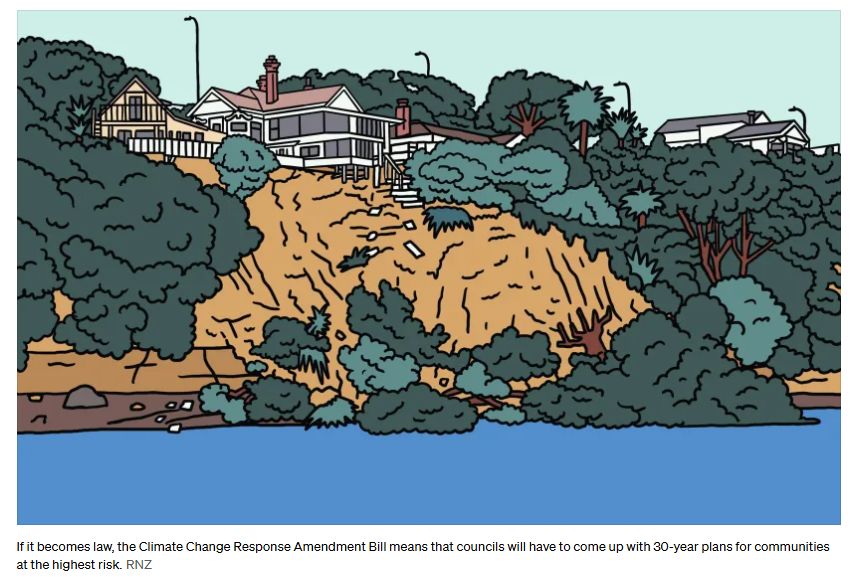
Councils
will have to come up with adaptation plans for communities
at high risk from climate change hazards, under a proposed
law change.
The Climate Change Response Amendment
Bill, introduced to Parliament on Wednesday, will require
councils to plan at least 30 years into the future, and
spell out the likely cost.
However, the government has
still not announced who should pay for adaptation,
previously saying decisions about cost-sharing would be made
in the next term of government.
Climate Change
minister Simon Watts said for the first time, councils would
be required by law to plan how high-risk communities in
their area will prepare for the impacts of climate
change.
“Some councils are already working well with
their communities to adapt, but this is inconsistent across
the country.”
The current and future costs of climate
change to communities and infrastructure are
enormous.
Earth Sciences New Zealand (ESNZ) modelling
published last year showed that 750,000 people were
already exposed to a major flood risk, and that would
rise to as the climate continued to warm.
Advertisement – scroll to continue reading
ESNZ said
critical services, including thousands of kilometres of
roads and stormwater pipes, were also at risk.
An
Infrastructure Commission report based on the ESNZ data and
published last week said the average annual costs of
infrastructure damage from flooding were already $471
million a year.
That could increase by between 43 and
53 percent by 2075 under various climate change scenarios,
the commission said.
An individual event could cost
far more: the damage from Cyclone Gabrielle and the Auckland
Anniversary Day floods in 2023 has been estimated at a
combined cost of $14.5 billion.
A Climate Change
Commission report published in May said there was already “long-lasting
hurt, grief and fear” from climate-driven severe weather
events.
Just 3 percent of the money spent on
hazard-related costs since 2010 had gone to reducing risk
ahead of time, with the rest spent on post-recovery costs,
the commission said.
Insurers and adaptation experts
have also warned
of the prospect of escalating insurance premiums and
even withdrawal
from some areas if risks are left
unmitigated.
Under the proposed law, regional councils
would have to identify high priority areas through the new
spatial planning process included in the RMA
reforms.
City and district councils would then develop
adaptation plans for any high priority communities within
their area.
A fact sheet published by the Ministry for
Cities, Environment, Regions and Transport says councils
will be expected to focus first on places where people live,
and start by looking at flood and coastal hazards.
The
plans would have to spell out a programme of work, including
the triggers or thresholds (such as a certain amount of sea
level rise) for adaptation actions to go ahead.
They
would also have to provide “high-level cost estimates” and
explain how any costs would be funded and financed over
time.
The government has not confirmed any funding
mechanisms for local climate adaptation, despite mounting
pressure from councils, insurers and the
Climate Change Commission to do so.
Local
Government NZ president Rehette Stoltz told
the annual Insurance Council conference in June that
councils were being asked to carry a national problem on
local balance sheets and needed “durable
co-funding”.
An independent reference group set up by
the Ministry for the Environment advised
the government last year that funding should largely
follow a ‘beneficiary pays’ model.
Central government
should only invest in adaptation if it would protect Crown
assets, “or where broader national benefits can be
realised”, the group’s report said.
Watts wrote to
councils earlier this month warning them off “unnecessary
gold-plating” when planning for climate risks.
He took
specific issue with councils using the most extreme climate
warming scenarios to develop their plans, saying such
scenarios should only be used for “stress testing and
contingency planning”.
“The Government’s expectation
is clear: councils should plan for climate risks, but they
must also plan for affordability.”
The proposed law
change would allow councils with existing adaptation plans
to keep them, provided they met the required
criteria.
Plans for the highest-priority areas would
need to be made within five years of a regional spatial plan
being adopted, with the remainder made within 10
years.
They would be reviewed every decade to make
sure they were current.
The Bill also contains changes
to the Emissions Trading Scheme, including providing a
future option to add new forms of carbon removals into the
scheme alongside forestry.
It also makes changes to
the sequencing of how the government develops and monitors
emissions budgets and plans, and will cut the number of
climate change commissioners from seven to five, not
including the chair and deputy
chair.
New Zealand’s public broadcaster, providing comprehensive NZ news and current affairs, specialist audio features and documentaries.
Radio New Zealand is a Crown entity established under the Radio New Zealand Act 1995. Radio New Zealand News are vital elements in our programming, providing impartial news and information to New Zealanders every day. Radio New Zealand (RNZ) provides listeners with exciting and independent radio programmes in accordance with the Radio New Zealand Charter.

