



Nik Dirga
Digital Explainer Editor
*Correction:
An earlier version of this story incorrectly referred to the
Law Society instead of the Law
Association.
Explainer – National is hyping
it as the return of car crushing. But what do tough new
antisocial road user laws mean?
The Antisocial Road
Use Legislation Amendment Bill passed
its third reading earlier this month, and gives police
and courts more powers.
“Communities across New
Zealand have been forced to put up with illegal street
racing, burnouts, fleeing drivers, intimidating convoys,
disorderly dirt bike gatherings and siren battles for far
too long,” Transport Minister Chris Bishop said in
announcing the bill’s passage.
“This law sends a very
clear message: if you use our roads to intimidate or
endanger communities, there will be serious
consequences.”
Waikato District Council mayor Aksel
Bech told RNZ’s The Panel that
the problem is epidemic in rural
communities.
Advertisement – scroll to continue reading
“It’s causing havoc and costing thousands
of dollars. It’s pretty antisocial and we’d like to get on
top of it.”
“You’ve got 50, 60, sometimes 100 people
gathering on a small rural road and then for a number of
hours tearing it up, leaving litter, leaving shredded tyres
and making a [lot of] noise.”
One of the biggest
talking points is the return of confiscating and destroying
the vehicles of repeat offenders.
“Car crushing is
back,” Prime Minister Christopher Luxon declared on his
Facebook page.
But didn’t we do that once before – so
how is this legislation different? Here’s what you need to
know.
What would the bill do?
It sets up a
variety of new offences and penalties for those broadly
described as “antisocial road users”.
These
include:
- Establishing a presumptive sentence of
vehicle destruction or forfeiture for those on a first
offence of fleeing police, street racing or burnouts. That
presumptive sentence can also apply to expanded offences for
withholding information from police or the new ‘intimidating
convoy’ offence. - The ‘intimidating convoy’ offence
applies when people are travelling in a group of two or more
vehicles in an ‘intimidating manner’ and commit offences of
fleeing police, street racing, burnouts, dangerous and
reckless driving, or careless driving causing injury or
death. - There is an expanded offence for failing to
give information to police officers who are trying to
identify offenders in cases including street racing,
burnouts and intimidating convoy offences, which can include
a court fine up to $10,000. - Giving police more
powers to manage antisocial vehicle gatherings by closing
roads or public areas and issuing infringements. This
includes a fine up to $3000 for people who fail to leave a
temporarily closed area when directed by
police. - Increasing the infringement fee for making
excessive noise from or within a vehicle from $50 to
$300
Read more detail from the
Ministry of Transport here.
“These
changes mean convicted fleeing drivers, street racers, and
people participating in intimidating convoys can expect to
lose their vehicles through destruction or forfeiture,
unless limited exceptions apply,” Bishop said.
Hang
on, didn’t we crush cars before?
Yes indeed, and a
politician even got a memorable nickname from
it.
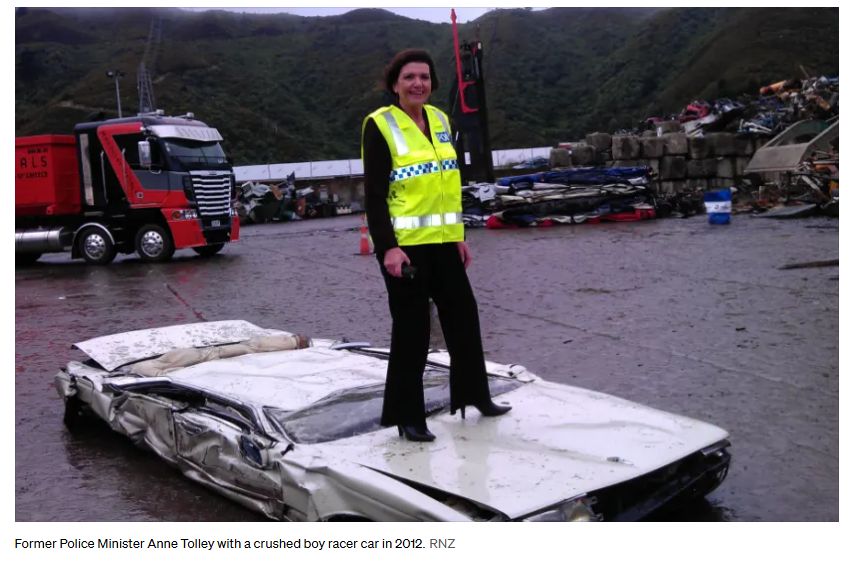
Former police minister Judith Collins got
the tag “Crusher” after introducing the law in 2009
which allowed boy racer vehicles to be seized and
destroyed.
However, only
two cars were crushed in the first three years of the
law. By 2017, eight years on, Stuff reported a grand total
of three cars had been crushed.
A later police
minister, Anne Tolley, said
in 2014 the goal wasn’t to crush cars but to decrease
dangerous driving.
She said then that illegal street
racing offences had halved since the legislation was
introduced in 2009.
Tony Herring, president of the Law
Association which offered submissions on the new bill, said
while car crushing made dramatic headlines, it only ever
affected a small group.
“There has never been strong
evidence that car crushing itself was a significant
deterrent. Even when it was introduced in 2009, it was
expected to apply in only a small number of
cases.”
So does this new bill allow more cars to be
crushed?
Police Minister Mark Mitchell told RNZ “this
new legislation goes significantly further” than the 2009
iteration, with its “presumptive sentence” of vehicle
destruction or forfeiture on a first offence of street
racing, burnouts or fleeing police.
“Under the
previous law, a vehicle could only be crushed after a third
qualifying offence, and even then, courts could choose an
alternate resolution. This meant that the crushing of
vehicles was rarer than the government intended when the
original law was written.”
Herring agreed the new
legislation was much broader than in 2009, where the focus
was mostly on illegal street racing.
“It creates new
offences, expands police powers, broadens vehicle
forfeiture, and introduces new powers to close public places
and disperse people. So while people talk about the return
of car crushing, this legislation is really a much wider
package aimed at antisocial road use generally.”
Deven
Solanki is the editor of NZ Performance Car, the
largest automotive magazine in New Zealand. He said car
enthusiasts were concerned how the legislation might affect
them.
“The vast majority of people causing the
problems are not car enthusiasts,” he said.
“The
problematic people openly destroy and dispose of their cars;
a car is just a toy for them, so using crushing as a penalty
is largely redundant anyway, they will not be ‘scared off’.
They will source, build or sometimes steal another one by
the next weekend.”
The Law Association has also
expressed concerns on the bill, Herring said, and some were
addressed as it made its way through the House.
“That
said, many of our concerns remain. The bill still contains
broad new police powers and mandatory forfeiture provisions
that raise questions about proportionality and how they will
work in practice.
“We all support tackling antisocial
driving. The challenge is making sure the laws are both
effective and consistent with fundamental legal
rights.”
There are exceptions to car destruction
orders if it will result in “extreme hardship” to the
offender or “undue hardship” to any other person that might
have an interest in the vehicle (a relative or partner, for
instance).
During debate on the bill, according to
Hansard records Labour MP Ginny Andersen pointed out the
previous car crushing plans came up against the hardship
claims and “in the past it’s resulted in very few vehicles
being actually confiscated and destroyed.”
“It has
been, in the past, a fundamental reason why attempts to
curtail street racing and illegal street racing haven’t been
effective. Because they’re registered to someone else and
because they front up to the court and say, ‘I need this to
get to work’, and it’s hardship.”
Herring said he
would not call the hardship defence a loophole.
“It is
an important safeguard that protects against unfair
outcomes, particularly for innocent family members or people
with a legitimate interest in a vehicle.
“The bill
certainly makes forfeiture easier by creating a presumption
in favour of it, but Parliament has deliberately kept the
hardship and manifest injustice exceptions. The Justice
Committee also restored some judicial discretion,
recognising that there will always be cases where an
automatic outcome would be unfair.”
Solanki said he
felt car crushing would just see offenders causing trouble
elsewhere.
“If you crush the cars of the main people
causing this problem, you’ll just find yourself with a new
trend to squash, because this group’s energy still has to go
somewhere. That’s bound to turn into something even more
damaging, like theft, drugs or ram raids. It’s just about
chasing attention, adrenaline, or showing off to
others.
“Just like in the ‘Crusher Collins’ days, this
flashy change is trying to address a symptom, not a root
cause.”
The government maintains the new laws will
discourage boy racers.
“We expect this version of the
law to have more impact” compared to the 2009 legislation,
Mitchell said.
“Ideally boy racers will quickly learn
that, since their vehicle is on the line, their anti-social
behaviour is completely unacceptable. If it works as
intended, most behaviour will change before the courts need
to order the forfeiture, or forfeiture and destruction, of
any vehicle.”
What exactly is an ‘intimidating
convoy’ and how will that be determined?
The bill
also adds the offence of “Dangerous or reckless activity
offence conduct in frightening or intimidating convoy”. It
defines a convoy as a group of two or more motor vehicles
travelling together.
There’s been some concern that
the notion of what a “convoy” of vehicles is could be
misinterpreted.
“The ambiguous ‘intimidating convoys’
part is what real enthusiasts are worried about, because a
huge part of car culture is around people coming together as
a community,” Solanki said.
People who don’t
understand cars often automatically assume the worst, he
said: “A completely legal car in a cruise convoy might
simply change gears, and sound like ‘racing’ to someone who
doesn’t know any better.”
During debate in Parliament,
Bishop said the offence is directed specifically at groups
engaged in menacing behaviour.
“The point is that any
convoy of vehicles, by itself, is not committing an
offence.
“To commit an offence for participating in an
intimidating convoy, an individual driver must commit
illegal street racing, burnouts, fleeing police, or
otherwise driving in a reckless, careless, or dangerous
manner, and they have to be travelling in a convoy – so two
or more vehicles – and they have to be operating the vehicle
in a manner that is either frightening or could cause
intimidation.”
But training of the police who will
enforce laws is a worry, Solanki said.
“A
sensationalist law like this only causes collateral damage
to real car enthusiasts because of how broad and widely
interpretable it is to a cop that doesn’t know any better,”
he said.
Bishop did say that work will be needed to
train police on how to deal with the new bill.
“We’re
saying that, with any new offence, there will need to be
training for front-line police staff to train them up as to
what frightening or intimidating means,” Bishop said in
Parliament.
How will it tackle noise like ‘siren
battles’?
Cars laden with high-volume audio systems
have been waging
“siren battles” throughout the night to see who can make
the biggest noise.
“It creates huge nuisance for
thousands of people in West Auckland especially for parents
and the elderly and vulnerable people,” Waitākere ward
councillor Shane Henderson has said.
The bill knocks
up the infringement fee for making excessive noise from a
vehicle from $50 to $300.
“No more $50 slaps on the
wrist,” Associate Minister of Transport James Meager said in
Parliament during debate.
“Submitters and other
members of the public have spoken or have written to our
offices to remind us how distressing this is. It’s
distressing due to nights of having no or disrupted sleep
because of this totally inconsiderate
behaviour.”
When will this all take
effect?
“Most changes will come into effect in six
months’ time,” Mitchell said.
“This transition period
allows for changes to be circulated with frontline staff and
for judiciary and legal stakeholders to be able to
operationalise changes.
Will this really lead to less
antisocial driving?
That depends on who you
ask.
Mitchell has said the law gives authorities the
power they need.
“For too long, the consequences
haven’t matched the harm being caused.”
During
Parliamentary debate, Green MP Julie Anne Genter said police
have not been given enough resources to deal with existing
problems, let alone new offences.
In the end, the bill
was supported at its third reading by National, Labour, New
Zealand First and ACT, with the Green Party, Te Pāti Māori
and independent MPs voting against it.
NZ
Performance Car’s editor said more understanding of the
root causes of antisocial driving was needed.
“There’s
a right way and a wrong way to go about antisocial driving;
I believe they’re doing it the wrong way,” Solanki said.
“Have they even tried to first understand why the problem
group is actually doing this?
“Forfeiture, as long as
you have some damning evidence and warnings at least, makes
more sense. But what’s the point in crushing a car? It’s a
sensationalist grab at attention, which has worked, by the
way.”
But Waikato mayor Bech said he thought something
needed to be done as existing laws weren’t
working.
“As a society we need to say this is not OK,
this is not an appropriate thing for anybody to do in public
spaces.”
New Zealand’s public broadcaster, providing comprehensive NZ news and current affairs, specialist audio features and documentaries.
Radio New Zealand is a Crown entity established under the Radio New Zealand Act 1995. Radio New Zealand News are vital elements in our programming, providing impartial news and information to New Zealanders every day. Radio New Zealand (RNZ) provides listeners with exciting and independent radio programmes in accordance with the Radio New Zealand Charter.

