



Analysis
– For reasons known only to Labour’s rulebook, the
party’s annual conference is rebranded a “congress” in
election years.
The semantic flourish is supposed to
signal a shift in focus to members, with no time allocated
for the constitutional quibbling or sub-committee selections
of other years.
Instead, congress is reserved for
campaign planning and strategising, along with a healthy
dose of hype.
Presumably the former was thrashed out
behind closed doors, although not a single duck-sized
horse was sighted.
The hype did eventually make an
appearance, even if a little late in the
weekend.
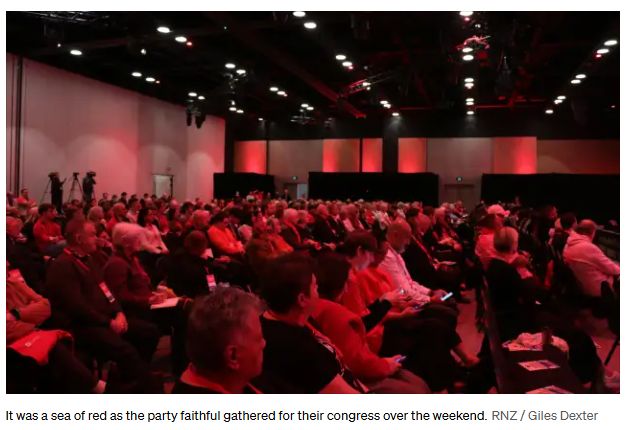
About 500 positive people poured
into the capital’s convention centre on Sunday, where
kapa haka group Te Pū Toi Kura shook the red-washed
room.
The crowd bellowed and cheered at appropriate
moments, brandishing placards.
But beneath the noise
lay a tepidity and sense of caution which the party has
struggled to shrug.
Advertisement – scroll to continue reading
The more muted feel on Saturday
could perhaps be blamed on the wild weather having delayed
or disrupted travel plans.
But there was no such
excuse for those on stage. The speeches open to media (and
there were not many) were forward-looking, but light on
substance.
Barbara Edmonds promised she’d make the
numbers add up but would not say how. Carmel Sepuloni spent
her time mostly attacking National.
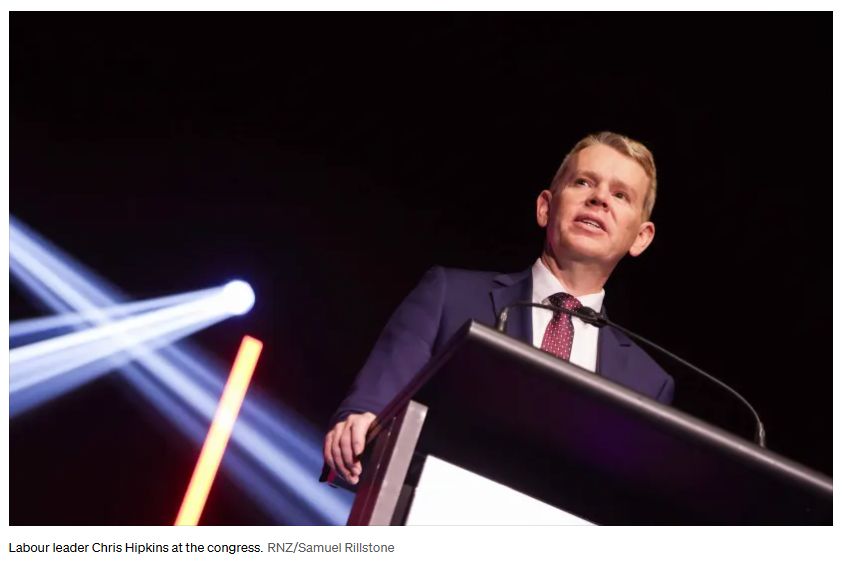
Leader Chris
Hipkins gave the most impressive address of the event, a
polished and passionate pitch on the Sunday, inviting those
at home to consider whether their lives were better or worse
than three years ago.
It was an effective line, but
missed the obvious follow-up: would it be any better under
Labour?
Hipkins
promised a “practical, funded plan” ready to start the day
after the election, but details were thin on the
ground.
In yet another symbol of the surface level
change on offer, the party’s much-thrashed slogan, “jobs,
health, homes,” was rebooted as, wait for it, “your job,
your health, your home.”
The headline policy
announcement fell squarely in the first category, with a
promise to ramp up support for employers to take on
apprentices.
The pledge is well-worn territory,
similar to that promised by Hipkins at his 2023 Congress,
and on brand for Labour as the party of workers.
It
went down well with members but could hardly be called
inspired or inspiring. It seems unlikely people will still
be discussing Apprenticeship Boost by the end of the
week.
Contrast that with National’s embrace of
KiwiSaver at its conference a week earlier, which kept the
commentariat chattering for days.
Labour has been in
desperate need of a gearshift, with its year defined to date
by an almost belligerent policy paucity.
The party
began to ease into campaign mode a fortnight ago with its
promise of a public transport fare cap.
But initial
polling suggests its concentration on the cost of living has
not quite landed as Labour might have hoped.
While
Tuesday’s 1News-Verian survey delivered victory for the
left, it also came with a five-point plunge for
Labour.
The coalition has been quick to characterise
Labour as a low rent Oprah: “You get a free GP visit! You
get a free prescription! You get a free maternity
scan!”
Labour will be worried that relentless
narrative is starting to stick.
No surprise that was
the line National immediately reached for in response to the
apprenticeship commitment on Sunday: who’s paying?
A
few weekends back, Nicola Willis called a media conference
at Parliament for the sole purpose of tallying up the cost
of Labour’s promises, almost-promises and
maybe-promises.
Inevitable parallels were drawn with
Steven Joyce’s 2017 “fiscal hole” claim (which fell apart on
closer inspection), but the better comparison is with John
Key’s devastating “show me the money” riposte of
2011.
Edmonds can promise again and again that she can
be relied on to find the money, but until she explains how,
that demand will resonate.
Asked on Sunday how Labour
would balance its books, Hipkins responded: “You will
see.”
When? “In due course.”
This year’s polls
have proved dangerously reassuring to the red
team.
Labour has steadily clawed back support since
its 27 percent trouncing and now comfortably holds the title
of most popular party, averaging about 34 percent this
year.
But that buoyancy hides a fragility in the
numbers and an untapped despondency in the wider
electorate.
Despite Labour’s primacy, most polls still
consign it to the opposition benches, with New Zealand
First’s surge keeping the coalition in the
conversation.
The public pessimism is also captured in
the numbers of undecided voters, as well as the emergence of
the Opportunity party as a potential player.
All of
that is to say that Labour is as much afflicted by the wider
malaise as National is.
And the weekend’s congress,
whatever its name, will do nothing to shift
that.
ACT’s David Seymour: ‘From today, we’re out
campaigning too!’
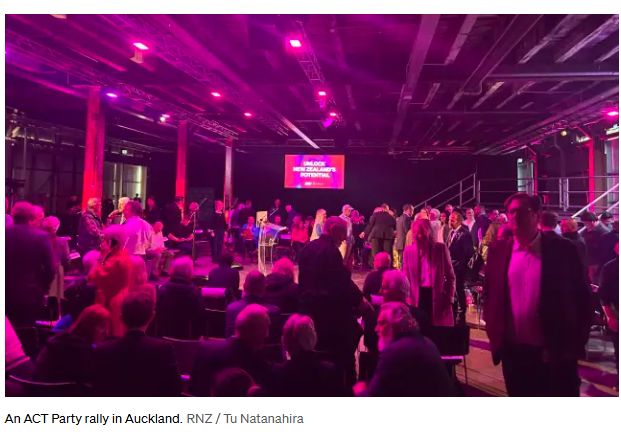
The
ACT Party also
held its election year gathering on Sunday, also
eschewing the “conference” moniker and associated procedural
wonkery.
Its aversion to over-consultation extends
even to its own members, meaning pesky matters of policy are
restricted to the board and caucus.
As such, ACT bills
its annual meeting as a “rally” – a ticketed tub-thumping,
open to all, not just the membership.
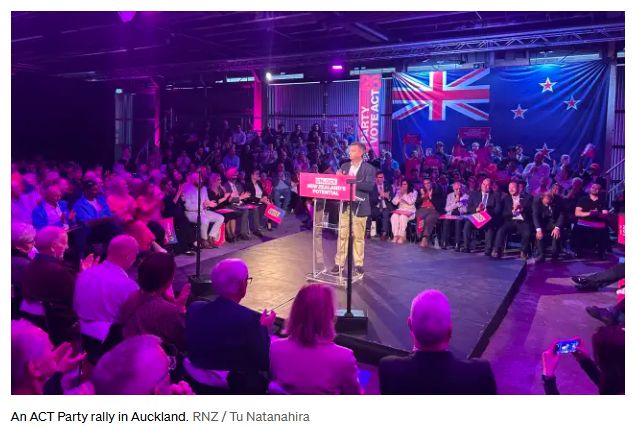
The set-up
mimicked political events more common in the United States,
with ACT leader David Seymour standing in front of a giant
New Zealand flag and surrounded by seated
supporters.
As with Labour, the new style nodded
towards the need for a shift, even if the party did not
necessarily deliver on that front.
Yes, there were
energetic chants and slick production.
But the
featured policies fell in familiar ground, fleshing out
long-held promises to slash ministries and crack down on
beneficiaries.
ACT’s polling woes are more immediately
apparent than those of its distant parent.
The
party has slowly shed support this term, outperformed by its
coalition partner New Zealand First in every single poll
this year.
Twelve months ago, ACT was consistently
registering around 9 percent – just above its 2023 election
result. Now, it is averaging closer to 7 percent.
Why?
In a response fit for a job interview, Seymour claims he’s
just too hardworking. Too much time doing the mahi, not
enough promoting it.
His speech rattled through ACT’s
key accomplishments, then noted all those he had not
mentioned, and in doing so, mentioned them.
It was a
neat rhetorical device but also sounded a little like
pleading: some credit would be nice!
Seymour presented
ACT as the coalition’s handbrake on “nutty stuff”, wielding
an argument well-used by New Zealand First.
We stopped
three taxes, he said. You think the LNG facility is dumb?
Just wait till you hear their other crazy ideas. (Not that
he actually divulged them, citing Cabinet
confidentiality).
Seymour has previously suggested ACT
was keeping its powder dry, waiting till closer to voting
day before clearing its throat.
Supposedly, that wait
is now over: “From today, we’re out campaigning
too.”
ACT has a healthy war chest to dip into, with
$1.3m in publicly declared large donations this
year.
That’s more than National ($730k) and NZ First
($500k) combined, or the entire opposition bloc (Labour
$180k, Greens $90k, TPM $40k).
One of Seymour’s
regrets of the 2023 campaign was that ACT peaked too soon,
recording double-digit support all year, only for it to slip
away in the final weeks.
He does not want to make that
same mistake again. But such observations often only become
clear with hindsight.
Timing is much trickier to
stage-manage than a conference slash rally slash
congress.
New Zealand’s public broadcaster, providing comprehensive NZ news and current affairs, specialist audio features and documentaries.
Radio New Zealand is a Crown entity established under the Radio New Zealand Act 1995. Radio New Zealand News are vital elements in our programming, providing impartial news and information to New Zealanders every day. Radio New Zealand (RNZ) provides listeners with exciting and independent radio programmes in accordance with the Radio New Zealand Charter.

