

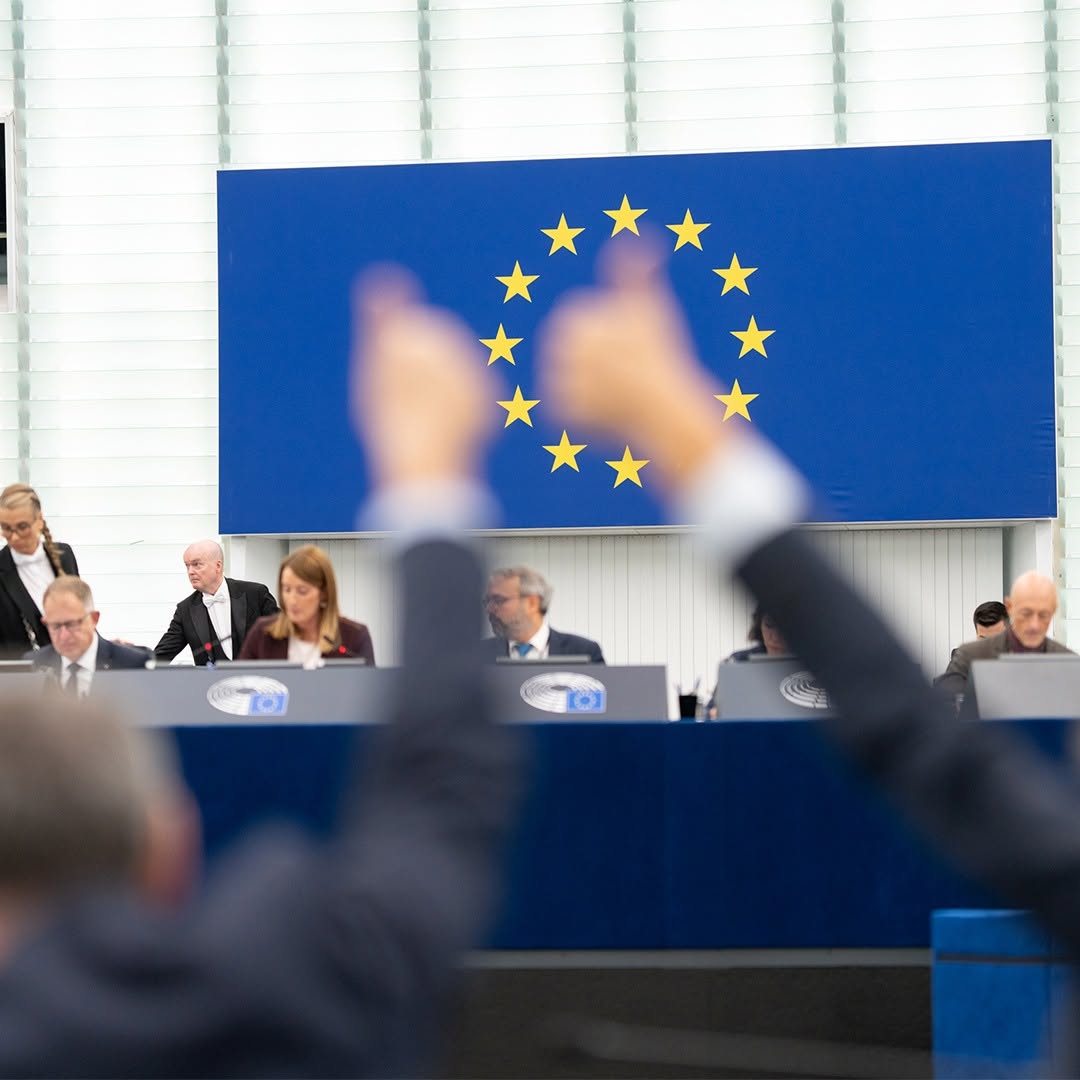
The European Parliament adopted a critical resolution on Georgia on June 17, calling on the EU and its member states to impose “targeted personal sanctions” on Bidzina Ivanishvili and other “key Georgian Dream leaders,” expressing regret that the authorities have not taken any steps to reverse “anti-European course,” and reiterating the “non-recognition of the legitimacy” of the country’s disputed parliament and authorities.
The resolution, prepared by Lithuanian MEP Rasa Juknevičienė of the European People’s Party (EPP), was first debated in February and approved by the European Parliament’s Committee on Foreign Affairs (AFET) in May. The final text was adopted with 436 votes in favor, 145 against, and 47 abstentions.
It also “strongly condemns” the role of Georgian Dream-aligned media outlets, naming Imedi TV, PosTV, and Rustavi 2, in disseminating what it describes as “systematic disinformation,” “smear campaigns,” and “hostile propaganda” against the EU, calling on EU institutions to “follow the United Kingdom’s example,” which sanctioned two of them, and “adopt appropriate and proportionate restrictive measures against individuals and entities responsible for orchestrating and financing these disinformation campaigns, including under the EU Global Human Rights Sanctions regime.”
It additionally calls for sanctions on “members and the leadership” of the Georgian National Communications Commission, a state media regulator, and the Georgian Public Broadcaster.
The MEPs also adopted an amendment tabled by the European Conservatives and Reformists (ECR) group, highlighting that “the lack of thorough academic research, historical education and public awareness concerning the Soviet occupation and its long-term consequences enables the spread of historical manipulation and disinformation campaigns, which the Russian Federation exploits to undermine the Euro-Atlantic aspirations of Georgian society.”
They rejected the amendments submitted by German MP Tomasz Froelich on behalf of the Europe of Sovereign Nations (ESN) group, which, among others, opposed sanctions on Georgian individuals, describing it an “unjustified foreign interference and political pressure.”
Document in Details
The document states that the situation in Georgia “has continued to deteriorate dramatically,” citing “further backsliding in democracy, human rights, and rule of law” under Georgian Dream, and saying that the “methods of repression, disinformation campaigns and political harassment mirror Russian hybrid tactics.” It expresses “full solidarity with the Georgian people” in their “struggle for a European and democratic Georgia” amid what it describes as “growing repression, unlawful arrests, relentless hostile rhetoric, disinformation and threats.”
It notes with “deep disappointment” that Georgian Dream “has not only suspended but effectively reversed Georgia’s course of European integration.” The report also “regrets the fact that there has been backsliding in the implementation of all nine priorities that were the conditions for granting Georgia candidate status.”
The document also criticizes what it calls the “inconsistency” of the GD government’s claims that EU integration remains its main priority, “while at the same time its highest officials and government-affiliated media run an orchestrated and systematic campaign spreading manipulative Russian-style narratives, disinformation and conspiracy theories against the EU, its officials and diplomats.”
It further “deplores” developments following the October 2024 parliamentary elections, which it reiterated were “rigged,” and points out that the municipal elections of 2025 were largely boycotted by the opposition parties, “reflecting the deep mistrust that the majority of the society has in the independence of the electoral process.” It also expresses concern over amendments to Georgia’s Electoral Code adopted by the disputed parliament in 2025.
The report reiterates its “strong call” on the EU and its member states to impose “targeted personal sanctions” on Bidzina Ivanishvili, party leaders, judges, prosecutors, and other officials deemed responsible for “the continuous democratic backsliding in Georgia, electoral fraud, human rights violations, and the persecution of political opponents and activists” as an “important instrument against impunity.”
It condemns “systemic impunity” of those it says are responsible for “political repression, harassment of journalists and human rights defenders, and persecution of opposition figures,” urging the European Council to adopt “coordinated, EU-wide restrictive measures against all responsible politicians, officials and enablers, including the expansion of sanctions lists, comprehensive asset freezes and visa bans targeting those responsible for state capture.”
It calls on the Hungarian government “to lift the blockade imposed by its predecessor” on the sanctions against Ivanishvili and the Georgian Dream.
Expressing “regret” that Georgian Dream has not taken any steps to “reverse its anti-democratic and anti-European course,” it considers that engagement with Georgian authorities should be “strictly conditional on them taking tangible and verifiable steps reversing their current course of democratic backsliding, repression, restrictions and fierce Russian-style anti-EU disinformation.” The EU Parliament reiterates its “non-recognition of the legitimacy of the [Georgian] parliament and the president appointed by it.”
The document also condemns “unprecedented” and “increasingly restrictive legislation,” which “aim to stifle civil society and independent media,” including the law on grants, as they make it “practically impossible for international support” to reach civil society and media. It calls on the authorities to “repeal” FARA, Broadcasting Law, Law on Public Service, the amendments to the law on Assemblies and Manifestations, which will be seen “as a tangible step back towards its EU path.” It reiterates its call to “release all political prisoners and other illegally detained persons without delay.”
The document further “calls for a comprehensive reform of the High Council of Justice in line with the Venice Commission recommendations” and “urges the Public Defender of Georgia to intensify the execution of his mandate and use all available mechanisms to safeguard human rights, while engaging in constructive dialogue and collaboration with human rights defenders and civil society in Georgia.”
It “regrets” the lack of progress made on “de-oligachisation,” condemns attempts by the “Georgian authorities to ban opposition parties,” and “expresses strong dissaproval of the of the recent introduction of a new article in the Criminal Code that prohibits ‘public and systematic’ criticism of the authorities or questioning of their legitimacy.”
It condemns “the degrading and inhuman treatment reportedly inflicted on Elene Khoshtaria during her detention,” demanding her “immediate” release. It expresses deep concern at the continued misuse of administrative detention against protesters and activists, citing findings by the Council of Europe’s Committee for the Prevention of Torture (CPT).
The resolution also expresses “deep concern over the systematic violation of human rights in Georgia and discrimination against vulnerable groups, including LGBTIQ+ persons,” urging the disputed parliment to “rescind the Law on Family Values and the Protection of Minors, whose provisions starkly violate human rights, including the rights to equality, non-discrimination, education, health, freedom of expression, peaceful assembly and association, as well as privacy, liberty and security.”
The document identifies Imedi TV, PosTV, and Rustavi 2 as “Georgian Dream-aligned media outlets,” which disseminate “systematic disinformation, smear campaigns, and hostile propaganda against the EU and its institutions and representatives,” calling on the EU institutions to “review the accreditation of such media outlets.” It also proposes sanctions against members of the leadership of the Georgian National Communications Commission (ComCom) and the Georgian Public Broadcaster.
The resolution comments on Georgia’s ongoing higher education reform, arguing that they appear to “centralize control over academic institutions, weaken academic freedom and university autonomy, and hinder integration into the European higher education system.” It cites concerns from education experts that the”cumulative effect of these measures risks reducing academic pluralism and further politicising the higher-education system.”
Alignment on Foreign/Security Policy
The EP notes that Georgia’s alignment with EU foreign policy positions and sanctions decisions “has further decreased from 53% in 2024 to 40%.” It expresses disappointment that “Georgia did not systematically align with international and EU initiatives in support of Ukraine,” while praising the strong solidarity of the Georgian public toward Ukrainians.
It also notes that Georgia has “still not aligned with the vast majority of sanctions against Russia, Belarus and Iran,” and calls on the authorities to strengthen cooperation to prevent Georgian territory and/or legal entities registered in Georgia “from being used to circumvent EU restrictive measures.”
The document notes that “having abandoned the path of Euro-Atlantic integration, Georgian Dream is making a strategic turn towards cooperation with China, Russia and Iran.”
It expresses concern over the involvement of “Chinese state-owned enterprises in “strategic projects such as the Anaklia Deep Sea Port,” reminding the Georgian authorities that “the success of the Middle Corridor is linked to Georgia’s adherence to the rule of law and that Global Gateway investments require Georgia to be a stable and transparent partner.”
The resolution also raises concerns about what it describes as “Iran’s growing influence in the country” through “economic structures that effectively enable Iran to evade sanctions,” and over the “growing influence of economic actors linked to the Iranian regime operating in Georgia.”
Noting that the Georgian Orthodox Church remains “an influential institution in Georgian society,” the document expresses concerns “regarding the use of religious networks by Russia as channels for disinformation and influence operations across Georgia, with the aim of undermining pro-European orientation and democratic resilience.”
The resolution reiterates strong condemnation of Russia’s continued occupation of the Abkhazia and Tskhinvali/South Ossetia regions and the “continued ‘borderization’ process, which constitutes a violation of Georgia’s sovereignty and territorial integrity.”
It highlights the importance of targeted restrictive measures against those responsible for human rights violations in the occupied territories, building on precedents such as the 2018 “Otkhozoria-Tatunashvili List,” and reiterates the importance of the continued work of the EU Monitoring Mission in Georgia (EUMM) on “conflict resolution, human rights monitoring and support for affected communities.”
Also Read:

