



Giles
Dexter, Political Reporter
Te
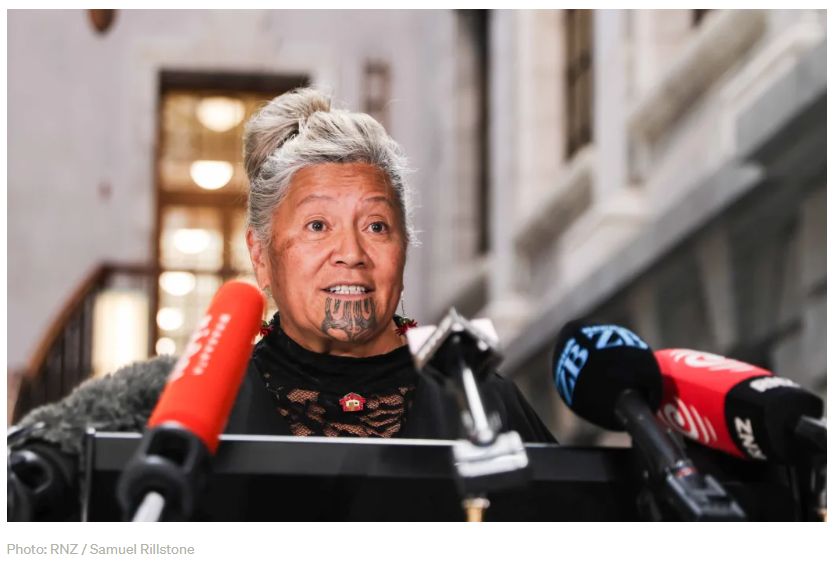
Tai Tokerau MP Mariameno Kapa-Kingi says she is still
waiting to learn what her reinstatement to Te Pāti Māori
will look like in practice, and there are still questions
over whether the party can be trusted by her rohe.
On
Tuesday, Kapa-Kingi was officially
reinstated to Te Pāti Māori after the High Court ruled
her suspension and subsequent expulsion was
unlawful.
Speaking to media for the first time
since her reinstatement, Kapa-Kingi said the court’s
decision was an important first step, but it would not heal
the hurt carried by her people.
“This moment is not
about personal vindication, it is about mokopuna. Mokopuna
in the sense that every decision I make is measured by
whether our mokopuna will inherit a better situation than
the one we have today.”
Te Tai Tonga MP Tākuta
Ferris, who was also expelled but had not been reinstated,
said Te Pāti Māori had a “huge job” to repair its
reputational damage.
Advertisement – scroll to continue reading
Kapa-Kingi said her legal
challenge was to ensure the voices of the people who elected
her were shown respect.
“Te Pāti Māori’s kawa exists
for a reason. They ensure respect for the authority and mana
motuhake of our individual electorates – that respect was
not afforded to the thousands of whānau in Te Tai Tokerau
who entrusted me with the responsibility to represent
them.
“The question remains whether Te Pāti Māori
can be trusted by my rohe, while no changes have been made
in the capability of the party beyond this term is debated
amongst te iwi Māori,” she said.
Kapa-Kingi said
there was no evidence she had misused funds or brought the
party into disrepute.
“Utu pursued with ill intent can
only attach where ill intent exists.”
She was
determined to stand again in Te Tai Tokerau, and said
running as an independent was possible despite her
reinstatement.
“There is a world that has that
potential possibility in it, yes.”
Asked whether she
had rejoined the party, she said she was “in the early
stages of what the detail of that actually looks
like”.
Te Pāti Māori co-leader Debbie Ngarewa-Packer
said the next steps would happen “behind closed doors, as
whānau,” and the party was focused on making sure it was
“credible in taking this government out.”
“I think
what we’ve shown is that we’re a real party and that
conflict doesn’t cancel us out.”
In his judgement,
Justice Paul Radich said the process had breached the
party’s “kawa” – rules, requirements and
protocols.
“To convene a meeting which would play a
fundamental part in determining Kapa-Kingi’s future with the
pāti without involving her, without giving any indication
that a resolution to suspend her was on the table, without
allowing her an opportunity for a substantive response, and
in the absence of the members of her electorate council,
could not on any view be seen, for example, as elevating and
enhancing relationships, as working together with respect,
as promoting whanaungatanga, as working for unity, as
developing an environment that nourishes wairua or that
reflects the attributes of rangatira,” Radich
wrote.
Kapa-Kingi had also sought to challenge the
re-appointment of John Tamihere as the party’s president,
but Justice Radich did not uphold that, saying there was “no
invalidity” in the process of Tamihere’s
re-election.
She said she had received contact to “get
together” with Tamihere and have a discussion, but she had
not had a chance as she was focused on nephew
Peeni Henare’s valedictory.
After Justice Radich
had released his decision, Kapa-Kingi posted on social media
that he had “brought justice” to Te Tai Tokerau
voters.
“Pursuing a legal pathway in the courts was
never my first choice. My intention in bringing this case
throughout was not to incite division, but seek clarity and
ensure that the processes we hold ourselves to –
particularly those grounded in tikanga, are honoured,” she
wrote.
Following Kapa-Kingi’s reinstatement, Te Pāti
Māori co-leader Rawiri Waititi said the party was looking
forward to “repatriating” Kapa-Kingi back in.
Te Tai
Tonga MP Tākuta Ferris, who was also expelled from Te Pāti
Māori, has not been reinstated as he did not challenge the
party’s decision. He will remain an independent MP for the
rest of the term, and intends to stand again in the seat as
an independent.
Speaking after Kapa-Kingi, Ferris said
the court had “put the truth out there” and iwi Māori would
be waiting to see how the party responded.
“The truth
is on display for everyone to see. The kaupapa of Te Pāti
Māori is a people movement, and it’s here to ensure that
the Māori view and Māori rights are looked after and
respected well in this House, and that’s the thing that
draws me to here.”
Ferris did not see a need to pursue
legal action, as Te Tai Tonga was happy with what he had
done and supported him.
“Te Tai Tonga invited Te Pāti
Māori to a hui, it wasn’t taken up, so the kaumatua of Te
Tai Tonga are clear about how Te Tai Tonga will
move.”
He said trust and confidence had been “eroded”
and the party’s reputational damage had been “sustained, and
it is going to be a huge job to rebuild it.”
Ferris
believed Tamihere had too much control over the party,
however, and suggested more distribution of power across a
broader base of rohe representation.
Asked whether he
wanted to be back in the party, Ferris said the ball was
“firmly in the court” of Te Pāti Māori, and nobody wanted
to be stuck in a to-and-fro
forever.
New Zealand’s public broadcaster, providing comprehensive NZ news and current affairs, specialist audio features and documentaries.
Radio New Zealand is a Crown entity established under the Radio New Zealand Act 1995. Radio New Zealand News are vital elements in our programming, providing impartial news and information to New Zealanders every day. Radio New Zealand (RNZ) provides listeners with exciting and independent radio programmes in accordance with the Radio New Zealand Charter.

