



Mark Rabago
RNZ Pacific CNMI correspondent
A
new US Census Bureau report projects significant population
declines in American Samoa, Guam, and the Northern Mariana
Islands by the end of the century, prompting calls for
greater political autonomy and decision-making powers for
American territories.
The report, released on 5
November, projects American Samoa will lose 61 percent of
its 2026 population by 2100, followed by Guam with 38
percent and the Northern Mariana Islands with 17
percent.
The US Virgin Islands is also expected to
lose 41 percent of its population over the same
period.
The Census Bureau attributes the projected
declines to falling birth rates and persistent outmigration,
with more people leaving than moving into the territories
since 2000.
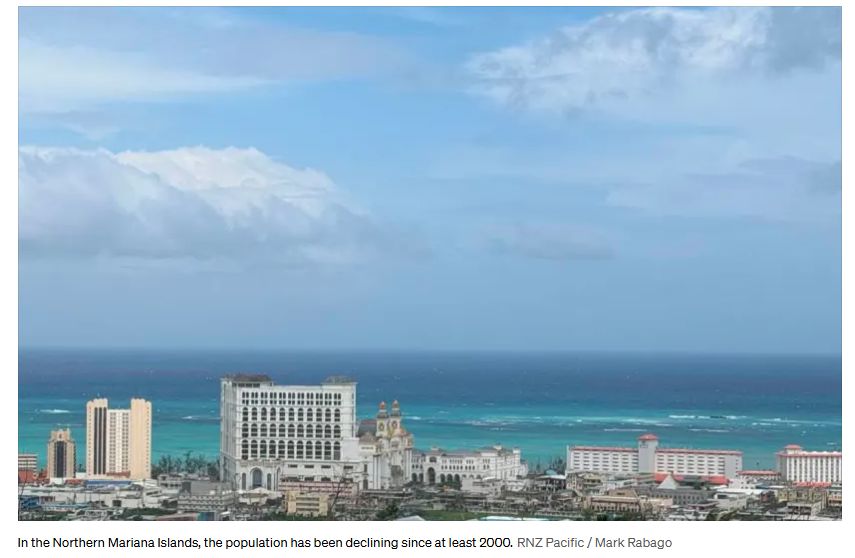
In the Northern Mariana Islands, the
population has been declining since at least 2000, while
American Samoa’s decline began around 2010. Guam’s
population is not projected to begin falling until
2030.
The report also found that fertility rates in
American Samoa and the Northern Mariana Islands have
experienced some of the steepest declines, with the latter’s
average number of children per woman falling from 3.3 in
2016 to 2.0 in 2026.
Right to Democracy, a nonprofit
organisation advocating for democracy, equity, and
self-determination in US territories, said the projections
highlight the consequences of the territories’ unequal
political relationship with Washington.
Advertisement – scroll to continue reading
Its
co-director, Adi Martínez-Román, described the findings as
a warning to territorial leaders.
“These Census
projections predicting a continued dramatic loss of
population in U.S. territories are a striking indictment
against the status quo relationship with the federal
government. Unilateral federal decision making does not
serve our interests,” she said.
“This report should be
a wake-up call to elected officials in U.S. territories to
demand a fundamental shift in the relationship with
Washington, otherwise this displacement will
continue.”
Fellow co-director Neil Weare said the lack
of political power was affecting the everyday lives of
territorial residents.
“No one should have to leave
their home and loved ones just to make ends meet or receive
the medical care they need,” he said.
The organisation
also expressed concern about proposed changes to U.S. Census
procedures, warning that they could further weaken the
collection of demographic data in the territories and among
their diaspora communities.
Martínez-Román said
federal agencies should improve data collection rather than
introduce changes that could further disadvantage
territorial populations.
Weare said the projected
declines would likely attract far greater national attention
if they involved US states.
“If these dramatic
population declines were predicted for any state, it would
be front page national news,” he said.
“The fact it is
not shows how the lack of political power contributes to the
invisibilization of our communities.”
The Census
Bureau said its projections reflect current demographic
trends and assumptions about future births, deaths, and
migration, rather than guaranteed population
outcomes.
The latest projections do not include Puerto
Rico, whose population declined by 11.8 percent between 2010
and
2020.
New Zealand’s public broadcaster, providing comprehensive NZ news and current affairs, specialist audio features and documentaries.
Radio New Zealand is a Crown entity established under the Radio New Zealand Act 1995. Radio New Zealand News are vital elements in our programming, providing impartial news and information to New Zealanders every day. Radio New Zealand (RNZ) provides listeners with exciting and independent radio programmes in accordance with the Radio New Zealand Charter.

