



Iliesa Tora
RNZ Pacific senior sports journalist
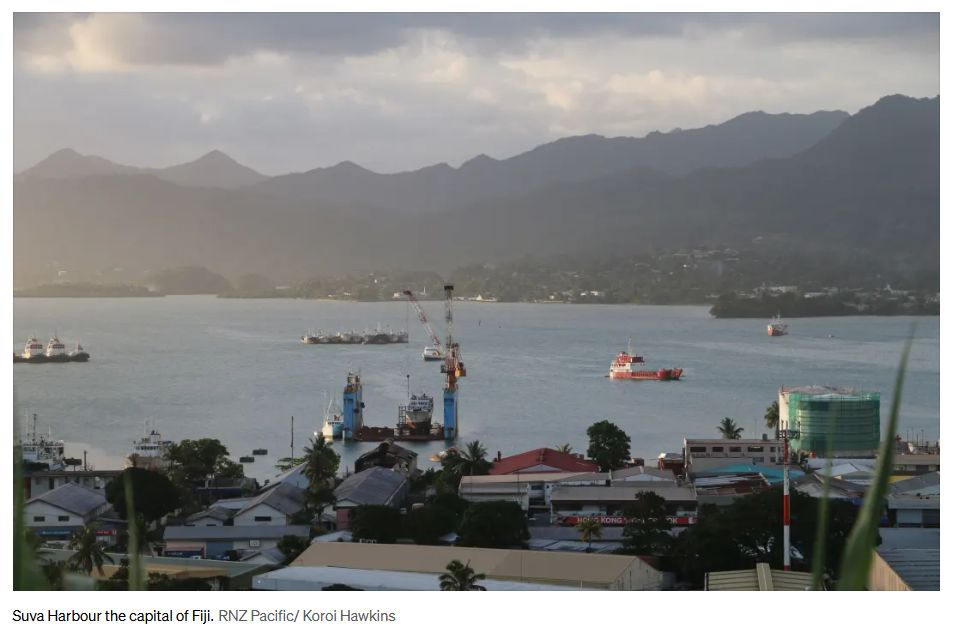
Fiji
and Tonga are exploring alternative fuel supply partnerships
to ensure their energy security needs are met.
Fijian
Foreign Affairs and External Trade Minister Sakiasi Ditoka
recently visited Malaysia and Korea and held discussions
with his counterparts in the two countries about possible
fuel supply partnerships.
He also met with
representatives of PETRONAS, Malaysia’s national oil and gas
company, which is wholly owned by the Malaysian
government.
The company manages Malaysia’s oil and gas
resources and operates across the entire energy value chain,
including exploration, production, refining, marketing, and
retail fuel sales.
He also discussed fuel supply and
renewable energy options while visiting Korea.
Ditoka
said he had held similar discussions in Singapore as
well.
Meanwhile, Tonga is also looking at fuel supply
security, with the government signing a feasibility study
agreement with Pacific Energy South West Pacific Limited,
which is funded by the United States Trade and Development
Agency (USTDA).
Prime Minister Lord Fatafehi Fakafanua
signed the agreement in Nuku’alofa last week.
Fiji’s
focus
Ditoka said Fiji had drawn several lessons from
the recent global fuel crisis, and there was a need to
strengthen resilience against future disruptions to
international supply chains, shipping routes and global
prices.
Advertisement – scroll to continue reading
He proposed a structured and formal
arrangement between Fiji and Malaysia to Malaysia’s Minister
for Investment, Trade and Industry, YB Datuk Seri Johari
Abdul Ghani, in Kuala Lumpur.
The proposed ‘Fuel
Security and Strategic Energy Resilience’ framework looks at
cooperation on fuel supply diversification, strategic
reserves and storage, supply-chain resilience, technical
cooperation, energy infrastructure and the transition
towards cleaner energy.
“Our experience has taught us
that energy security cannot be addressed only when a crisis
occurs,” Ditoka said.
“We need to build the systems,
partnerships and resilience that will prepare us for the
next disruption.”
In his meeting with PETRONAS
executives, Ditoka highlighted Fiji’s particular
vulnerability as a small island developing state dependent
on imported petroleum products.
He said that
disruptions to international shipping, rising freight costs
and congestion can have significant consequences for Fiji
and the wider Pacific.
He said they are hopeful that
Fiji can be considered within PETRONAS’ existing
arrangements for oil storage and stockpiling with
international partner countries.
“The recent global
fuel volatility and Middle East shipping disruptions have
underscored that small island developing nations cannot rely
solely on spot-market arrangements,” he
said.
“Securing Fiji’s energy supply chain is vital
not only for our 900,000 citizens but also for our maritime
neighbours, who rely on Fiji as a regional hub. Partnering
with a global energy leader like PETRONAS allows the
Coalition Government to build true long-term resilience for
Fiji and the wider Blue Pacific.”
Fiji supplies fuel
to Tonga and smaller Pacific island nations like Kiribati,
Nauru and Tuvalu.
Ditoka said for Fiji, the objective
is ensuring that fuel supply security is guranteed before
the next international crisis.
The current crisis
arose as a direct result of the war between Iran and the
United States of America, as Iran closed the Strait of
Hormuz, the shipping passage between Iran and Oman that
connects the Persian Gulf to the Gulf of Oman and the
Arabian Sea.
Around 20 percent of the world’s oil
trade and a significant share of liquefied natural gas (LNG)
exports normally pass through the Strait of Hormuz, from
major exporters such as Saudi Arabia, Iraq, Kuwait, Qatar,
and the UAE.
Ditoka said he is hopeful that Fiji’s
interest in being considered in Malaysia’s fuel stockpiling
and supply-security arrangements being developed with
Australia and New Zealand will come to reality,
He
added that the work now would be left to Fijian officials
following through with their Malaysian counterparts on the
technical details and determine what practical arrangements
may be possible.
In Korea, he said, the country’s
Minister of Foreign Affairs Cho Hyun was receptive to
discussions that Fiji and Korea should strengthen
cooperation towards maintaining stable and resilient supply
chains.
Ditoka said they were also able to discuss
tapping into Korean expertise in renewable energy, battery
storage, smart-grid technology and other areas that can help
Fiji progressively strengthen its energy independence and
resilience.
Tonga study
In Nuku’alofa, Lord
Fakafanua said the feasibility study would help determining
how Tonga’s fuel transport and storage infrastructure could
be modernised.
The study would assess options to
enable Tonga to receive larger medium-range fuel tankers
directly, reducing the need for costly fuel transhipment
through third countries and strengthening the island
kingdom’s fuel supply.
The proposed way forward for
Tonga would see the country’s fuel storage capacity
increased from 15-20 days of supply to 60 days.
Lord
Fakafanua said that would provide greater protection against
international supply disruptions and volatality in fuel
prices.
“This is an important investment in Tonga’s
long-term energy security,” he said.
“By increasing
storage capacity and improving fuel transportation
infrastructure, we are protecting our people and economy
from further external disruptions and putting in place
infrastructure that will serve Tonga for years to
come.
“Tonga welcomes partnerships that strengthen the
resilience of its existing energy supply.”
Tonga
currently gets it supplies via Fiji through Pacific Energy
and Total, with supply tankers visiting Nuku’alofa every
fortnight or in a 15-day cycle.
There were attempts in
2016-2017 for a local storage and supply depot with a bigger
capacity to be constructed in Nuku’alofa, that proposal put
forward by the International Bunker Supplies Limited of
Australia.
That proposal also included having Medium
Range Tankers (MR Tankers) servicing Tonga but it did not
received government approval until 2019 by which time the
company had withdrawn their interest.
MR Tankers are
used to transport refined petroleum products, including
Petrol (gasoline), Diesel, Jet fuel, Kerosene, Naphtha and
some chemicals and biofuels.
Tonga currently gets fuel
supplies through Local Coastal Tankers (LCTs) for the
Fiji-to-Tonga leg of the journey, usually originating from
Vuda in the West of Fiji’s main island Viti
Levu.
New Zealand’s public broadcaster, providing comprehensive NZ news and current affairs, specialist audio features and documentaries.
Radio New Zealand is a Crown entity established under the Radio New Zealand Act 1995. Radio New Zealand News are vital elements in our programming, providing impartial news and information to New Zealanders every day. Radio New Zealand (RNZ) provides listeners with exciting and independent radio programmes in accordance with the Radio New Zealand Charter.

