



Lillian
Hanly Political Reporter
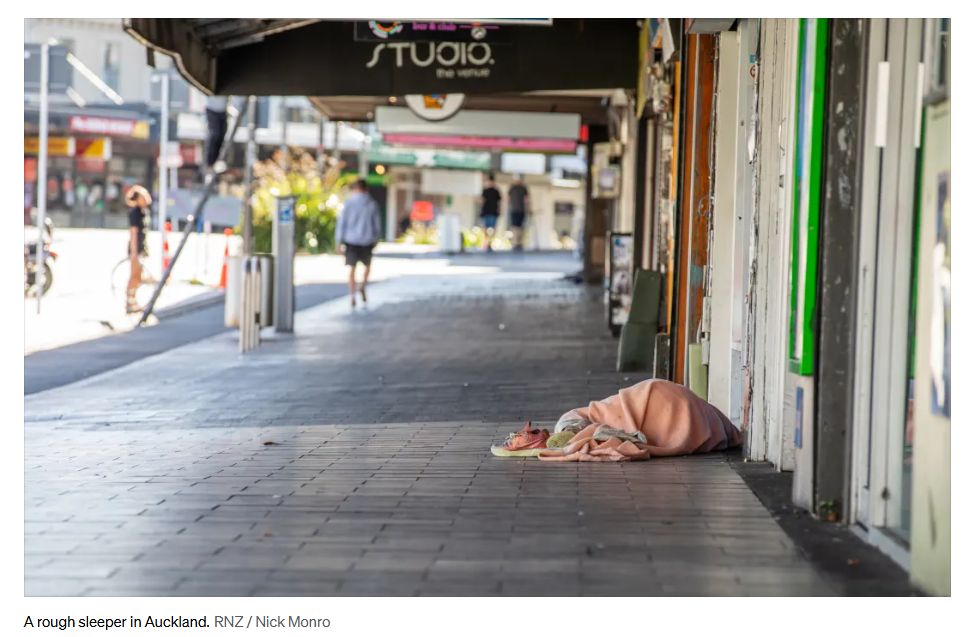
Weeks
before the government is set to give
police powers to move on rough sleepers, officials have
admitted to RNZ they can’t guarantee immediate shelter for
anyone on any given night.
Auckland City Missioner
Helen Robinson says she’s grateful it’s been “formally
acknowledged”, but is “deeply distressed” that’s the reality
in the country.
It comes as the largest provider of
the most immediate form of shelter tells RNZ it’s managing
with the resources it has, but demand is
“relentless”.
In June, it was reported that Ministry
of Social Development (MSD) managers had performance
measures related to reducing emergency housing numbers.
These measures have now been refocused to achieve
“sustainable housing”.
At the time, the prime minister
admitted he did
not know there was no night shelter in Auckland for
people sleeping rough.
Advertisement – scroll to continue reading
Since then, RNZ has attempted
to understand what shelter is available for someone who is
sleeping rough.
Over the past month, RNZ sought
clarification from both MSD and the Ministry for Cities,
Environment, Regions and Transport (MCERT) – which leads the
government’s overall programme of work to address rough
sleeping – to understand where exactly someone is supposed
to go if they need shelter immediately.
After multiple
requests, RNZ was finally told by MCERT “there is no
guarantee that shelter can be provided for every person in
every circumstance in every location”.
The agency said
access to accommodation was dependent on a range of factors
such as “an individual’s circumstances, location, service
capacity, and real-time availability of accommodation and
appropriate support”, all of which could change quickly it
said.
Robinson told RNZ she’d never had it formally
acknowledged there was no guarantee, “I am distressed and I
am calling for change.”
It comes as the government’s
move on orders legislation, which has received strong
opposition, are being progressed ahead of the
election.
The law would give police the power to order
people as young as 14 to move elsewhere or face a possible
jail sentence if they were being disorderly, begging or
rough sleeping.
It also comes following reports of rough
sleepers dying outdoors overnight, a man found
unresponsive in a Cuba Street doorway in Wellington and a
woman found unresponsive on New Brighton beach in
Christchurch. RNZ understands another rough sleeper died in
Auckland in July.
So for those who had nowhere else to
go, and may be told to move on, where exactly could they
go?
Understanding the current situation
As
recently as Sunday, the minister in charge of move on
orders, Paul Goldsmith told TVNZ’s Q+A there were
“resources available and places available for people
24/7”.
Emergency housing grants
are the government’s primary mechanism for providing
immediate shelter to people who have “nowhere else to go”
and “can’t stay where they are”.
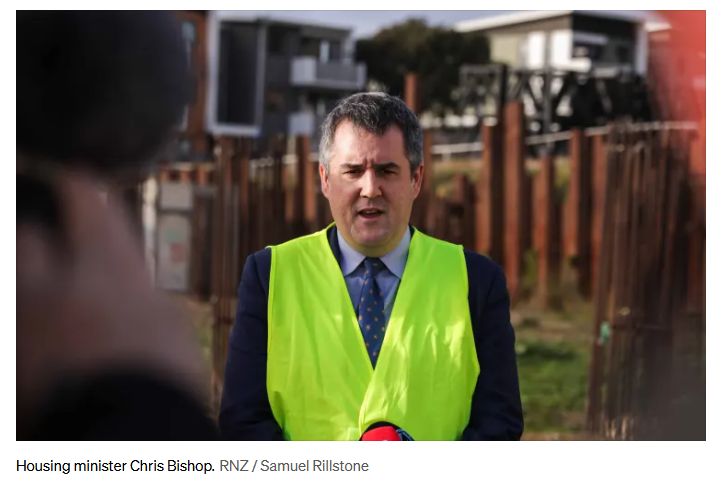
Housing Minister
Chris Bishop said
in July emergency housing still existed “because there
will always be people facing genuine housing
crises”.
“But now it’s being used as it was always
intended: as a temporary last resort.”
Housing
providers and social services have consistently said the
governments tightened emergency housing criteria has
resulted in an uptick in homelessness. That concern was
raised by RNZ as early as March last year, with Community
Housing Aotearoa chief executive Paul Gilberd saying again
this week there was a direct
link between the two.

As
recently as Thursday, Serena Moran – a nurse practitioner
and clinic lead at Te Aro Health Centre in Wellington – told
RNZ there’d been an increase
in rough sleepers she was treating, including people
being released from prison with no plans to continue
accessing antipsychotic medication.
She said the
reality most days was treating patients who may have been
assaulted and having nowhere to send them.
“I
basically have to say to them, ‘I’m sorry, I can’t find you
anywhere to stay tonight. You’ll need to go back to the
street. I’ll give you pain relief. I’ll try and make you
feel as comfortable as I can’.”
But ministers and MSD
have consistently maintained
that emergency housing remains available to anyone who
meets the criteria and has a “genuine need”.
Ministers
and MSD have also repeatedly said that people who did not
receive emergency housing could have their “needs met in
another way”, including through other housing
pathways.
Other options
include:
- transitional housing;
- social
housing; and - immediate access transitional
housing
But none of those pathways guaranteed a
person sleeping rough today would have somewhere safe to
sleep tonight, especially if the limited immediate access
transitional housing beds were full. There were only 65
nationwide.
Kāhui Tū Kaha provided the majority of
these beds and told RNZ it was managing with the resources
it had, but said the demand was “relentless”. It also
accepted referrals from police and hospitals
overnight.
On Thursday evening, it accepted an elderly
woman with physical access needs and a 17-year-old who had
both been sleeping on the street. It also accepted a woman
becoming homeless due to family violence, and a young woman
who police wanted separated from a violent
partner.
Kāhui Tū Kaha said things were tight but
“we’re constantly juggling”.
What
shelter is actually available tonight?
Over the past
month, RNZ asked MSD and MCERT multiple times what options
were available for someone sleeping on the streets to go
somewhere that night – more specifically, to get a bed under
a roof within 24 hours.
Through various responses and
phone calls, RNZ received the following
information.
RNZ was told that emergency housing “is
not necessarily the best option for rough sleepers” who may
have a range of complex needs and require additional
support.
MSD noted there were more outreach and
support services for rough sleepers announced in June by
associate housing minister Tama Potaka, and referenced the
additional
$14.5 million attached.
“Of those who approach MSD
for emergency housing, 89 percent receive either emergency
housing, transitional housing, help with a private rental,
or hardship assistance.”
In response, RNZ asked for
figures around the percentage of people who were declined
emergency housing and offered “some other form of
assistance”, specifically actual shelter tonight – noting
that someone could not sleep in a food grant, but an
official information act request was required, which has
since been made.
MSD also outlined that emergency
housing was intended as a last resort – despite earlier
stating it wasn’t the “best option”. Its service centre
hours were between 8:30am to 5pm Monday to Friday and 9:30am
to 5pm on Wednesdays.
It was possible for clients to
receive a short-term grant outside of service hours, to
“meet immediate housing needs until client can attend the
next available appointment”, but MSD wasn’t able to provide
the percentage of calls received outside hours and how many
of those were granted without an official information act
request, which has since been made.
Where possible MSD
would refer people with an urgent housing need to suitable
transitional housing or Housing First placements – these
were funded by MCERT and generally provided more support
than was available to someone in Emergency
Housing.
MCERT’s response clarified the different
housing pathways for those in need:
Housing
First
This supported people experiencing “chronic
homelessness” to access and remain in stable housing.
Support was available for as long as needed, but you had to
have been sleeping rough for at least 12 months over the
past three years to be considered. Those “new” to rough
sleeping weren’t elegible by definition.
The
government announced an additional 300 homes for Housing
First in 2025, following the concerns of increased
homelessness.
Transitional
housing
Transitional Housing offered “short-term,
temporary accommodation” for those who may be affected by a
change in circumstances. It also provided tailored support.
Emergency referrals could generally be accomodated
here.
However, MCERT confirmed the total number of
contracted transitional housing places had fallen since
2023, that’s despite increasing reliance on transitional
housing as an alternative to emergency housing.
It
said there were around 300 less places contracted in June
2026, compared to November 2023, reflecting the “planned
exit of higher-cost motel-based places, as well as routine
fluctuations associated with portfolio management”, MCERT
said.
As well, when existing transitional housing beds
were redesignated as “immediate access” beds from December
2025, MCERT did not specify those beds were replaced
elsewhere in the system.
Immediate access
transitional housing
This is the most immediate
option available, where contracted providers could
accommodate eligible households without the need to first go
through “standard MSD assessment and referral
processes”.
MCERT confirmed:
- there were
only 65 immediate access transitional housing beds
nationwide; - all 65 were in Auckland;
- only 20
were in central
Auckland
New Zealand’s public broadcaster, providing comprehensive NZ news and current affairs, specialist audio features and documentaries.
Radio New Zealand is a Crown entity established under the Radio New Zealand Act 1995. Radio New Zealand News are vital elements in our programming, providing impartial news and information to New Zealanders every day. Radio New Zealand (RNZ) provides listeners with exciting and independent radio programmes in accordance with the Radio New Zealand Charter.

