



Kate Newton
Climate Change Correspondent
The government has
quietly told officials to look into new climate policies to
help with a future shortfall in the country’s carbon
budgets.
The directive is included in a tranche of
documents about settings for the emissions trading
scheme, which the government proactively released on
Thursday.
The documents also confirm that transport,
industry and other sectors will have to pick up the slack
from removing agriculture from the emissions trading scheme
(ETS) for good.
In July, the Climate Change Commission
warned the countrywas
off-track for all its climate targets.
If the
government did not come up with new ways to save emissions
within the next year or two, the country would not be able
to meet some of its targets at all, the commission
warned.
“The time available to correct course is now
short,” it said.
Prior to the commission’s warning,
though, ministers had already given approval to officials to
start working on new policies.
The decision was
prompted by earlier warnings from the commission in 2025
that the country was off-track to meet its 2031-2035
emissions budget – the maximum amount of emissions the
country can produce over that period and still stay on track
for its 2050 climate targets.
Advertisement – scroll to continue reading
Officials said the gap
had grown further, after the government weakened
policies targeting agricultural emissions, including
cancelling a planned methane tax.
“Recent government
decisions on the 2050 methane target and the removal of
agricultural pricing have increased reliance on [other]
sectors to meet [the emissions budget] and increased the
size of the gap.”
In addition, officials wrote,
higher-than-expected agricultural emissions meant the
current emissions budget for 2026 to 2030 was also at risk,
unless other sectors reduced their emissions even
further.
“Additional options to support and encourage
emissions reduction and removals across major emitting
sectors will be needed.”
The government has repeatedly
said the ETS – which puts a price on carbon – is the
country’s main tool for driving down
emissions.
However, without agriculture, it only
covers about 40 percent of total greenhouse
gases.
“The ETS remains a major tool for meeting
emissions budgets, but it is not expected to meet [them] on
its own,” officials wrote.
They
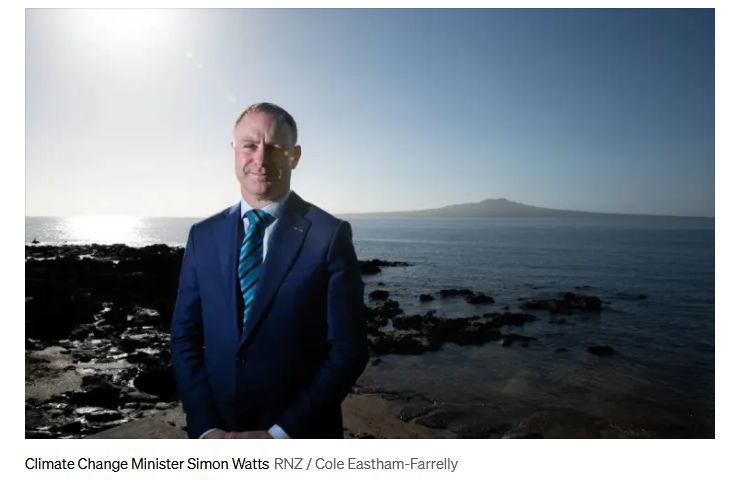
recommended that Climate Change Minister Simon Watts get his
colleagues to agree to “proactive development” of new
policies to bring emissions down.
“This would also
start to address the Commission’s advice that government
needs to act ahead of [the 2031-35 emissions
budget].”
In response, a Cabinet committee directed
officials “to identify and develop strategic options across
major emitting sectors to support meeting the third
emissions budget and to report back to the minister after
the 2026 general election”.
In a committee paper,
Watts told his colleagues that doing so could also help the
government’s “public climate change narrative” and speed up
its renewable energy plans.
It would also mean
ministers in the next government would have “detailed,
realistic and implementable options” when they started work
on the country’s next emissions reduction plan, due in
2029.
The government has until October to respond to
the Climate Change Commission’s July
advice.
New Zealand’s public broadcaster, providing comprehensive NZ news and current affairs, specialist audio features and documentaries.
Radio New Zealand is a Crown entity established under the Radio New Zealand Act 1995. Radio New Zealand News are vital elements in our programming, providing impartial news and information to New Zealanders every day. Radio New Zealand (RNZ) provides listeners with exciting and independent radio programmes in accordance with the Radio New Zealand Charter.

