



Nik Dirga
Digital Explainer Editor
Explainer: With
about two weeks until we decide who the next government will
be, New Zealanders still have questions.
A lot of
them.
As the election enters the home stretch and
early voting is about to begin, we take a look at the most
frequent questions being asked.
After a dive into some
analytics, we found 10 of the most common NZ election
questions being asked out there in cyberspace on Google,
Copilot and ChatGPT – and the answers.
When is
Election Day?
Saturday, 7 November… coming your way
before you know it.
What is an election?
There
are no stupid questions here.
An election is how we
choose our government, and we’ll be deciding if the current
National-led coalition will get a second term or if the
opposition led by Labour will form the next
government.
We’ll elect 120 members of Parliament (and
possibly more, if you start getting into overhangs, which
are a whole thing you can read about here).
How
can I enrol?
It’s easy and it’s free, and if you
haven’t done it yet, time
is running out.
Advertisement – scroll to continue reading
In case you missed it, the rules
this year have changed and there
will be NO enrolling in the early voting period or on
election day.
That means, if you haven’t enrolled
by midnight on Sunday, 25 October, you’re out of
luck.
How to enrol to vote:
“This weekend,
we’ll be at events around the country to help people enrol
or check their details. You can also drop off an enrolment
form at one of our hubs. Locations and hours are available
on vote.nz,” Chief Electoral Officer Karl Le Quesne told
RNZ.
Youth enrolment rates for those aged 18-24 are
particularly bad this year, so if you’re in
that demographic and on the fence, you’re almost out of
time before Sunday night’s deadline.
When
does voting start?
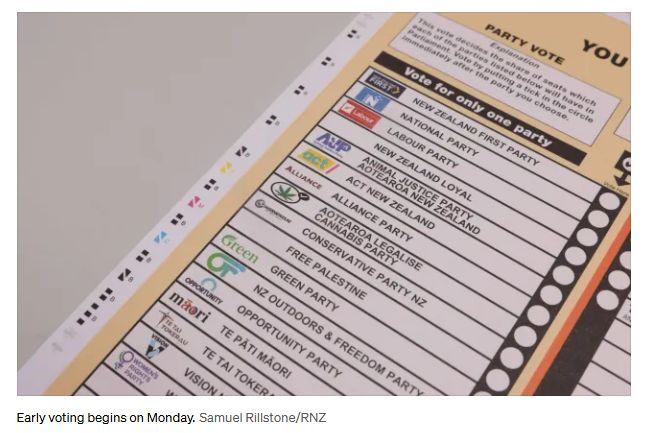
Early
voting kicks off on Monday, Labour Day, and 207
locations will be open on
the public holiday itself.
You can find your local
voting place details here. You can also call the
Electoral Commission on 0800 36 76 56 to find a polling
place.
Votes will be taken at a total of 2638
locations during the voting period.
Early voting then
continues right until election day, Saturday, 7 November,
when places will be open from 9am to 7pm.
How does
MMP work?
‘Mixed Member Proportional’ is New
Zealand’s system that allows you to vote for both local
electorate candidates and also whatever party you
support.
Read RNZ’s full explainer here on
just how MMP works and what it means for how our
election results will be determined.
What are the
main parties’ policies and how do they differ?
There
have been a flood of announcements by all the parties in the
last several weeks and it’s impossible to keep up.
If
you want to know the positions on cost of living, climate
change, health, AI or a heap of other topics, we’d suggest a
good place to start is RNZ’s handy-dandy policy guide, which
gathers up information the parties have announced.
You
can also find more about party positions on their official
websites.
Who are my candidates?
First, you
need to know what electorate you’re in. If you’re not sure,
you can check that through
the Electoral Commission website.
Once you know
your electorate, you can then find out who the candidates
are for
both general and Māori electorates through the
government’s website.
Who should I vote
for?
Look, we can’t make these decisions for you, but
a good place to start gathering information is a nonpartisan
websites like Policy.nz to see what your
local electorate candidates are saying about themselves. You
can look up the candidate info for every electorate
there.
And for broader party policies, RNZ’s guide as
linked above and the individual party websites are good
places to go as well.
How to vote in the NZ election
from overseas?
Overseas
voting began this week and will end at 7pm on election
day. Overseas voters who are enrolled can download
their voting papers from the Electoral Commission
website, fill them out and then upload them.
There are
also overseas voting places available – check
here to find out if there’s one near you.
Who is
most likely to win?
It’s really too close to call.
It’s been a tight race, but polls generally suggest National
and Labour’s support is cratering, while parties like the
Greens and NZ First are surging, and Opportunity remains the
wild card.
At this point, it’s pretty hard to predict
who could lead the next government.
RNZ-Reid
Research’s most
recent polling, released 6 October, had National at 25.9
percent support and Labour at 30.8 percent, with the Greens
at 14.8 percent, New Zealand First at 10.6 percent, ACT at 9
percent and hopeful newcomers to Parliament – Opportunity –
at 5.5 percent, while Te Pāti Māori sits at 2 percent in
the party vote.
Other polling has had similar results,
with National and Labour practically tied, when you start
factoring in the margin of error. The New Zealand
Herald’s most recent average of polls showed a near-tie
between the two major parties.
If National fails to
lead a government, it’ll be the first one-term National
government in New Zealand history, but if Chris Hipkins
brings Labour back to lead a government, he’ll be the first
prime minister with nonconsecutive terms, since Sir Keith
Holyoake was held office in 1957 and then again from
1960-72.
New Zealand’s public broadcaster, providing comprehensive NZ news and current affairs, specialist audio features and documentaries.
Radio New Zealand is a Crown entity established under the Radio New Zealand Act 1995. Radio New Zealand News are vital elements in our programming, providing impartial news and information to New Zealanders every day. Radio New Zealand (RNZ) provides listeners with exciting and independent radio programmes in accordance with the Radio New Zealand Charter.

