



Monique
Steele Journalist
In
the heart of dairy country in Waikato, politicians have gone
head-to-head on issues affecting rural New Zealand to vie
for the farmer vote.
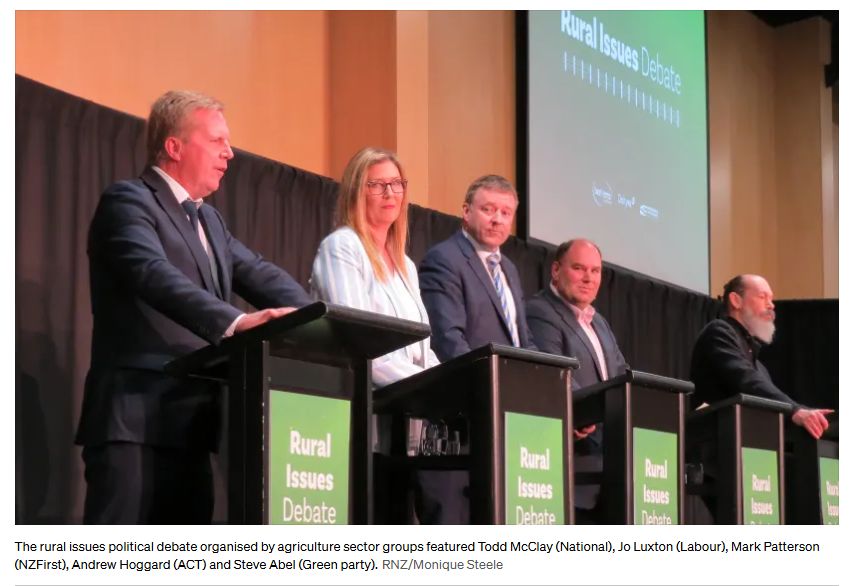
Representatives from five major
parties pitched
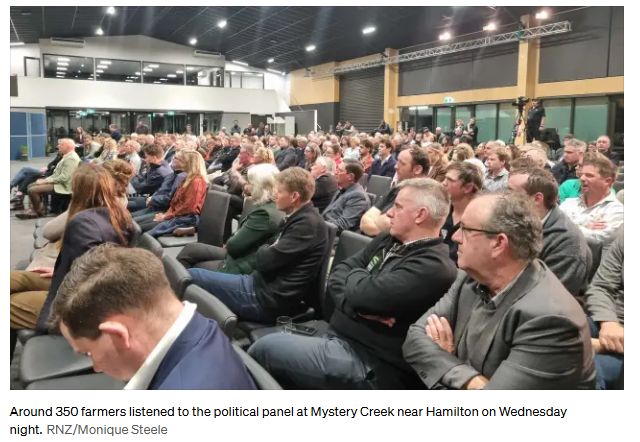
their agricultural, fiscal and environmental policies to
around 350 farmers at Mystery Creek near Hamilton on
Wednesday.
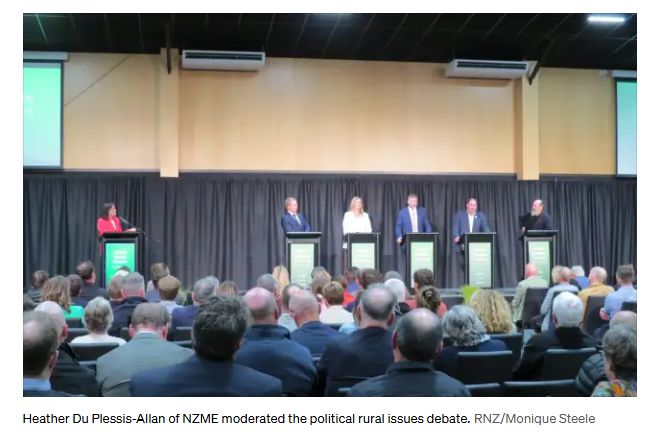
Industry groups Beef and Lamb New Zealand,
Dairy NZ and Federated Farmers organised the rural
issues debate ahead of next month’s election.
It
featured representatives from National, Labour, ACT, New
Zealand First and the Greens, but neither Te Pāti Māori
nor the Opportunities Party.
Agriculture, forestry
and the ‘distorted’ ETS?
A hot topic was the Emissions
Trading Scheme (ETS) that enabled the carbon farming
regime and offsetting greenhouse gas emissions.
Advertisement – scroll to continue reading
Last
month, the Parliamentary Commissioner for the Environment
Simon Upton said the “complicated” role of forestry in the
“essentially rudderless” scheme and climate mitigation
policy generally needed re-imagining.
The scheme
was also under fire by many farmers concerned about the
loss of productive farmland to forestry.
But Todd
McClay of National said the Government had improved policy
settings to protect productive farmland classes, while
respecting property rights.
“This isn’t a fight
between trees and farming,” he said.
“It’s about
making sure that one people have choice but that a
government decision which ends up being a subsidy to grow
trees from the carbon market doesn’t change the nature of
their decisions.”
He said it had worked to limit new
farm-to-forest conversions.
“It’s the first full year
that the sale of valuable farmland for conversion to trees
has stopped,” he said.
“There will be still some
legacy where they’ve got a few years to plant.”
McClay
said it will also later review the work to ensure it was
working.
Labour committed to developing new rules to
limit full farm-to-forest conversions at the
debate.
Its agriculture spokesperson, Jo Luxton, said
it wanted to review the ETS and forestry’s role in
it.
“We will do an urgent review into the ETS because
we want to disincentivise planting pine trees just in that
capacity,” she said.
The Green Party’s agriculture
spokesperson Steve Abel said it would price agricultural
emissions under the scheme, if elected.
“We’re the
only ones who are going to make the ETS work by taking
forestry out of it entirely, so we don’t get the distortion
that we’ve currently got and the workaround that this
Government’s tried to do which is not sufficient to actually
solve the problem.”
NZ ETS carbon auctions have failed
to sell any carbon units since December 2024, as of the last
auction last month.
Taxes and investments
At
the debate, National committed to no
new taxes for farmers, as did Labour and ACT.
The
coalition Government removed agriculture from the ETS and
abandoned industry emissions plan He Waka Eke
Noa.
Meanwhile, Labour’s Luxton confirmed that farms
would not
be subject to a capital gains tax.
“It is a
simple, targeted capital gains tax on commercial property
and investment properties.”
Mark Patterson of New
Zealand First said the pre-election campaign featured a lot
about tax.
“New
Zealand First is the only party that’s not talking about
tax, we’re talking about an economic plan, how we’re going
to actually turbocharge and grow the pie,” he
said.
“That’s what dropping the company tax rate is
about, to drive the engine room of our economy, those small
and medium sized businesses.
He said it would
establish a sovereign wealth fund towards the country’s
long-term economic plan, and push for continued momentum
with the Regional
Infrastructure Fund.
“So we’re not just having to
try to cut our way to prosperity, we’re going to
invest.”
Abel said the Greens’ wealth,
corporate and inheritance taxes would only affect a
small number of New Zealanders.
“The 46,000 farms in
New Zealand, it will touch 2 percent of those farms, so
those big corporate farms will be touched by [the wealth
tax],” he said.
“Our capital acquisitions tax is only
on inheritance over $1 million, excluding the family farm
and the family home.”
The Greens would also establish
a $150 million Fair Food Fund to expand community-led food
security initiatives.
Freshwater quality
bottomlines
Luxton said it would take its National
Policy Statement for Freshwater Management 2020 rules to
select committee for further refining.
“We will be a
very different Labour Party than we were three years ago.
We’ve listened, we’ve acted, we’ve learned,” she
said.
“We want to ensure that we have absolutely
thriving rural communities, profitable farms, and we want to
ensure that we have environmentally sustainable standards as
well.”
Andrew Hoggard of the ACT Party said the party
wanted catchment-specific freshwater targets, as did the
Greens.
“We’ve got to look at each catchment and be
going what is the starting point,” Hoggard
said.
“We’ve got to ask the question, ‘do we want
farming? Do we want towns? Do we want cities; industry
working in these catchments?
“These are the things
we’ve got to have a methodology around,” he said.
Abel
said regulators needed to set reasonable perimeters for
activities in each catchment.
“It is not for the
government to tell farmers what they can do on their farm,”
he said.
“But it is to set the parameters around which
how we protect our fresh water, how we protect our ground
water, how we protect our drinking water.”
The Greens
also proposed lowering the cap for the use of synthetic
nitrogen fertilisers on dairy farms only, from 190 kilograms
per hectare at present to 125kgs/ha.
“We have to
manage the stocking rates of dairy cows in certain
catchments,” Abel said.
“Frankly, there’s lots of
parts of Southland where there should be a heck of a lot
fewer cows.”
Furthermore to environmental reasons,
Patterson also admitted the party killed the Gene Technology
Bill, due to concerns around trade market access in losing
the genetic engineering-free status and the ability to
co-exist.
A plan for wilding pines
ACT’s
Hoggard said a national pest management plan for wilding
conifer pine trees was a key mechanism the Government
had to control them.
“In terms of wilding pines, we
would put in place a national pest management plan, that is
what we announced.
“That is the key thing that
provides certainty around funding and for the actions and
the rules that are needed to provide stability for that
programme. That’s a key mechanism the government’s got,” he
said.
“So that would be a definite focus of mine if I
was returned as Biosecurity Minister to make sure that’s put
in place in the next term.”
One of the few points of
consensus was increasing funding for the QEII
Trust.
New Zealand’s public broadcaster, providing comprehensive NZ news and current affairs, specialist audio features and documentaries.
Radio New Zealand is a Crown entity established under the Radio New Zealand Act 1995. Radio New Zealand News are vital elements in our programming, providing impartial news and information to New Zealanders every day. Radio New Zealand (RNZ) provides listeners with exciting and independent radio programmes in accordance with the Radio New Zealand Charter.

