

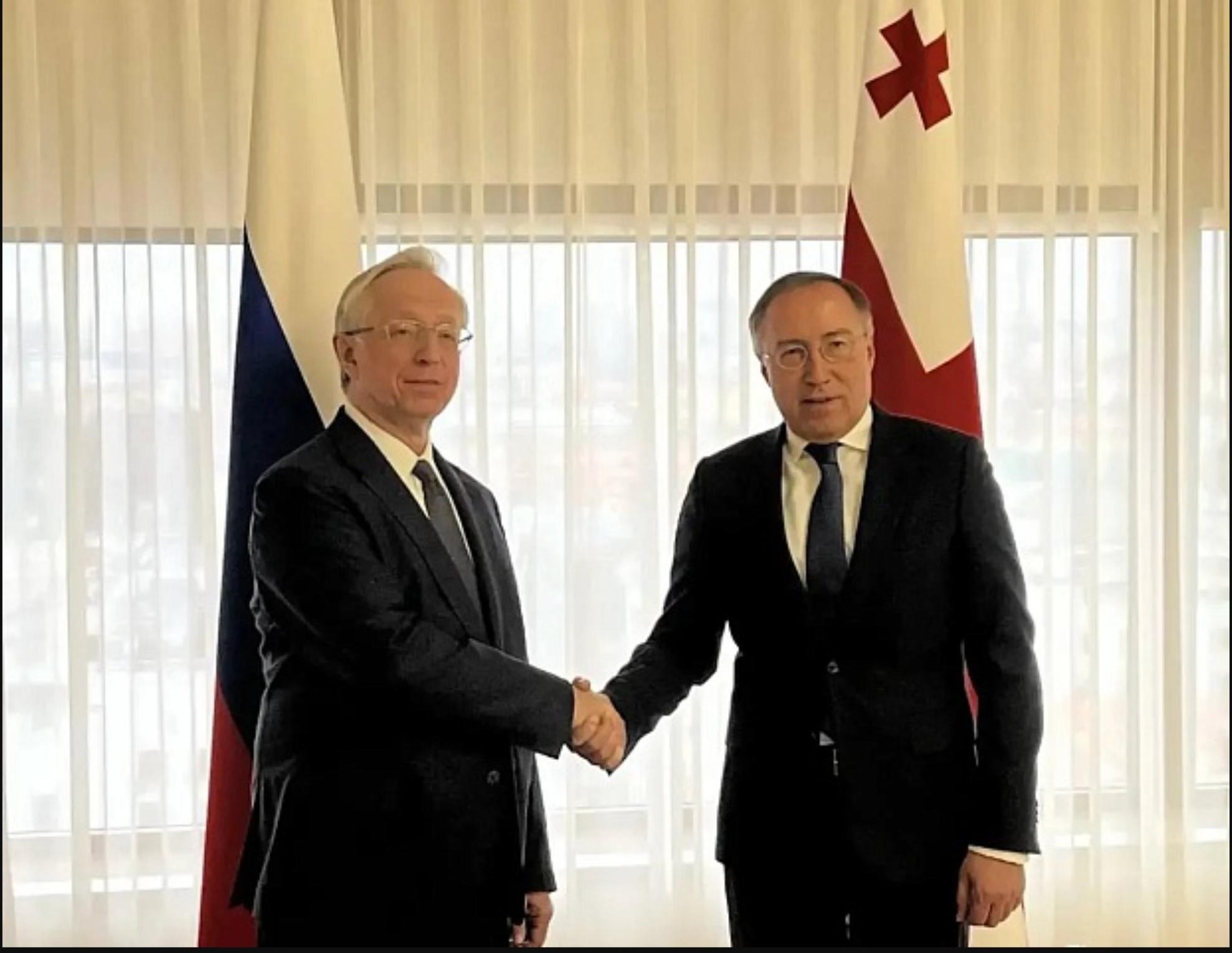
Giorgi Zurabashvili, Georgia’s first deputy foreign minister and the prime minister’s recently appointed special representative for relations with Russia, met Russian Deputy Foreign Minister Mikhail Galuzin in Minsk, Belarus, on 19 November, in their first meeting under what Moscow called a “resumed direct Russia–Georgia dialogue”. The Georgian government says diplomatic relations cannot be restored while Russia occupies Georgian territory, while opposition politicians and former diplomats say the talks signal a shift in policy.
Key points
- The Russian Foreign Ministry said the talks covered current bilateral issues, with a focus on trade, economic, cultural and humanitarian cooperation, that “a number of practical agreements” were reached and that regional security was also discussed.
- Both delegations thanked Belarus for helping organise the meeting, and agreed to maintain contacts.
- Prime Minister Irakli Kobakhidze has ruled out restoring diplomatic relations while Russia occupies Georgian territories and recognises Abkhazia and Tskhinvali/South Ossetia as independent states.
- Critics point to the change of venue to Minsk and the wording of the post’s mandate as signs of an upgrade in relations.
Background: the special representative format
The post of special representative was set up as part of the informal direct dialogue between Georgia and Russia launched in late 2012, known as the Abashidze–Karasin format. It was designed to address trade, economic, humanitarian and cultural issues, because diplomatic relations have been severed since the 2008 war, amid Russia’s continued occupation of Georgian territories and its recognition of the two regions as independent states. Meetings have traditionally been held in Prague.
Kobakhidze appointed Zurabashvili as special representative on 21 October, filling a post that had been vacant since December 2025. Zurabashvili kept his job as first deputy foreign minister, which required Parliament to pass legislative amendments in October. He replaced Giorgi Kajaia, who held the post from March 2024, and Kajaia had succeeded Zurab Abashidze, who served from 2012.
The Russian Foreign Ministry said in November that Galuzin would be Zurabashvili’s counterpart and described the development as a resumption of the dialogue launched in 2012. It said it sees the promotion of people-to-people contacts, trade and economic cooperation, tourism, transport links and cultural projects as the priorities of the channel.
The government’s position
On 16 November, Kobakhidze said there is a natural obstacle to restoring diplomatic relations, namely the occupation of Georgian territories and Russia’s recognition of the two regions as independent states, and that the government’s position remained unchanged. He said Zurabashvili represents Georgia in relations with Russia in his capacity as special representative. Foreign Minister Maka Botchorishvili has said it is impossible to speak about restoring or normalising relations under occupation, and Parliament Speaker Shalva Papuashvili has said the only obstacle is the occupation. After the Minsk meeting, Botchorishvili said there is nothing dangerous about dialogue with Russia.
Kobakhidze’s remarks when presenting the new representative also left some professionals with the impression that the post’s mandate had widened to include what he described as the peaceful resolution of the conflict with Russia.
Criticism from the opposition and former diplomats
The Diplomatic Society of Georgia, which brings together former and career diplomats critical of Georgian Dream, said on 19 November that the new post and the choice of Minsk showed another clear shift in foreign policy. It said talks with an occupying state, without international mediators and in the capital of a Russian ally, are a political choice and not a technical one, and that the dialogue serves to normalise relations on Russia’s terms rather than to secure the de-occupation of Georgian territories.
Nika Gvaramia, a leader of the opposition Coalition for Change, said the meeting formalised previously covert channels of communication with Russia and amounted to restoring diplomatic relations. Grigol Gegelia, leader of Strong Georgia, said formats that put Georgia alone face-to-face with Russia are neither appropriate nor justified given national security interests. Imprisoned United National Movement leader Levan Khabeishvili called the meeting a betrayal.
The venue and the Geneva talks
Moscow has repeatedly called since 2022 for the Geneva International Discussions, the internationally chaired forum on the consequences of the 2008 war, to be moved away from Switzerland. Critics see the choice of Minsk for the bilateral talks as part of a similar shift away from Western venues.
What happens next
Both sides said they would maintain contacts. This article will be updated if the Georgian government releases further details of the Minsk talks.
Read more: More Georgia news

