

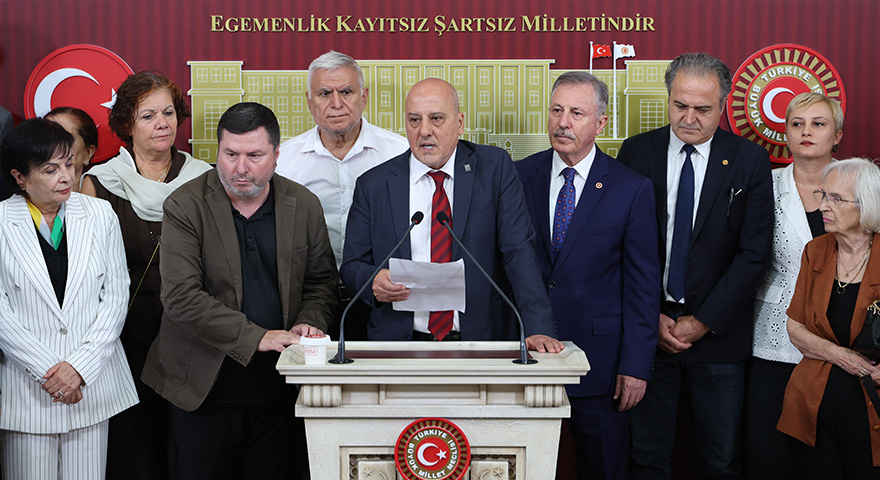
A group of lawmakers from several Turkish opposition parties has rallied against the “isolation” of Georgia’s occupied Abkhazia region, calling on Ankara to accept travel documents issued by Sokhumi’s de facto authorities, and to establish direct sea and air links between Turkey and the region.
The calls, which follow a broader campaign — “End the Isolation of Abkhazia” — led by the local Abkhaz diaspora, were voiced at an August 5 press conference in the Turkish Grand National Assembly, the country’s legislative body. Turkey is known to host the largest Abkhaz diaspora group, with some sources estimating their number at around half a million.
According to the press release of the Turkish parliament, the press conference featured MPs from at least seven parties, including New Party (Yeni Parti), Peoples’ Equality and Democracy Party (DEM Parti), Workers’ Party of Turkey (TİP), Labor Party (EMEP), as well as Felicity Party (Saadet Partisi), Democracy and Progress Party (DEVA) and the Future Party (Gelecek Partisi), with the latter three united in the New Path (Yeni Yol) party/parliamentary group.
Local Abkhaz media also reported a representative of an eighth force, New Welfare Party (Yeniden Refah Partisi), to be present at the press conference.
The address was made by Ahmet Şık, Istanbul MP of the Workers’ Party of Turkey (TİP), who, according to the official press release, called to accept “Abkhaz passports as a valid identity and travel document at Turkey’s borders,” and to establish “direct sea and air links” with Abkhazia.
The MP was quoted as saying that Abkhazia is “in an isolated state,” including owing to Turkey’s efforts, noting that “the humanitarian, cultural and commercial relations between the two countries have remained far behind their real potential.”
The current mandates held by the listed parties comprise around a third of the 600-member parliament (with currently occupied 592 mandates).
Turkey recognizes Georgia’s territorial integrity, and there have been no reports of Turkish officials reconsidering the stance. Neither Ankara nor Tbilisi has officially commented on the lawmakers’ calls.
The press conference followed separate calls by the representatives of some of these parties, which cited the need to ensure access of Abkhaz residents to rights to health, freedom of movement, and education, among others.
Late in July, MP Selçuk Özdağ, a Deputy Chairman of the New Path (Yeni Yol), suggested, among others, introducing a “special” travel regime for Abkhaz residents without the policy affecting Turkey’s official stance towards the recognition, offering to hold consultations with Tbilisi as well as establishing international frameworks to discuss such matters, among others. Speaking at a press conference, the MP raised concerns over Abkhazia’s dependence on Russia, including in terms of international travel.
A similar statement was made by the Labor Party (EMEP) on July 4.
Commenting on the campaign in an August 10 statement, Abkhazia’s de facto foreign ministry said Sokhumi has “for many years” raised the issue of recognizing Abkhaz passports and travel documents as part of Geneva International Discussions.
“For us, the recognition of the documents of our state is part of the crucial task of achieving broader international recognition of the independence of the Republic of Abkhazia and establishing full-fledged economic, humanitarian, and cultural ties with other states. Therefore, we view any steps that contribute to achieving this goal exclusively positively,” the de facto ministry said.
Georgia’s occupied regions of Abkhazia and Tskhinvali/South Ossetia have faced isolation amid a lack of international recognition, with one of the few countries recognizing them as independent states – Nauru – recently also withdrawing the recognition.
Ensuring access to health, education, and mobility has been part of the confidence-building policies led by Tbilisi for many years, including Tbilisi introducing in 2011 the so-called “status-neutral” passports to the residents of the two regions. The initiative, however, has hit opposition from Moscow and the de facto authorities of the two regions, including since the documents, even if assuring status neutrality, are still issued by the Georgian state.
A vast majority of the residents of Abkhazia and Tskhinvali/South Ossetia regions are known to rely on Russian passports for international travel.
Also Read:

