

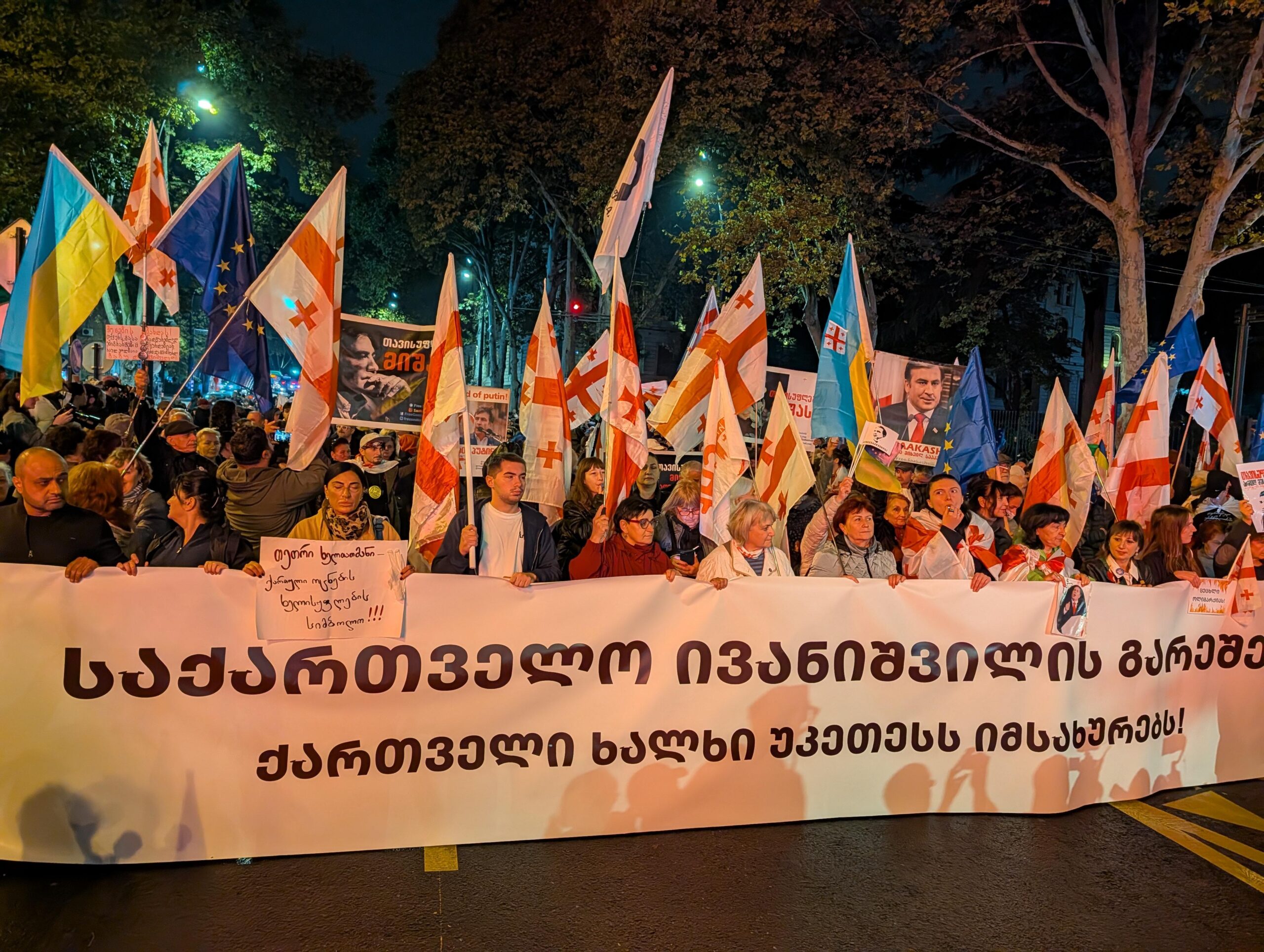
An opposition-led march under the slogan “Georgia without Ivanishvili. Georgia deserves better” took place in Tbilisi on 25 October, launching a protest campaign set to culminate in a larger demonstration on 28 November. It comes as Georgia’s Constitutional Court hears a lawsuit, brought by ruling Georgian Dream MPs, seeking to ban five opposition parties.
Key points
- The Opposition Alliance, a coalition of nine parties formed in March 2026, organised the 25 October march.
- The campaign is set to culminate in a rally on 28 November, the second anniversary of the protests that followed Georgian Dream’s announcement that it was suspending EU integration efforts.
- The Constitutional Court is hearing a lawsuit filed by 88 Georgian Dream MPs seeking to ban five opposition parties. Hearings were scheduled to resume on 26 October.
- The court must rule by June 2027, and its decision is final.
What happened at the rally
Marchers set off from the first building of Tbilisi State University on Chavchavadze Avenue and walked to Rustaveli Metro Station, where opposition politicians addressed the crowd. The organisers invited protesters to join the wider campaign.
- Levan Tsutskiridze, leader of Freedom Square, a party not yet named in the lawsuit, urged people to stand by the political parties, saying the change they want will be impossible without stronger parties.
- Tamar Chergoleishvili, leader of the Federalist Party, which is named in the lawsuit, said Bidzina Ivanishvili was admitting a crisis of legitimacy by banning the alternative and that he feared the free choice of the Georgian people.
- Nika Gvaramia, leader of Coalition for Change, called 28 November a “significant peak day” and said the parties would contest the case in the courtroom, on the streets and in the media.
The lawsuit and how it has grown
Georgian Dream filed the constitutional lawsuit in October 2025, seeking to outlaw the United National Movement (UNM), Lelo/Strong Georgia and Ahali/Coalition for Change. It was expanded in April 2026 to include the Federalist Party, and again in September to add For Georgia, the only opposition party still represented in Parliament. Each expansion required Georgian Dream to resubmit the lawsuit, which reset the court’s nine-month deadline for a ruling.
The seven-judge Constitutional Court plenum held three days of hearings from 21 to 23 October in Batumi. It rejected For Georgia’s request to postpone the proceedings by a month, and, according to Civil.ge, turned down every motion the opposition parties presented.
Georgian Dream’s position
The claimants argue that the five parties violated Article 23 of the Constitution, which prohibits parties that aim to overthrow or forcibly change the constitutional order, and they also point to the parties’ refusal to recognise Georgian Dream’s legitimacy, JAMnews reported.
Georgian Dream describes the case as a lawful constitutional process. Reuters reported that the party says it is protecting the country from opposition figures it accuses of trying to seize power and provoke a catastrophic war with Russia. Georgia’s Foreign Ministry said that EU officials questioning the proceedings before a ruling amounted to undue pressure on a constitutional institution and interference in Georgia’s internal affairs.
The opposition and international response
The five parties reject the accusations and describe the case as politically motivated. Civil society groups quoted by Reuters say the lawsuit points toward one-party rule, and Reuters reported that rights groups and the European Union have condemned it. On 8 October, the European Parliament adopted a resolution, by 445 votes to 37, condemning the attempts to ban opposition parties and demanding that the lawsuit be withdrawn. Georgian Dream Secretary General Kakha Kaladze responded that European Parliament resolutions have no value.
The case follows the 2024 parliamentary elections, which Georgian Dream won and which the opposition says were rigged.
What happens next
The court has until June 2027 to rule, and its decision cannot be appealed in Georgia. If it upholds the lawsuit, the five parties would legally cease to exist. The next major date in the protest campaign is the 28 November rally.
Read more: More Georgia news

