

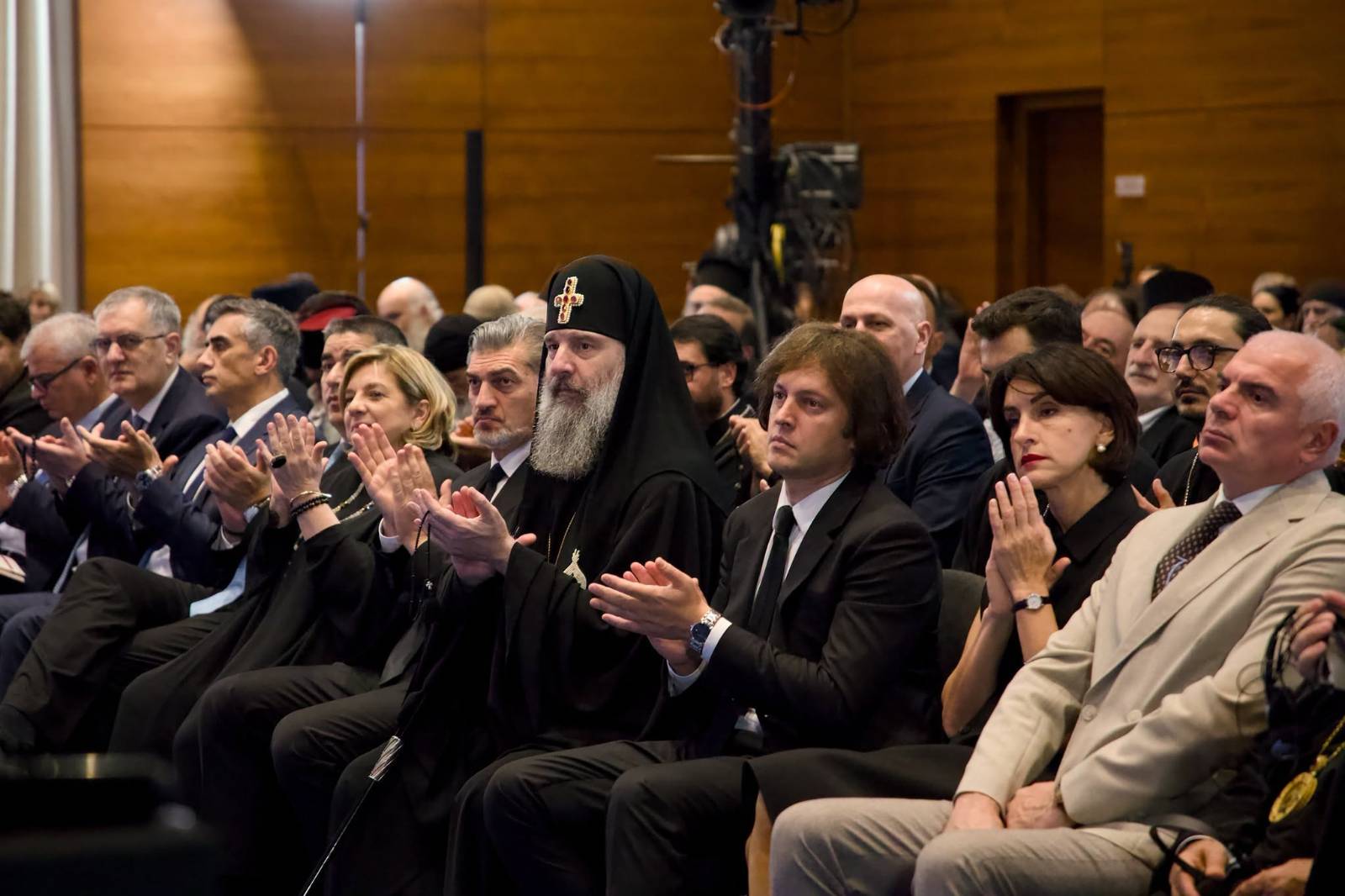
Georgian Dream officials, Orthodox clergy, academics, and foreign church delegations gathered on October 11 for the opening ceremony of the international symposium “God, Homeland, Human Being,” dedicated to the 1,700th anniversary of Georgia’s adoption of Christianity.
The symposium, which will last for several days and cover thematic sessions involving scientists, historians, theologians, and clergy, is dedicated to “promoting a deeper understanding of Georgia’s Christian heritage and its historical, cultural, and spiritual significance, as well as to highlighting Georgia’s role in the development of world civilization,” according to the Georgian Orthodox Church Patriarchate.
“God, Homeland, Human Being” was a line introduced by the late Patriarch Ilia II, who articulated these three values as expanding on the famous earlier triad — “Fatherland, Language, Faith” — from the revered 19th-century Georgian public figure and writer Ilia Chavchavadze. Chavchavadze’s triad is often regarded as a basis of Georgian national consolidation under Russian imperial rule.
Patriarch Shio III delivered the opening remarks, followed by speeches by Georgian Dream Prime Minister Irakli Kobakhidze, Georgian Dream-elected President Mikheil Kavelashvili, and Parliament Speaker Shalva Papuashvili. The event was chaired by Roin Metreveli, president of the Georgian National Academy of Sciences.
Patriarch Shio III on Faith, Technology, and National Unity
In his opening address, Shio III described “God, Homeland, Human Being” as “the three main pillars that reflect our centuries-old spiritual and national path,” emphasizing Christianity’s historical contribution to Georgian culture and the responsibilities facing society today.
“Christianity gave the Georgian nation the strength to create that utterly unique spiritual and cultural world, which made our country a precious pearl of the common Christian civilization,” he said.
Reflecting on modern challenges, the Patriarch cautioned against letting technology overshadow spirituality, saying that “technology should serve humans, not the other way around,” and noting that “knowledge must not distance us from faith; progress must not make us forget spirituality.”
He added that modern science and technology offer significant opportunities but also demand responsibility, warning against the risk that “false values and ideologies” must not cause the people to “lose free will, love, the capacity for compassion, humility, and conscience.”
“Times change, but the calling of a Christian is unchanging: to labor and live in faith in the Lord, with love and devotion toward God and neighbor,” he said.
Shio III also paid tribute to Ilia II, saying that his legacy demonstrated “the grace and strength of the continuity of apostolic labor, of faith turned into deed, of devotion to the homeland, and of love for people.”
Turning to Georgia’s occupied territories, he said that “our thoughts and prayers are directed especially to the people living in Abkhazia and the Tskhinvali region.”
The Patriarch also addressed Georgians living abroad, describing them as “precious children of our nation and Church” and expressing hope that “they preserve their faith and their bond with the Church and the homeland. We always pray for them and await them.”
Kavelashvili Presents Seven-Value Formula
Kavelashvili, who spoke after the Patriarch, expanded on the two national-value formulations, presenting a seven-part formula comprising “God, Homeland, Human Being, Fatherland, Language, Faith, Family.”
“This unique seven-component formula, which is rooted in the 19th-century national triad of Saint Ilia the Righteous [Ilia Chavchavadze] and the spiritual legacy of His Holiness Ilia II, transcends the boundaries of time and space and organically brings together the centuries-old tradition of Georgian national thought, including such supreme pinnacles of the Georgian intellect and spirit as the immortal legacy of Shota Rustaveli and Vazha-Pshavela,” Kavelashvili said.
He said we live in an age of globalization, in which “artificial intelligence seeks to devalue human identity.” In his view, the “eternal values” he listed are “our foremost existential shield.” He added that “Georgian youth raised in accordance with these ideals are the guarantee that our society will be far more secure, progressive, morally resilient and empathetic.”
Kobakhidze Pledges Close Cooperation with Church
Kobakhidze took the podium next, emphasizing the role of the Georgian Orthodox Church in the country’s history and the relationship between Christian values and the development of the modern Georgian state.
“For centuries, the Mother Church has been the spiritual pillar of our country,” he said, describing Ilia II’s contribution as “exceptional” in ensuring that Christian values underpinned the building of an independent state and the spiritual unity of the nation.
“In close cooperation with the Church, we will firmly protect the heritage upon which our national unity and development are based,” he said. “It is applaudable that the international symposium is being held precisely on this theme and aims to comprehend the interconnection between these values and their significance in modern life.”
Papuashvili Stresses Identity as the Basis of Statehood
Papuashvili spoke last, dwelling on Christianity’s role in preserving Georgian identity through periods when the country lost its statehood.
“Today, a state’s might is measured by its economic, technological, and military strength. But history has an entirely different measure. Only those states endure through the centuries that preserve their own identity. This is precisely one of the greatest lessons of our history: one may lose statehood temporarily, but if a nation preserves its own identity, the possibility of restoring the state remains,” he said.
He concluded that “the 1,700th anniversary is not merely a jubilee marking a milestone in the Church’s history. It is also a milestone in the cultural biography of the Georgian state and a symbol of national continuity. It is a day to remember our shared past and reflect on our responsibility towards the future.”
Also Read:

