

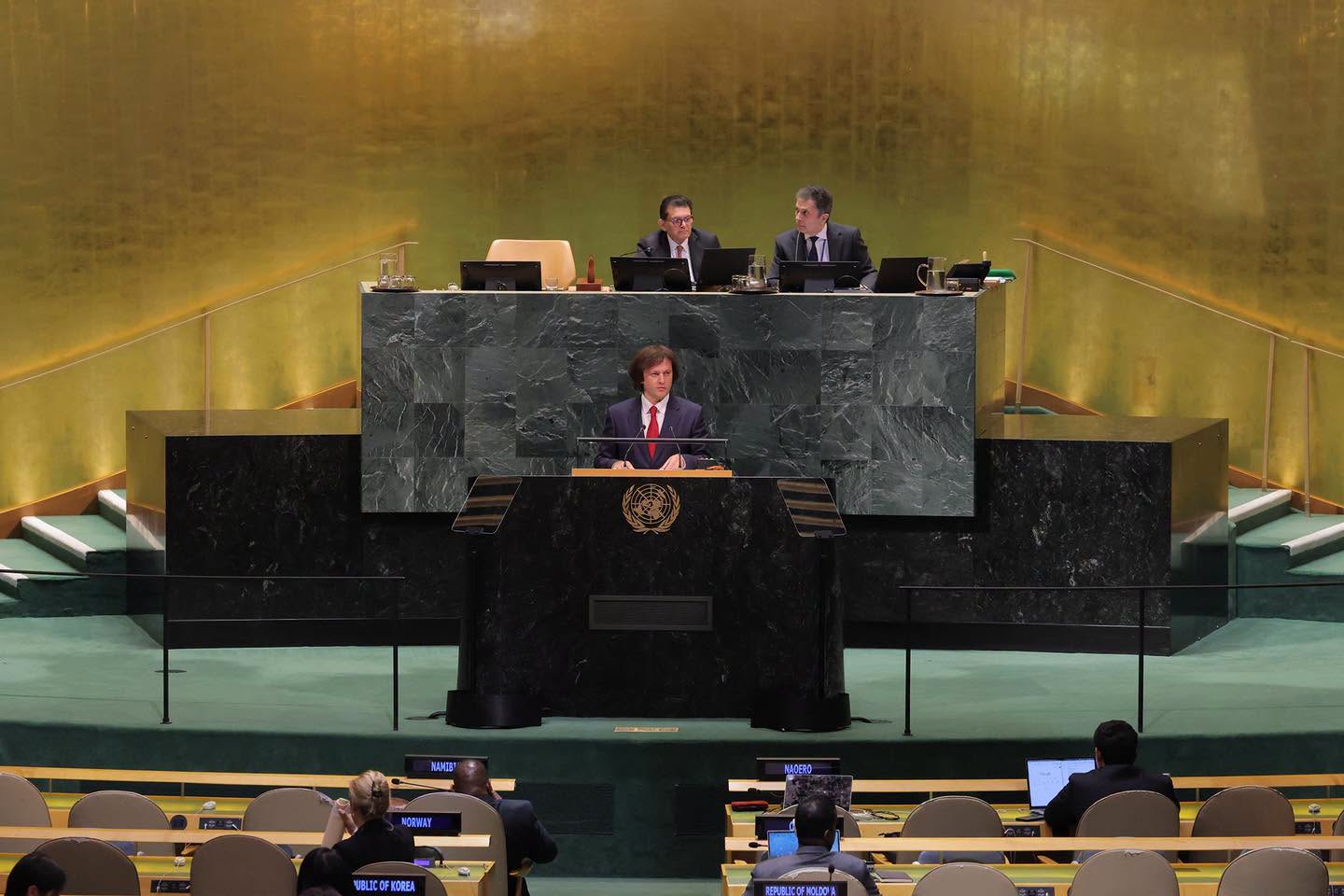
Georgian Dream Prime Minister Irakli Kobakhidze addressed the 81st session of the United Nations General Assembly (UNGA) on September 24, focusing on sovereignty and peace, Russia’s occupation of Georgian territories, reconciliation with Abkhazians and Ossetians, Georgia’s role in the Middle Corridor, and what he described as the country’s strong economic performance.
Speaking of “considerable change in the international environment,” Kobakhidze said developments around the world were “challenging existing arrangements and raising questions about the future of the international order.”
“The trials of the past have also taught us that sovereignty can never be taken for granted, the stability must be protected, and the strength of international order ultimately depends on the same principles being upheld for every nation,” he said.
The address repeated many themes voiced by Georgian Dream leaders at UNGA in recent years, but struck a slightly softer tone than Georgian Dream-elected President Mikheil Kavelashvili’s speech a year earlier, which had advocated a transition toward a “multipolar international order” and warned against speaking to Georgia in the “language of ultimatums, blackmail or intimidation.”
Partly echoing the latter remarks, Kobakhidze said that “Georgia remains open to meaningful engagement with every international partner, prepared to engage with us on the basis of mutual respect and sovereign equality,” and that “lasting peace cannot be imposed by force; it must be built through communication and mutual respect.”
Unlike the past years’ speeches by Georgian leaders, Kobakhidze also explicitly mentioned Russia when speaking about the occupation of Georgian territories. Georgian Dream Prime Minister, however, no longer spoke about Russia’s war against Ukraine.
Russian Occupation
“Twenty percent of our country remains under the occupation of the Russian Federation, while hundreds of thousands of our citizens continue to live in displacement, unable to return to their homes,” Kobakhidze said.
He then switched to people living in Russian-occupied Abkhazia and Tkshinvali/South Ossetia regions, noting:
“I would like to address our Abkhazian and Ossetian brothers and sisters. We have shared a homeland and a history for centuries,” he said. The divisions of today cannot erase that history, nor should they determine the future of our children.”
Kobakhidze continued: “We believe that the dividends of peace and economic growth of Georgia should know no artificial boundaries. It must reach the people living in our occupied historic regions as well, who remain and will always remain part of our shared vision.”
South Caucasus, Regional Cooperation, Middle Corridor
Kobakhidze then focused on the South Caucasus, saying, “The challenges facing our country also remind us that national stability and success cannot be separated from the wider regional context.”
“We believe that the South Caucasus should not be defined by the divisions of the past,” he said, again stressing Georgia’s role as a facilitator of regional cooperation.
“We have consistently sought to act as an honest broker in regional initiatives, fostering cooperation and contributing to peaceful solutions,” he said. “Today we see a genuine opportunity to turn a new page and build a more peaceful and interconnected region based on shared commitment to a better future.”
Kobakhidze then took time to promote Georgia’s role as part of the Middle Corridor transport route.
“This spirit of cooperation must also translate into tangible economic opportunities for the region,” he stated. “As an integral part of the South Caucasus and the Middle Corridor, Georgia is well positioned to strengthen connectivity between Central Asia and Europe.”
“Our network of free trade agreements provides access to a market of approximately 2.3 billion consumers,” he said, noting that Georgia plans to invest USD 7 billion through 2032 in transport infrastructure, including railway modernization, the Anaklia Deep Sea Port, airport development and highways.
He also highlighted plans for a Black Sea submarine fiber-optic connection and next-generation data infrastructure, saying Georgia aimed to strengthen “secure, resilient and diversified digital links between Europe and Asia.”
Economy
Kobakhidze devoted a substantial part of the speech to the economy, arguing that Georgia’s infrastructure ambitions “are underpinned by Georgia’s strong economic performance.”
“Over the past five years, our economy has grown by an average of 9.3 percent annually, and this momentum has continued in 2026, with growth reaching 7.9 percent in the first seven months of the year,” the GD PM stressed, describing Georgia as “one of the fastest-growing economies worldwide.”
“We are actively building an innovation-oriented, business-friendly environment that supports both local and foreign enterprises,” Kobakhidze continued.
According to the GD Prime Minister, “the true measure of success is how it improves people’s lives,” singling out poverty reduction as evidence of progress.
“We are already seeing these outcomes reflected in measurable improvements, including a triple decline in Georgia’s poverty rate, which dropped from 21.3 percent to 7.1 percent since 2020,” he said.
This, he said, “is only part of the broader transformation we seek to achieve,” noting that “over the next five years, our focus will therefore be on narrowing disparities between urban and rural communities, expanding opportunities across every region, and ensuring that the benefits of economic growth are shared widely and that no one is left behind.”
Kobakhidze also said the government’s longer-term goal was to move Georgia from the World Bank’s upper-middle-income category to high-income economies.
“Looking further ahead, our ambition for the coming decade is to transform Georgia from an upper-middle-income country into a high-income economy underpinned by greater economic diversification, a growing share of knowledge-based activities and broad-based prosperity,” he said.
Also Read:

