

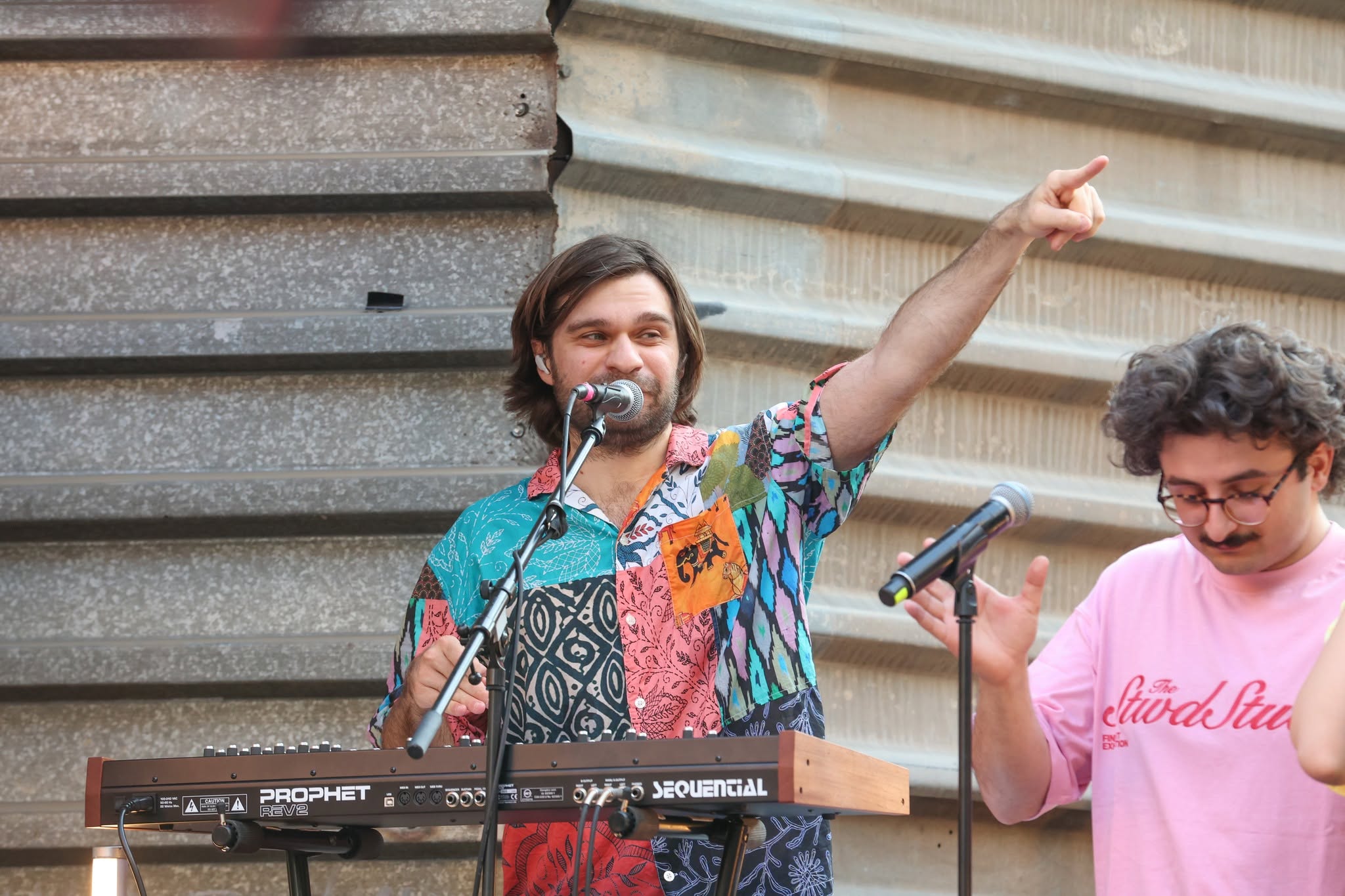
The planned concert of Georgian government-critical musician Alexander Kordzaia (Kordz) in the central Georgian town of Gori was cancelled over “security considerations” after days of campaigning and scrutiny by ruling party figures and pro-government media targeting the musician and the event’s European sponsors and organizers.
The concert was planned to take place on September 26 as part of the Kamara festival, organized by the Danish Cultural Institute as part of the Creative Compass project funded by the EU and co-funded by Goethe-Institut Georgia. After a series of statements by Georgian Dream figures and reports by pro-government media, however, the Danish Cultural Institute said late on September 23 that the festival “cannot take place as planned and has therefore been postponed,” citing “security considerations.”
While the Institute has not clarified further details and did not mention Kordz’s name, the musician’s posts and media reports suggest he will no longer be playing in the festival.
“Getting my concerts cancelled by the ruling party is the new low, a little bit of support by the organizers would have been nice,” Kordz wrote in a Facebook post, saying that the local Gori municipality threatened the venue with what he described as an “angry mob” if his performance were to take place. The concert was to be hosted by Gori Art House, a popular local cultural venue.
“Sponsors of the event (EU & Goethe Institute & Danish Cultural Institute) think it’s ok to not respond in this kind of situation. I think it’s not ok,” he noted.
In a separate Facebook post, Kordz said there was “no security guarantee on the ground because of the attacks and threats from the local government, Georgian Dream members, and pro-government media.”
Kordz became a target of Georgian Dream circles after he turned the anti-government protest chant “Ole, Ola,” which includes swear words directed at Georgian Dream, into a popular track. In particular, the lyrics – which were popularized during the 2024-2025 anti-government protests and police dispersals – include swear words directed at “Kotsebi,” a term that can be interpreted as a derogatory reference either to Georgian Dream members or also to its supporters.
Pro-ruling party media have interpreted the lyrics as targeting the ruling party’s entire electorate. During the days preceding the cancellation, pro-government channels such as Rustavi 2 and Imedi reported asking the EU delegation and Danish Cultural Institute questions about whether they shared responsibility for working with a musician “who verbally insulted more than a million voters.”
The reports featured further comments from Georgian Dream figures, including MP Tornike Cheishvili, who accused “particular diplomatic missions, EU Embassy” of “encouraging extremism” over supporting the artist.
It is not the first time that concerns have been raised over the safety of artists or other figures following campaigns by the pro-government media and ruling party figures. Similar campaigns have been followed by cases of physical assault.
In one of the recent cases, comedian Onise Okriashvili was physically assaulted near his apartment in July following several days of negative campaigning by pro-government media over a joke referring to acclaimed 20th-century Georgian writer Nodar Dumbadze.
Earlier, last July, Kordz also reported a similar attempt, including being chased by several “thug-type” figures, but managed to escape.
EU Response
The Delegation of the European Union to Georgia issued a statement expressing regret over the postponement of the festival, saying it was postponed “due to security concerns.”
“We regret that the Kamara Festival, funded by the EU under the Creative Compass Georgia project, had to be postponed by the organisers due to security concerns,” the statement said.
“The EU has been supporting Georgia’s cultural sector over the past 30 years – helping preserve its unique cultural heritage, supporting its creative industries, and connecting Georgian artists and cultural organisations with their European counterparts.”
The statement added that “the EU believes in the freedom of artistic expression.”
While speaking to reporters during a visit to Luxembourg, disputed Parliament Speaker Shalva Papuashvili slammed the EU’s statement as “incitement to hatred.”
“The last sentence of [the EU’s statement] is mockery, claiming that this is freedom of expression and that they take care to protect Georgian cultural heritage,” he said.
“If Paweł Herczyński thinks we Georgians are fascists and that cursing someone’s mother in public is okay for Georgians, then this person truly has understood nothing,” Papuashvili claimed. “If his standard is that cursing someone’s mother counts as freedom of expression, we will take that into account: it turns out that cursing someone’s mother is a European standard. It’s truly shameful.”
Papuashvili went further, describing the EU statement as “a direct incitement to hate speech, to swearing at mothers, calling people slaves, fascism and radicalism.”
“It is shameful that they have such a narrow political goal, to somehow bring Natsebi [opposition United National Movement party] into power, and are ready to sow resentment within society and introduce radicalism… I am disappointed by Pavel Herczynski’s actions,” Papuashvili said.
“Then he [Herczyński] comes out and says things in broken Georgian. Who needs his broken Georgian if he allows himself to do something like this to the Georgian people,” he said.
Note: This story was updated at 16:00 to add the EU Delegation’s statement and Shalva Papuashvili’s response.
Also Read:

