

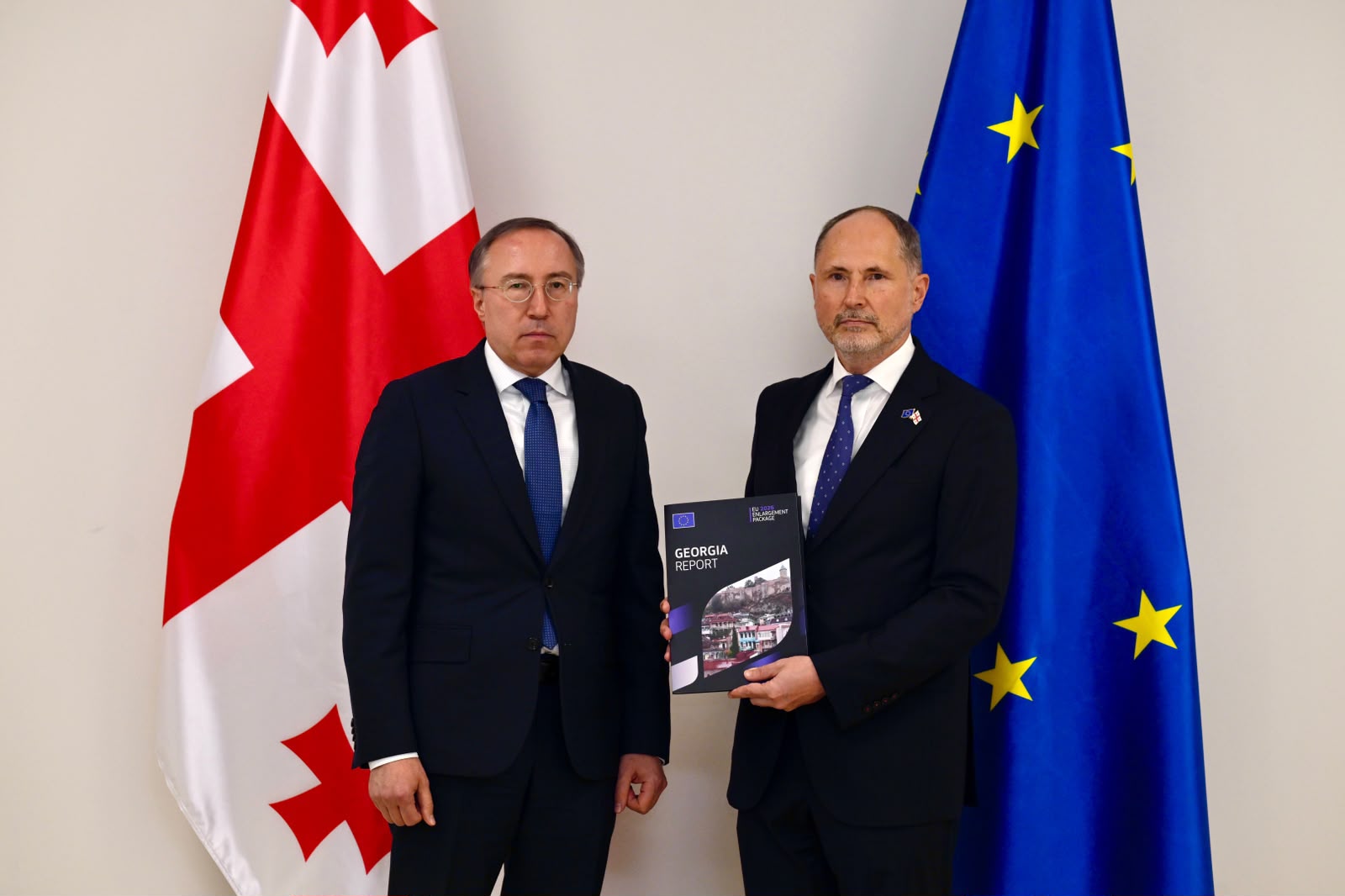
The European Commission has warned Georgia continues to miss out on EU accession benefits while the accession remains “de facto halted,” as it published the annual enlargement report noting the country’s “continued backsliding” and democratic deterioration.
The report and the communication document published on November 4 have put Georgia alongside Turkey when highlighting a number of democratic and human rights concerns, and said Georgia’s failure to address the democracy concerns risks the visa-free regime “more generally.” The Commission also said Georgia’s integration “could resume” if Georgian authorities “change course.”
“Georgia has been on a collision course with the EU over democratic backsliding and fundamental rights. Georgia’s accession remains de facto halted,” EU High Representative Kaja Kallas said during a press briefing presenting the reports.
Responding to a journalist’s question, Kallas further noted that the bloc “will have a deeper discussion with the foreign ministers regarding Georgia in January, how to best actually support the people and their aspirations for European membership.”
The relations between Georgia, which became the EU candidate country in 2023, and Brussels worsened amid the Georgian Dream government’s anti-democratic moves and anti-EU discourse. The EU said in November 2025 that Georgia is a candidate country “in name only” and moved to suspend visa-free travel for Georgian holders of diplomatic and service passports.
Georgia ‘Continues to Forego Benefits’
“The continued backsliding on the fundamentals observed during the reporting period confirms that Georgia remains an EU candidate in name only and continues to forego the benefits that candidate status and the pre-accession process bring,” the Commission said in the 2026 Communication on EU enlargement policy, a 62-page document published by the Commission on November 4 to assess the progress made by candidate countries.
“The ruling party in Georgia has continued to undermine the country’s EU path by pursuing its attack on democratic principles, the rule of law and fundamental rights, as well as by enabling further state capture,” the document said, noting that “as a result of increasingly repressive legislation, civic space has been further and severely curtailed.”
It reiterated that Georgia continues to fall short of the nine steps outlined in the Commission’s recommendation for candidate status. The document also said that Georgian authorities “have not addressed the concerns about the state of democracy and fundamental rights” that led to the suspension of the visa-free regime for diplomatic and service passport holders in Georgia earlier this year, “putting at risk the visa-free regime more generally.”
“The EU’s longstanding support for Georgia’s independence, sovereignty and territorial integrity stands firm, as does its unwavering support for the European aspirations of the Georgian people,” the document said.
According to the Commission’s document, the country’s EU path “could resume” should the Georgian authorities decide to change course “and recommit to the fundamental principles underpinning EU accession – democracy, the rule of law and fundamental rights.”
“The Commission would welcome such a resumption in light of the strong people-to-people ties that exist and the broad and longstanding public support in Georgia for the country’s democratic European future,” it concluded.
‘Further Backsliding’
“In Georgia there has been further backsliding on the fundamentals, and the accession process remains de facto halted,” the Commission’s Communication document said.
The assessment placed Georgia alongside Turkey, a candidate country since 1999, in a series of assessments, including noting that “democratic standards, fundamental rights and freedoms and the rule of law deteriorated further” and “the dismantling of institutional safeguards continued” in these two countries.
Turkey and Georgia were also identified as the two countries where “judicial independence remains seriously weakened,” where the situation regarding the implementation and enforcement of legal frameworks for the protection of fundamental rights “continued to deteriorate,” and where the enforcement of human rights, including of European Court of Human Rights judgments and recommendations of international and European monitoring bodies, “particularly” needs to be improved.
According to the document, Georgia, alongside Bosnia and Herzegovina, Serbia, and Turkey, are the countries where the risk of state capture remains “especially” salient. Serbia, Georgia, and Turkey are also the three countries where, according to the document, the situation regarding the safety of journalists “has further deteriorated.”
“In Georgia, civil society operates in a repressive environment and is subject to restrictive legislation, deepening the chilling effect,” the Communication document said. It also noted that Georgia’s October 2025 municipal elections “were held under deeply compromised political and electoral conditions including intimidation and pressure on independent media and civil society.”
The document further noted that Georgia’s alignment with the EU’s Common Foreign and Security Policy (CFSP) “declined further,” while the economic growth “remained strong” at 7.5%.
No Recommendations Beyond Fundamentals
In a separate, 90-page Georgia-focused enlargement report, the Commission said that, given the “continued backsliding” and the need to address the nine steps outlined in 2023 “as a matter of priority,” the report “does not set recommendations” for the chapters beyond the fundamentals.
“The state of democracy continued to deteriorate during the reporting period due to a growing erosion of democratic institutions, increased concentration of power, an escalating crackdown on civil and political liberties, further shrinking of the civic space, as well as hostile anti-EU rhetoric and disinformation,” the report said, adding that “attempts to ban main opposition parties through a Constitutional Court case threaten the foundations of the country’s democracy.”
According to the report, the authorities “have not taken steps to reform the general electoral framework according to longstanding recommendations,” while the 2025 local elections were held “in a highly polarised and repressive environment which severely undermined the competitiveness and transparency of the process.”
It also noted “new severe restrictions on political activity and political participation” adopted in the reporting period “in contradiction of international standards on pluralism and democracy.”
“Political polarisation deepened and democratic pluralism deteriorated further,” the report said, noting that most opposition leaders are “either facing criminal charges, in exile or imprisoned.”
“The authorities’ declared aspiration to join the EU is contradicted by their systematic engagement in hostile anti-EU rhetoric, undermining of fundamental values and failure to address key EU-related reforms,” the document said.
‘Severely Curtailed’ Human Rights
According to the report, “human rights have been severely curtailed and undermined by increasingly repressive laws that infringe upon fundamental rights, in particular freedoms of expression, assembly and association, as well as equality and non-discrimination.”
The Commission called for “urgent action” in several directions, including to release “all arbitrarily detained people, including politicians, journalists and activists,” and repeal laws that “restricts fundamental rights and freedoms.”
Among such laws, the Commission listed the Law on Transparency of Foreign Influence (2024 Foreign Agents Law), the Foreign Agents Registration Act (2025 FARA), as well as amendments to the Law on Grants, to the Law on Assemblies and Demonstrations, to the Law on Political Associations and related amendments to the Administrative Offences Code and Criminal Code, as well as the legislative package on “family values and protection of minors” (2024 anti-LGBT laws).
The Commission also urged to “comprehensively investigate allegations of excessive use of force, torture and other illtreatment by law enforcement and bring the perpetrators to justice.”
Media and Freedom of Expression
The report said that the area of freedom of expression was “marked by backsliding for a third consecutive year” in Georgia.
The report called for “urgent action” in ensuring the safety of journalists and providing “prompt, impartial and due legal follow-up to all cases of attacks against and intimidation of journalists”; repealing laws restricting freedom of the press and expression; and ensuring “an open, safe and pluralistic environment for media workers and media organisations, free from government censorship, retaliation, dismissals or legal punishment in all forms of expression, including online.”
Visa-Free Suspension
Citing the eighth Visa Suspension Mechanism (VSM) report of December 2025, the Commission noted that “Georgia failed to implement nearly all recommendations” issued in the previous report. “It backtracked further, in particular on key governance and rule-of-law benchmarks that form the basis for granting visa-free travel,” the Commission said.
In the report, the Commission also recalled the June meeting with the Georgian delegation to discuss the partial visa-free suspension, but noted that the enhanced dialogue “did not lead to progress when it comes to the Commission’s recommendations underpinning the suspension.”
The report called on Georgia to “ensure fulfilment of the visa liberalisation benchmarks and address the recommendations of the seventh and eight Visa Suspension Mechanism reports,” and to “address the issues of Georgian nationals illegally staying and filing unfounded asylum claims in the EU.”
Foreign and Defense Policy Alignments
According to the Enlargement Report, “there was no political dialogue between the EU and Georgia on common foreign and security policy (CFSP) during the reporting period due to downgraded political contacts by the EU in response to the serious democratic backsliding undertaken by the Georgian authorities.”
Georgia’s alignment with the EU statements on behalf of the decisions on sanctions “continued to decrease during the reporting period and remains low, with an alignment rate of 38% as of 1 September 2026, against 40% in 2025,” the report said.
“Georgia has not fully aligned with the majority of sanctions against Russia, Belarus and Iran, and not fully aligned with EU statements, notably those related to Iran, Russia’s malicious cyber ecosystem, or Israel/Lebanon,” it noted.
The report also said that Georgia did not participate in EU common security and defence policy (CSDP) missions and operations since 2023, noting that “security and defence cooperation has not progressed, due to the political developments in the country.”
More to follow…

