

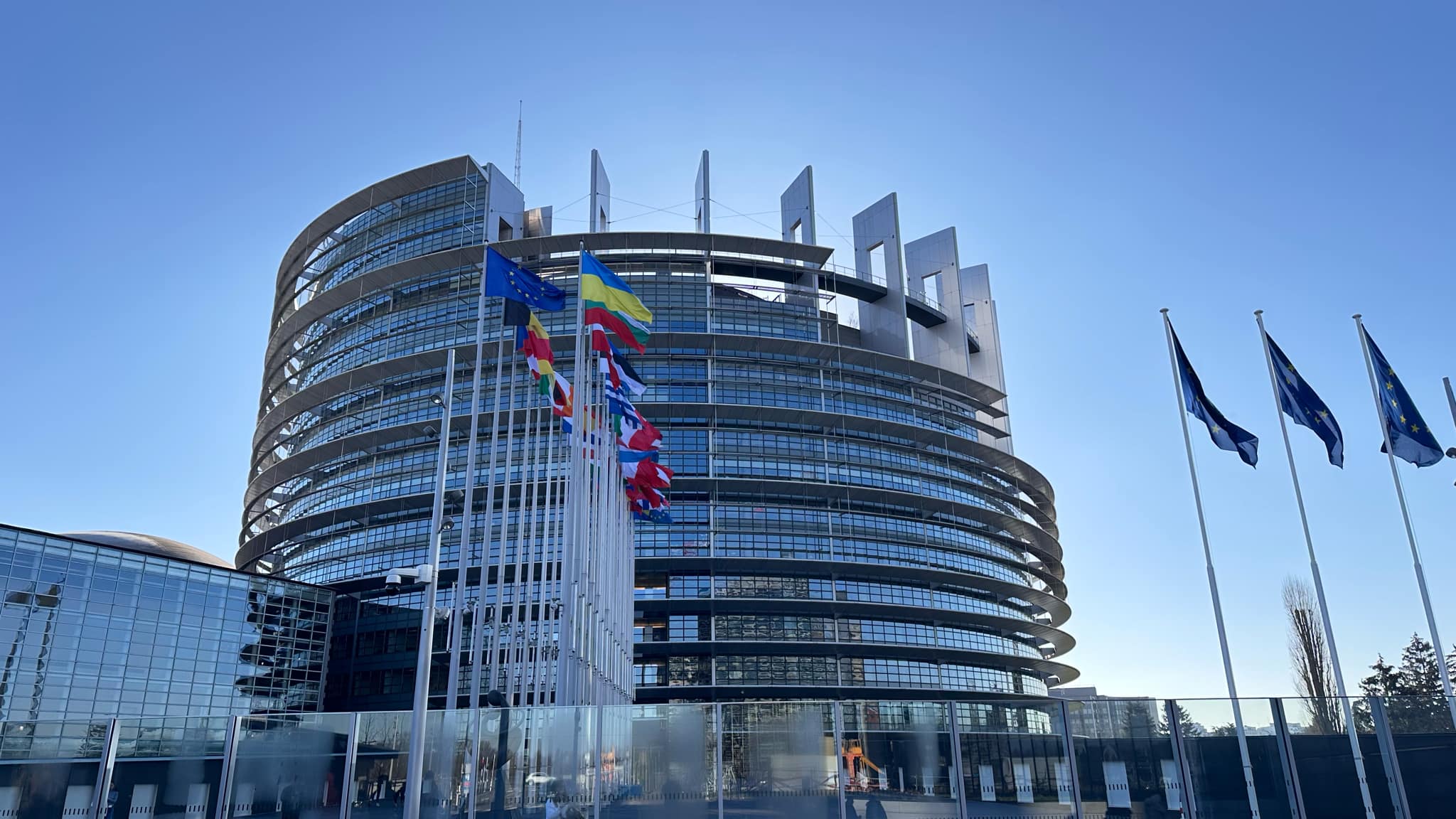
The European Parliament adopted a resolution calling for the “immediate withdrawal” of the Georgian Dream’s constitutional lawsuit seeking to ban opposition parties and reiterating calls for the release of what it describes as “political prisoners,” as well as for “targeted sanctions” against key Georgian Dream figures.
The resolution, titled “Attempts by the ruling party Georgian Dream to ban opposition parties in Georgia” and adopted on October 8 with 445 in favor, names Georgian Dream founder Bidzina Ivanishvili, Prime Minister Irakli Kobakhidze, Parliament Speaker Shalva Papuashvili, and Tbilisi Mayor Kakha Kaladze as those who should be subject to targeted sanctions and visa bans.
The document notes that in November 2025, “the Georgian Dream-controlled Parliament” lodged a constitutional claim seeking to ban opposition parties, including the United National Movement, Coalition for Change, and Strong Georgia – Lelo. The Federalists party was added to the lawsuit in April, while For Georgia, described in the resolution as the only opposition party still represented in Parliament, was added in September 2026.
The resolution says the proceedings amount to “eliminating legitimate political opposition” and are part of a broader strategy aimed at “turning Georgia into a one-party regime by eliminating political pluralism.” It says this follows the model of Russia and Belarus and “serves the Kremlin’s objective of keeping Georgia outside the European and Euro-Atlantic space.”
It says the situation in Georgia “is progressively deteriorating, with further backsliding in democracy, media freedom, human rights and the rule of law due to the Georgian Dream authorities’ actions,” which, according to the resolution, are increasingly “incompatible with Georgia’s international obligations and commitments,” including the Copenhagen criteria.
The European Parliament also notes that new judges were appointed to the Constitutional Court in September, saying the appointments raise “serious doubts about their independence in the proceedings.”
The resolution says that “numerous journalists reporting on the government’s crackdown on opposition and civil society have been imprisoned.” It also cites the closure of the Tbilisi offices of two German foundations, the Konrad Adenauer Foundation and the Friedrich Naumann Foundation, which it says were “forced to close their Tbilisi offices in September” after authorities rejected their project funding applications under the Law on Grants.
It “strongly condemns” the attempt to “outlaw Georgia’s opposition parties” and demands the “immediate withdrawal” of the constitutional claim. It stresses that “a functioning political opposition is an indispensable pillar of democracy and that eliminating legitimate political opposition through judicial means is incompatible with democracy.”
The resolution also notes that banning the sole opposition party represented in the Georgian Parliament would “dismantle the regime’s previous narrative of only targeting ‘boycotting’ parties.”
The EP calls for the “immediate and unconditional release” of people it describes as political prisoners, including Elene Khoshtaria, Mzia Amaghlobeli, Mikheil Saakashvili, Giorgi Baramidze, and Nika Melia, as well as “all those detained for peaceful protest.”
It also calls for “dropping politically motivated ‘sabotage’ charges” and for the repeal of provisions enabling “disproportionate restrictions on parties and individuals associated with prohibited parties.”
The resolution condemns “the misuse of legislation and state institutions to silence political opponents” and calls for an end to what it describes as the “obstruction of European political foundations.”
The resolution “regrets” what it describes as “the persistent lack of action by the EU and most Member States to ensure tangible consequences for the continuously deteriorating situation in Georgia.”
It reiterates its call for “targeted sanctions against and visa bans for those responsible for democratic backsliding, violent repression and political persecution, first and foremost Bidzina Ivanishvili, Irakli Kobakhidze, Shalva Papuashvili and Kakha Kaladze.”
The EP also reiterates “its unwavering support for the Georgian people’s European aspirations” and recalls its previous warnings that “any attempt to ban established political parties alienates Georgia from the EU and precludes any move towards EU accession.”
The resolution instructs the European Parliament President to forward it to the EU Council, European Commission, High Representative/Vice-President, EU Member States and “the self-appointed authorities of Georgia.”
More to follow…
Also Read:

