

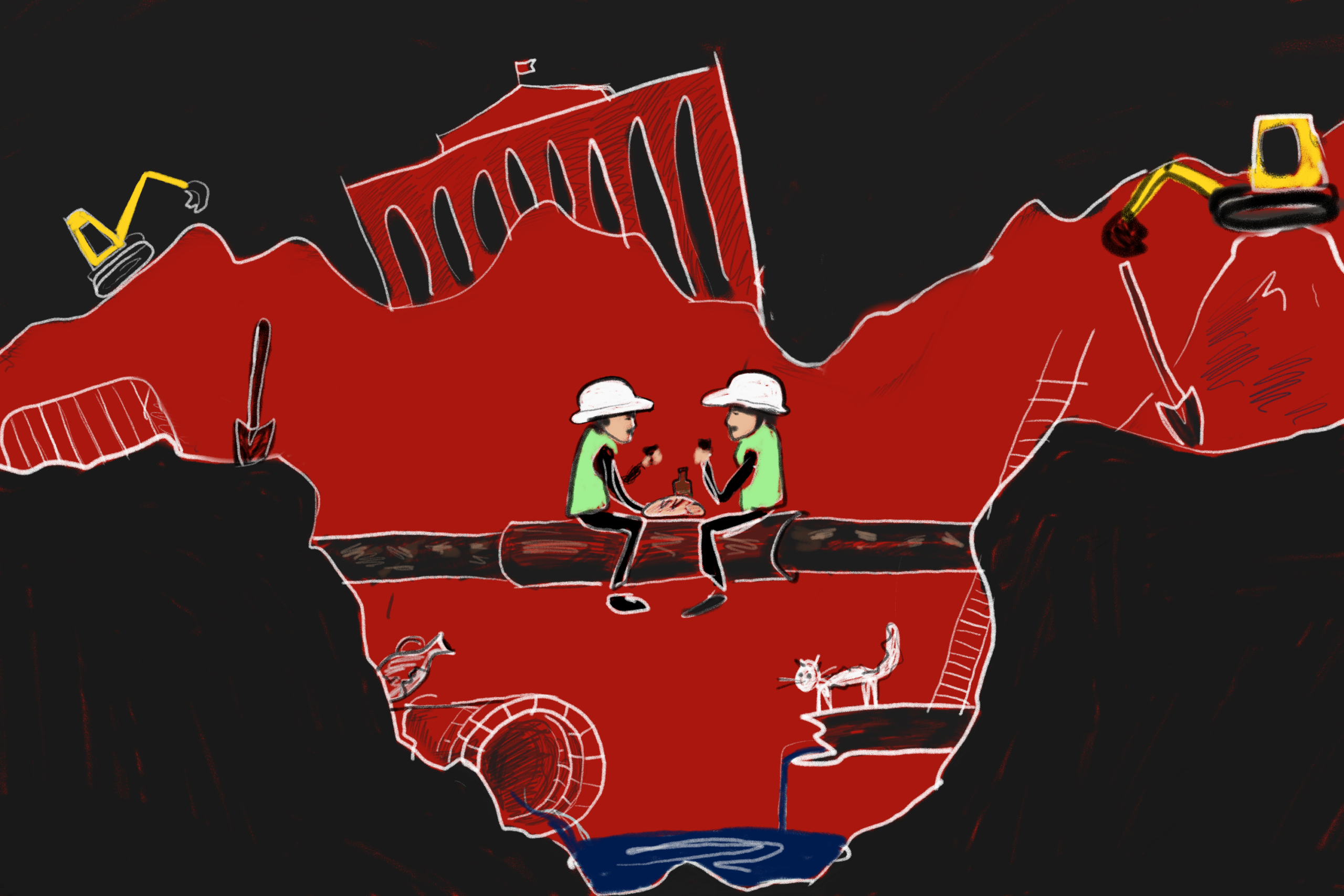
It’s after 10 pm, and about a hundred meters from the parliament building, in a place once covered with asphalt, there is a large, deep, dark hole. Inside the hole lies a massive concrete box, the outer frame of the underground passage, and over that large box runs a pipe, a newly installed one, but dirty. Over the pipe sits a man, his legs apart.
His jacket is red, his cap is black, and his left fist is tightly pressed against his left thigh as if in deep meditation. His frozen gaze rests on the illuminated parliament, or maybe the flags beneath, held by currently hidden, increasingly caged protesters.
In front of the man, on a small section of the pipe that appears relatively and deliberately clean, lies a packaged loaf of bread. There are also other things in plastic bags — could be dinner, or breakfast, or lunch. Work has been ongoing round the clock here, so it’s hard to say. Soon, another worker will be joining him.
Here is Nini and the Dispatch newsletter, back on Halloween to dive into the temporary dark holes of Georgia’s eternal street.
As with any news, the news about the planned rehabilitation of Tbilisi’s Rustaveli Avenue kept coming like an alarm. As with any alarm, the country kept snoozing it, and as with any noise that is repeatedly muted, it ultimately failed to wake anyone up. So, on July 21, authorities said they would start on July 23, and on July 23, they started digging.
Georgian capital’s main thoroughfare was soon filled with deep holes, red pipes, yellow machines, grey rubble, green vests, piles of soil, and trucks in many colors. The traffic noise gave way to the equipment’s rumbling, yet it still felt like the street fell silent.
The loudest noise came from online. Users started complaining about disruptions, dust, traffic jams, and also human traffic jams on temporary pedestrian bridges, which are quite useless on rainy days. Local business owners recorded bitter reels, vainly hoping to lure back their lost customers with dark humor. And there were constant “why now” cries from tourists who arrived in the midst of the season to find the central street in chaos.
Yet no matter how you decide to feel, those feelings may not always survive the actual contact with the street. That is, if you are adventurous enough, don’t love your shoes way too much, and it hasn’t rained in a while. Take a slow walk, and all the pre-existing emotions are instantly absorbed into the street’s newly dug holes. You are left with silent curiosity, which is also what you read on the faces of others you encounter during the walk.
***
Once the asphalt is gone, the definitions follow. There are no more painted lines telling who belongs where, and what belongs to whom, and whether it’s for cars or pedestrians, locals or tourists, city snobs or villagers, protesters or police, government or people.
And there are no ready guidelines on how to react: some will complain about expected corruption and incompetence, because they’ve seen it happen before; some will say it’s all done against ongoing protests, because things have indeed been done against protests, including many absurd things, on this very street.
There is little you can do with this type of learned anxiety. Once, as they love to say in watchdog reports, the line between party and state is blurred, you no longer know how to feel good about anything at all: because anything around you is the state, and the state is now the party, and the party has hurt you many times.
***
Weeks into the renovation works, the street started producing the past.
- In August, archaeological finds were uncovered near the National Museum. Those were presumably brick structures from the 19th–20th-century water-collecting system, and ceramic vessels from medieval times. The good news left us all worrying — would they ruin those precious artefacts, or would they use them as an excuse to forever delay the road’s reopening?
- Soon, a site was arranged for archaeologists to study the pieces. Reporters kept coming and asking questions. Archaeologists explained that this place may have been a ceramic workshop dating to the 10th–12th centuries, back when the city was under Arab rule and formed a section of the Silk Road routes. Even government officials came, looking unwillingly humbled and small when physically faced with the same past they had overexploited to preach their greatness;
- Later in August, the street also revealed the fragments of pipes possibly made of asbestos, a substance apparently so deadly that it brought Georgia’s Public Defender back to life to warn of dangers. After the warning, many must have avoided the street. Others still ventured there, asking ourselves, “Is that it?” whenever a strange, chemical smell reached our noses, mixing the sense of fatal doom with the adrenaline of forgotten risk. We’ve smelled toxic substances here before.
***
Many will tell you that Rustaveli Avenue is a literal hell, a safety disaster these days, and they will be absolutely right. Yet, on dryer days, it feels strangely easy to walk through the venue that, not so long ago, was wildly contested between protesters, police, and cars. And it feels unnaturally legal to do it, even if everything around warns that you shouldn’t be here.
The place now belongs to workers, working CATs, and wandering cats. Trucks and tractors regularly sneak up from behind like some parallel-universe creatures, leaving you with a sense of relief but also a void as they pass by without paying the slightest attention: it feels unusual not being watched.
As weeks pass, the piles are getting higher, and the holes are getting deeper. More pipes emerge beneath the holes, new ones, old ones, and historic brick ones, and there are streams of water bypassing all three of them. More rain falls, and more pedestrians are seen fighting for their lives as they try to find their way through the mud.
***
- There was also this tree. Early into the works, we learned that a plane tree was chopped in the process. Authorities claimed it was a damaged one, and they cut it to keep us safe, and that they were trying their best to save the rest. Suddenly we became one of those advanced democracies where everyone worries about what happens to a tree, one of those countries where entire university classes are devoted to studying the discourse and narratives around that one tree, to baffle exchange students who suddenly realize there are political issues beyond sheer survival;
- And there were, of course, ruins, the symbolic ones. The Soviet-era Communications building was demolished during the rehabilitation, so fast that we never had time to debate whether we had to do anything about it, because there were obviously things more urgent that we couldn’t do anything about either. Eventually, what was left of that building was a pile of rubble, a small piece of facade with the EU-Georgia graffiti on it, and the door frame — with the Georgian Airways sign hanging nearby — that led nowhere: allegories so many that, at that point, it became really boring.
***
There are so many things that can kill you here. Asbestos, roaming machines, falling trees, collapsing buildings, bottomless holes, dirt, and dust. If days have been rainy, there’s a chance you simply disappear in the mud, with nobody ever finding you again. Avoid the place at any cost, good people will tell you.
But then there are these two workers who, about a hundred meters from the parliament, on a muddy pipe that runs through a large hole, surrounded by rubble, iron fences, water tanks, tools, machinery, and who knows what else, break their bread and share a quiet conversation – after a long day, or before the long night. The only disruption of the normalcy is a stranger’s phone camera pointed from a distance.
Aren’t those reckless men aware of the safety rules? Or do they even care about rules if the life those rules were meant to protect is gone, or perhaps never even arrived? Where rules exist for their own sake, laws could be scarier than lawlessness.
But never mind: the rules will come back.
In weeks or months, fresh asphalt will cover that large hole and the other holes too. Lines clearer and yellower than before will be drawn, and new yellow lines will bring new red lines. And then, inside those painted lines, inside the new tiny squares and rectangles, between concrete islands and brand-new bus stops, under the previously unseen traffic lights, we will again be allowed to look for our lost freedoms.
Unless, before the holes close for good, those lost freedoms, too, will somehow emerge from under the ground.


