

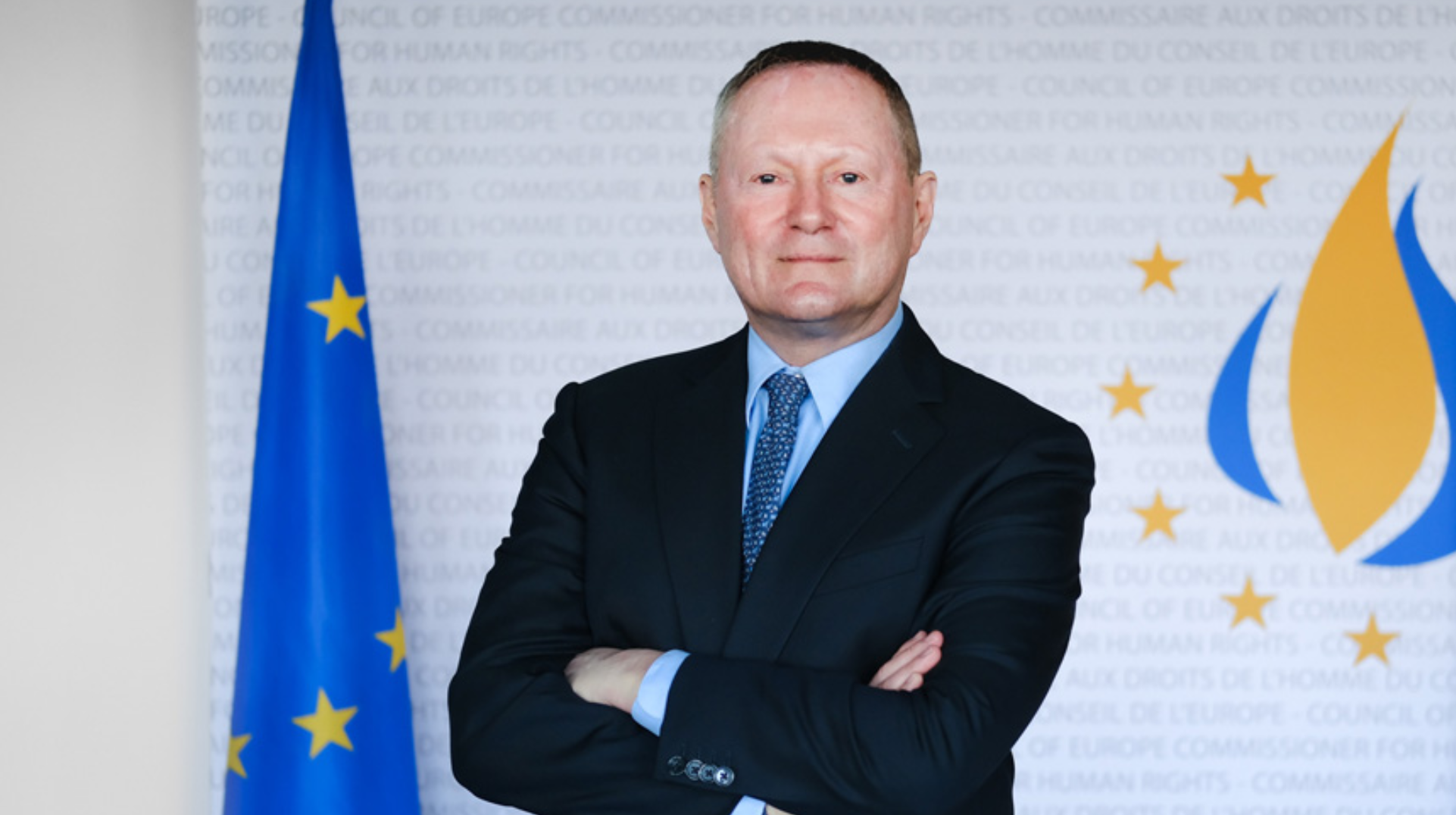
Council of Europe Commissioner for Human Rights Michael O’Flaherty has intervened as a third party in the case challenging Georgia’s Foreign Agents Registration Act (FARA) before the European Court of Human Rights (ECtHR), arguing that the law is part of a broader pattern of restrictions seeking to intimidate Georgian civil society organizations.
A Georgian version of the U.S. legislation, which came into effect last year as part of broader restrictions cracking down on media and civil society in the country, foresees criminal penalties for those failing to register as “foreign agents” if they receive foreign funding and are considered to be engaging “in political activities for or in the interests” of the “foreign principal.”
A group of Georgian non-governmental and media organizations, including the Georgian Young Lawyers’ Association, filed a joint application against FARA with the ECtHR in September 2025. GYLA said in April that the Court started examining the case.
“The enactment of the Georgian FARA on 1 April 2025 forms part of a broader pattern of restrictive measures intended to intimidate CSOs who are perceived as critical of the government,” O’Flaherty says in the submission, published on September 8. “The aim of the Georgian FARA may have been to discredit civil society activists.”
The Commissioner notes that FARA operates alongside the 2024 Law on Transparency of Foreign Influence [the so-called Foreign Agents Law], rather than replacing it, while further restrictions were introduced in Georgia since FARA’s adoption on foreign grants, foreign funding of broadcasters, civil society participation in public decision-making, and freedom of assembly and expression.
In the document, O’Flaherty raises concerns over what he sees as vague provisions in the law while comparing the level of control to the Russian foreign agents law.
Georgian FARA “defines ‘political activity’ expansively to cover virtually any activity aimed at shaping domestic or foreign policy or political attitudes, blurring any meaningful distinction between legitimate international cooperation and covert foreign interference and contributing to making it difficult for anyone to know whether Georgian FARA applies to them,” the Commissioner says.
The law “appears to target broad categories of legitimate actors for ulterior purpose of discouraging civil society activity,” the Commissioner says. It “creates a regime of pervasive administrative control that is comparable in intrusiveness to the Russian ‘foreign agent’ laws criticised by the Court.”
The Commissioner says the use of the term “agent” itself has a stigmatizing effect. “The enactment of the Georgian FARA has in itself had a significant stigmatising effect on the reputation of CSOs in Georgia,” the Commissioner says, noting that this effect is compounded by rhetoric portraying civil society organizations and human rights defenders as “enemies of the state.”
He argues that Georgian FARA provisions are inconsistent with the requirements of “legality, legitimacy, necessity and proportionality” under Articles 10 and 11 of the European Convention on Human Rights, which protect freedom of expression and freedom of assembly and association, as well as with the principle of non-discrimination under Article 14 of the Convention.
The law’s adoption “forms part of a broader pattern of restrictions on the rights to freedom of association and freedom of expression affecting civil society in Georgia, which have a chilling effect on the work of media outlets and CSOs, including those working on human rights, democracy and the rule of law,” the Commissioner writes in the concluding remarks.
“There are several aspects which call into question the Georgian FARA’s declared purpose of ensuring the transparency of foreign influence regarding the funding of civil society organisations,” the Commissioner adds.
The Commissioner previously intervened in another case brought before the ECtHR over Georgia’s 2024 Foreign Agents Law.
Also Read:

