

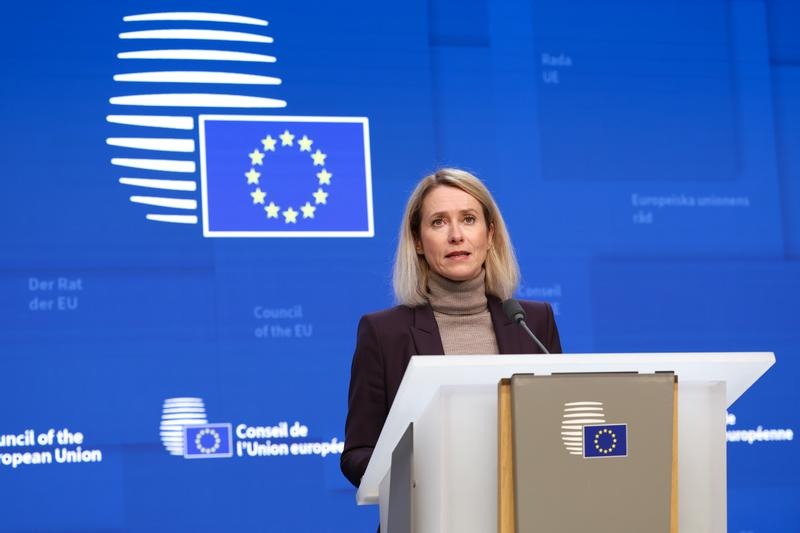
EU foreign policy chief Kaja Kallas said that the non-recognition of “occupied Ukrainian and Georgian territories” should be among the conditions for the bloc’s modernized Association Agreement with Syria, referring to Russian-occupied territories Damascus recognized as “independent” under the ousted Bashar al-Assad regime.
Kallas, however, noted that two separate processes were underway: one focused on signing the existing Association Agreement negotiated with Damascus in 2008 but never signed, which would serve as the initial framework, and the other on a modernized Agreement that should reflect the issues that emerged since, including similar non-recognition clauses.
Asked at a press conference following the Foreign Affairs Council meeting on November 16 whether EU member states shared the same objectives on Syria and what conditions they wanted met before proceeding with an association agreement, Kallas said there was broad agreement on the need to engage with the country, arguing that otherwise the resulting vacuum would “be filled by other players.”
“The compromise would be that we sign the association agreement that is from the 2008. That gives us the framework to deal with all the issues that are in the interest of us and also for them,” Kallas said.
She added that under the follow-up, modernized agreement with Syria, the EU should have “clear conditionality regarding human rights. We should also have the non-recognition of occupied Ukrainian, Georgian territories that they have recognized under the Assad regime and different things that member states proposed. So now we work in the working parties to sort out the technical and legal details.”
Asked in a follow-up question whether the condition meant Syria would have to withdraw its recognition of Georgia’s occupied territories, Kallas clarified that the EU was keeping the two processes of signing the 2008 agreement and the modernized one separate.
“We can’t change the association agreement that we have from 2008. So basically it’s just whether we sign it or not. That gives us the framework to work. But it is clearly something that the member states raised for the mandate of the next modernized agreement, because all these issues have come after the 2008 agreement. And therefore it’s not only the non-recognition, but it’s a lot of things that we want to see also from the Syrian side. But yes, we are keeping them separate,” she clarified.
Syria is one of five countries that recognize the independence of Georgia’s Russia-occupied territories. Under Bashar al-Assad, Damascus recognized Abkhazia and the Tskhinvali region/South Ossetia as independent states in 2018. Following Assad’s fall in December 2024, calls grew for Syria’s new interim government to reverse the decision.
Kallas’ latest remarks follow an earlier statement concerning the bloc’s readiness to engage with Syria’s newly formed People’s Assembly and its members “to support capacity building and good governance and to work together towards achieving common goals, including ensuring respect for international law and the UN Charter.”
Shared by Lithuania’s Foreign Ministry, the statement’s accompanying social media post specified that this would include “revoking Assad-era decisions that recognized violations of Ukraine and Georgia’s sovereignty and territorial integrity,” although Kallas did not explicitly mention the revocation in the statement itself.
Days after the statement, Tskhinvali’s de facto foreign ministry raised concerns that the EU and its member states were exerting “pressure” on Syria’s new leadership over Damascus’ recognition of Georgia’s occupied territories. Abkhazia’s de facto foreign minister, meanwhile, said efforts to reverse the recognition were “nothing new” following Assad’s fall.
Meanwhile, the Coalition for Change, a Georgian opposition force, said in response to November 16’s Kallas remark that it sent appeals on July 21 to her, the President of the European Council, the European Commissioner for Enlargement, the President of the European Commission and the foreign ministries of EU member states.
“On September 14, the Coalition was informed by official correspondence from the European Commission that EU institutions would raise the issue of recognizing Georgia’s territorial integrity on the agenda in dealings with the Syrian authorities,” the opposition group said, adding that the issue remained “a permanent and unchanging subject” of its “external communication.”
Also Read:

