

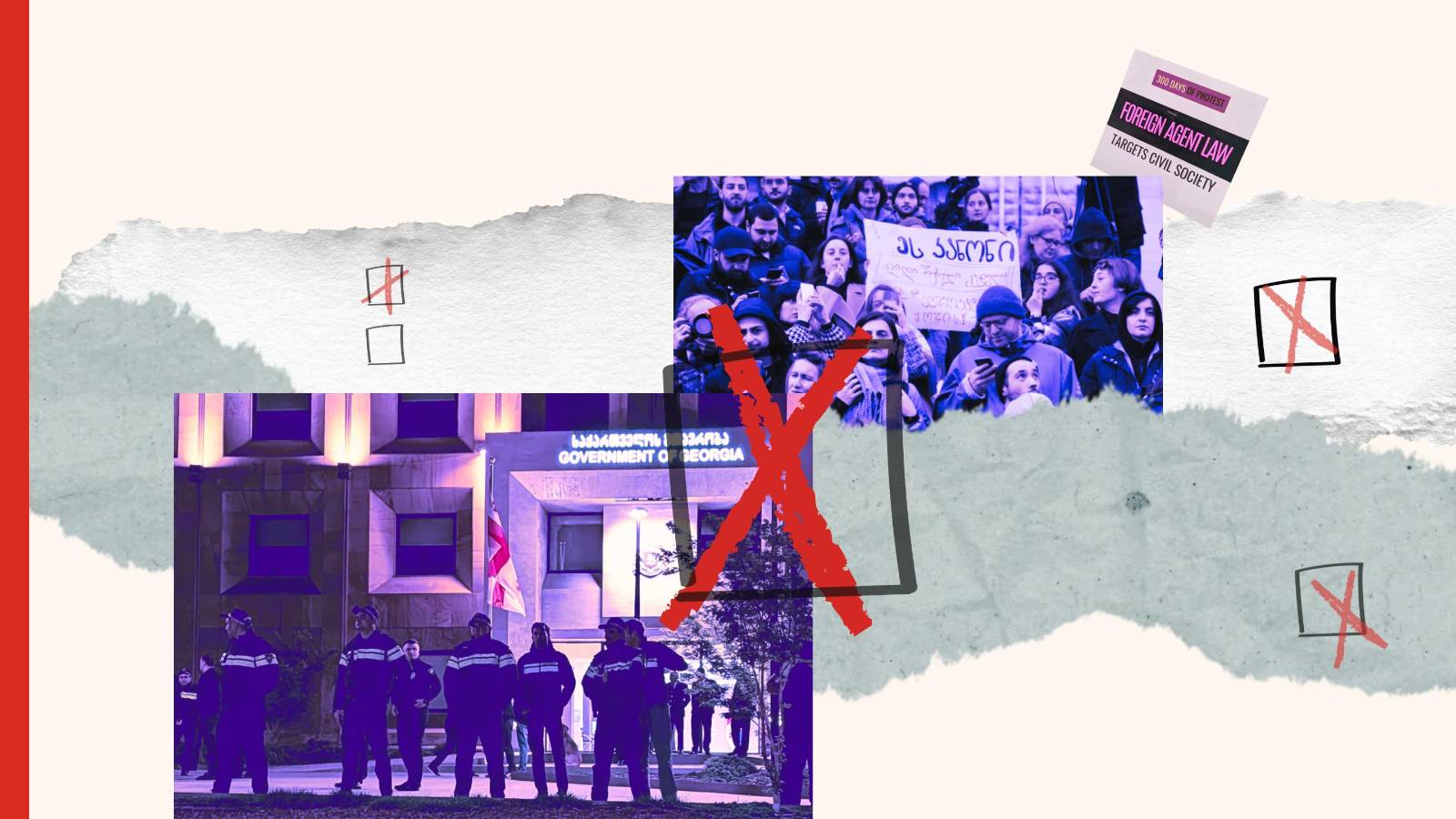
Early in October, two German political foundations announced their exit from Georgia after their project applications were rejected under Georgia’s newer grant laws. Their exit again raised the question of what foreign-funded activities are even allowed in Georgia.
The 2025 and 2026 amendments to Georgia’s Law on Grants introduced a requirement for foreign donors to seek government consent before disbursing grants. Failure to do so may put grant recipients at risk of imprisonment and organizational closure. However, an analysis of recent practice shows that only a small proportion of active CSOs in Georgia have used the mechanism, while the scope of approved activities has remained limited, excluding key democracy-related areas such as human rights protection and the rule of law.
Georgia’s government consent rule for grant funding is thus nothing but another tool designed to suppress Georgian civil society, reshape the substance of its work, and interfere with its vital autonomy.
Nona Kurdovanidze is a lawyer, researcher, and human rights defender with over 18 years of experience in civil society and human rights protection. She served as Chairperson of the Georgian Young Lawyers’ Association (GYLA) from 2023 to 2025.
The laws adopted throughout 2024 and 2025 equated foreign-funded civil society activities with “pursuing the interests of a foreign force” or, more directly, acting as a “foreign agent,” a term often used as a synonym for a spy in Georgia. The new laws require organizations to register in discrediting bases. The penalties for non-compliance range from heavy financial fines under the 2024 Law on Transparency of Foreign Influence to criminal liability under the Georgian version of the Foreign Agents Registration Act (FARA), adopted in 2025.
April 2025 and March 2026 amendments to the Law on Grants introduced further barriers, including a requirement for foreign donors to seek government approval before disbursing foreign funding. The 2026 amendments also expanded the definition of grants to cover forms of cooperation beyond traditional agreements, including sharing specialized knowledge, technologies, or other monetary or in-kind support. The funds allocated for the branches of foreign organizations in Georgia, as well as foreign-based organizations whose work “substantially” covers Georgia, now also fell under the government approval rule.
The related violations were classified as “serious” criminal offenses, carrying criminal liability for grant recipients and, in the case of organizations, potentially leading to their liquidation.
How the Mechanism Works
In the period from July 2025 to September 2026, Georgian authorities approved 382 projects and rejected 39 under the new mechanism. Out of the 382 approved projects, 300 were implemented by Georgia-registered non-governmental organizations, while the rest were distributed among limited liability companies (LLCs), individuals, religious organizations registered as Legal Entities under Public Law (LEPL), and the Georgian branches of foreign organizations.
Taking into consideration that some of these non-governmental organizations had more than one project approved, the number of NGOs implementing up to 300 approved projects can be estimated at around 150. Of these, 65% had only a single project approved, while only 5% of applying organizations received government consent for five or more projects.
According to the official statistics, 34,360 organizations were registered as non-profit in Georgia as of 2026, with only 3,611 of them having an active status. The list of active non-profits, however, also includes state-run organizations such as theaters, museums, sports federations, and kindergartens. While their exact number is not publicly known, it is estimated to be around 1,500. This would mean that the approximately 150 NGOs implementing government-approved projects account for only 7% of active non-governmental organizations in Georgia.
Scope of Approved Projects
The analysis of the Georgian government’s decisions regarding the project funding shows that the projects approved under the new mechanism fall into several broad categories:
- Social assistance and services – 29%
- Environmental protection – 23%
- Education – 9%
- Healthcare – 8%
- Agriculture and regional development – 3.5%
All these are important directions for civil society work, and authorities approving such projects does not in itself constitute a problem. And yet activities focused on human rights protection and advocacy, good governance, or rule of law remain absent from the list. The role of civil society cannot be limited to the provision of social services: it also covers documenting human rights violations, combating discrimination, monitoring government activities, evaluating public policy, representing citizens’ interests, and demanding accountability from state institutions.
It must also be noted that many of the traditional independent watchdog groups in Georgia have refused to seek government approval, as they consider the amendments that introduced the mechanism unconstitutional and an interference with their autonomy. Yet current practice suggests that, had they even applied, their projects would most likely have been rejected.
Reshaping Substance
The political significance of civil society work does not automatically mean engagement in party politics. When, for example, an organization calls for an investigation into police use of force, defends those subjected to discrimination, or assesses the independence of the judiciary, it may have to address political issues, but such activities are a normal part of civil society work in a democratic society.
An examination of how the government approval mechanism operates clearly shows that its purpose is to significantly narrow the scope of CSO activities and reshape their real substance. Activities that fall within the broad and unforeseeable definition of “political activity” under the more recent restrictive laws fail to obtain government consent.
The approval mechanism thus far transcends the bounds of administrative oversight and instead serves to define the substance and scope of civil society activities. Under this mechanism, civil society organizations may formally retain the right to exist, but their space for independent action is restricted. For this reason, the government consent mechanism should be regarded as a tool for controlling the autonomy of civil society.
The views and opinions expressed on Civil.ge opinions pages are those of the authors and do not necessarily reflect the official policy or position of Civil.ge editorial staff

