

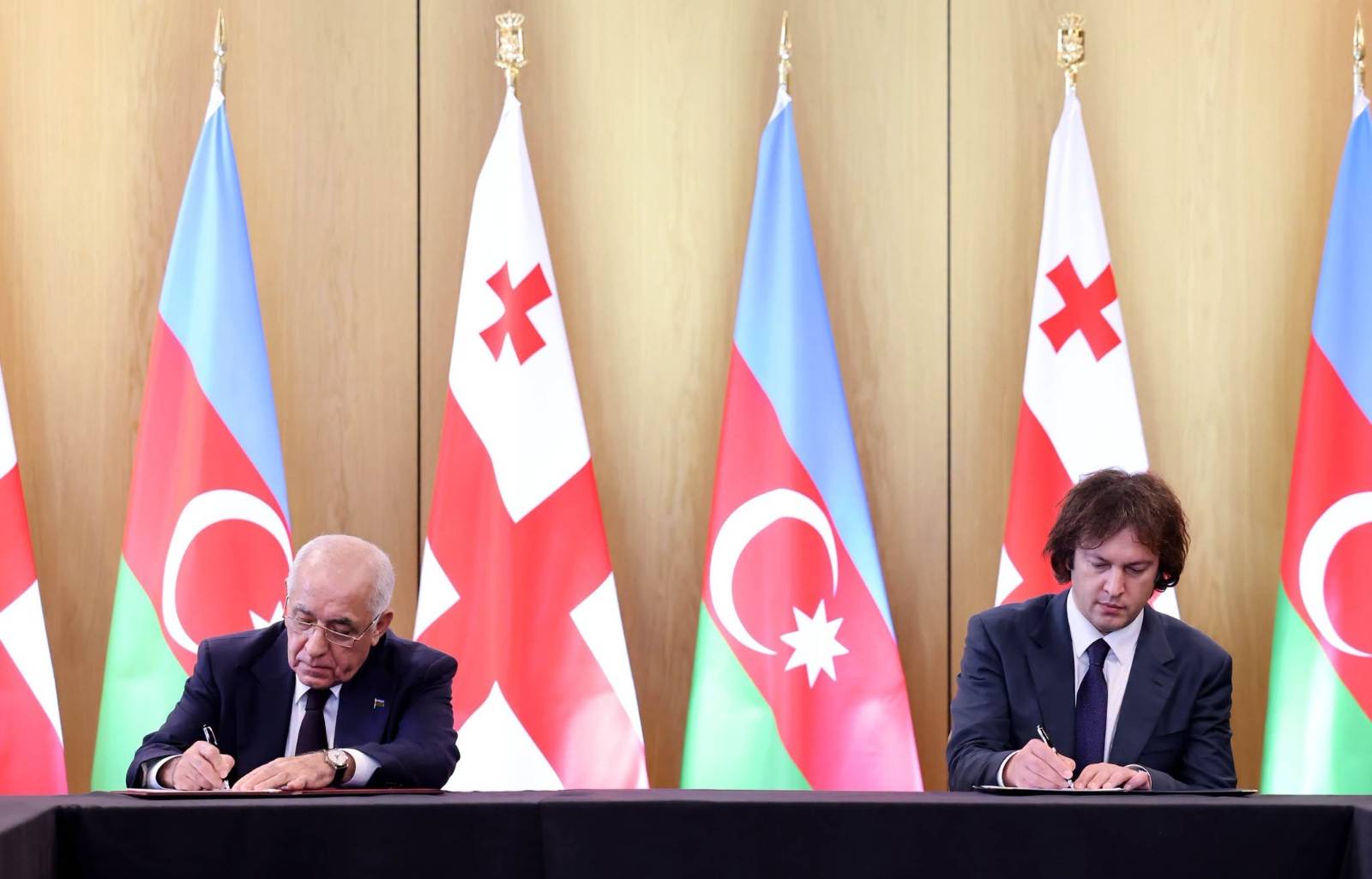
Georgia and Azerbaijan signed documents, discussed cooperation, and agreed to speed up the border demarcation and delimitation process as officials from the two countries held the 11th meeting of the Georgia-Azerbaijan Intergovernmental Commission on Economic Cooperation on October 30 in Tbilisi.
The meeting, co-chaired by Georgian Dream Prime Minister Irakli Kobakhidze and visiting Azerbaijani Prime Minister Ali Asadov, focused on trade, energy cooperation, infrastructure, and Middle Corridor-related projects. Kobakhidze also told the journalists later that the two sides had agreed to accelerate the process of demarcating and delimiting their shared border, including the area around the historic David Gareji Monastery complex.
Following the meeting, Kobakhidze and Asadov signed the protocol of its 11th session, while the officials from the two countries also signed “an agreement on the practical operation of the joint Georgia-Azerbaijan international road border crossing point, Silk Road-Ipek Yolu, as well as memoranda of understanding on cooperation in the fields of veterinary services and plant protection,” according to the Georgian government’s press release.
Kobakhidze also held a separate meeting with Asadov, during which they discussed bilateral strategic partnership, cooperation across various sectors, as well as “the prospects for the Middle Corridor and the particularly important role of the Baku-Tbilisi-Kars (BTK) railway in enhancing regional transport connectivity.”
Meeting Details
According to the Georgian Dream government’s press service, officials from the two countries reviewed progress in trade and economic cooperation over recent years and discussed plans, with attention devoted to the Middle Corridor, “major infrastructure projects underway in Georgia, the successful partnership in the energy sector and opportunities for implementing new joint initiatives.”
The press service cited Kobakhidze as saying that “for centuries, our peoples have lived side by side, respecting each other’s traditions and national interests. It is precisely this mutual respect that has been and continues to be the solid foundation of our partnership.”
Kobakhidze noted that the two countries’ strategic partnership is reflected in their high-level political dialogue, pointing to Azerbaijani President Ilham Aliyev’s visit to Georgia in April, which, he said, “once again reaffirmed our mutual interest in further developing and deepening bilateral relations.”
He also addressed the “ongoing geopolitical developments in the region,” highlighting that Georgia has “always been a strong advocate of peaceful coexistence and dialogue in the region.”
Kobakhidze described Azerbaijan as “among Georgia’s largest trading partners,” saying the objective is to “build on the progress achieved, including by better utilizing the export potential of Georgian products, further diversifying trade relations and providing additional incentives for investment.”
He highlighted the Middle Corridor project, saying it’s “our shared objective” to “further increase the capacity, efficiency and competitiveness of this route.”
To achieve this goal, Kobakhidze said Georgia is implementing “large-scale infrastructure projects,” including the East-West Highway, the modernization and expansion of Georgian Railway, the Baku-Tbilisi-Kars (BTK) railway, the Anaklia Deep Sea Port and the new Tbilisi International Airport.
On energy cooperation, he highlighted the Baku-Tbilisi-Ceyhan (BTC) oil pipeline, the Baku-Tbilisi-Erzurum gas pipeline, the Baku-Supsa oil pipeline and the Southern Gas Corridor, saying these projects “have for many years facilitated the reliable transit of energy resources while contributing to regional and European energy security.”
He also noted that, together with Azerbaijan, Romania and Hungary, “Georgia is participating in the development of the Green Energy Corridor, an initiative aimed at facilitating the transmission of renewable energy and strengthening the integration of the South Caucasus with the European energy market.”
Kobakhidze added that the agenda of bilateral relations “also encompasses defense, culture, education, agriculture, healthcare, tourism and customs cooperation,” saying Georgia stood ready to strengthen existing ties and facilitate new joint initiatives.
The press release also included remarks by Azerbaijani Prime Minister Ali Asadov, who noted that the strategic partnership had entered “a qualitatively new phase” in recent years, also highlighting Aliyev’s visit to Tbilisi and Kobakhidze’s visit to Baku in May.
He described Georgia as one of Azerbaijan’s “key trading partners,” noting that during “the first nine months of this year, bilateral trade volumes increased by over 40%, reaching 1 billion USD compared with the corresponding period of the previous year.”
“Our cooperation in the field of investment is also demonstrating very positive momentum. Azerbaijan has invested approximately 4 billion USD in Georgia,” he said.
On major infrastructure and energy projects, Asadov highlighted the Southern Gas Corridor, saying it plays a particularly important role in “ensuring energy security in the region and Europe.” He also noted that cooperation in the electricity sector is developing successfully and that the two countries are working on the Green Energy Corridor project to Europe.
He pointed to the Baku-Tbilisi-Kars railway and the increase in its capacity to five million tonnes, describing it as the “result of our successful joint efforts.”
Asadov also highlighted cultural and humanitarian cooperation, expressing hope that “construction of the new building of the Heydar Aliyev Tbilisi State Professional Azerbaijani Drama Theatre will begin in the near future.”
“The Azerbaijani and Georgian communities residing in our respective countries play a particularly important role in strengthening bilateral relations,” he was cited as saying. “Providing education in their native languages and the achievements of the relevant schools contribute to deepening the ties between our peoples.”
Speeding Up Border Talks
Speaking to the media following the meetings, Kobakhidze said the two sides “touched on the issue of border demarcation and delimitation,” including Davit Gareji Monastery and “the corresponding territory.”
According to Kobakhidze, the Georgian side “expressed hope that work on border demarcation and delimitation will continue at a very fast pace,” noting that “there has been no change over the past many years in terms of border demarcation and delimitation, and we need rapid progress.”
Kobakhidze added that they expressed that request to the Azerbaijani side, “to which we received a very friendly response,” and that “we agreed that we will speed up the processes related to border demarcation and delimitation.”
He noted that “there are approximately 15 such sections, and we need to work very actively on all fifteen. The main thing is to resolve the issue in principle, and for that, it is essential to complete the demarcation and delimitation process and to move forward in this direction, and that is exactly what we discussed today.”
Also Read:

