



Phil
Pennington Reporter
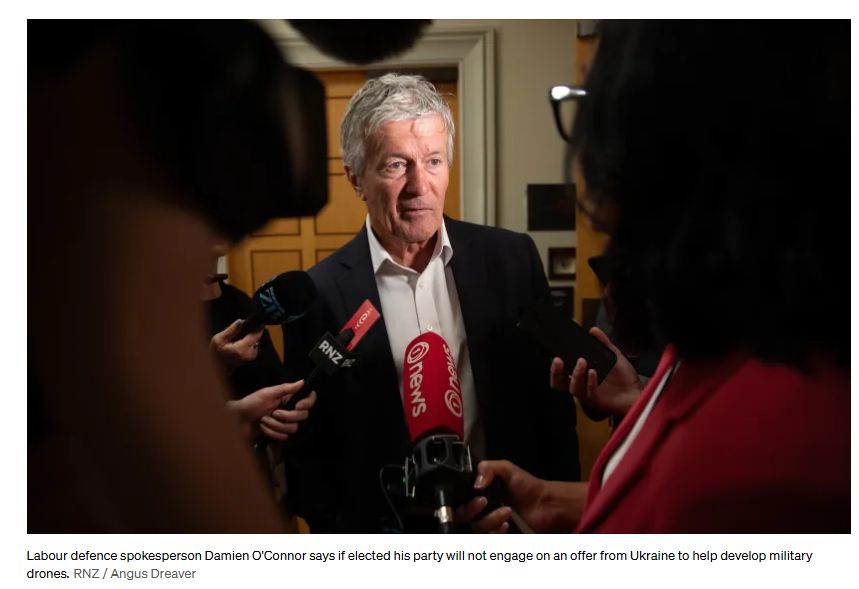
Labour
says it will not engage on an offer from Ukraine to help
develop military drones if elected.
Ukraine’s offer
has been taken up in various ways by over a dozen countries
this year including New Zealand’s Five Eyes
partners.
But defence spokesperson Damien O’Connor
rejected it.
“We had an issue of Ukraine wanting to
sell us drones. It just popped up,” O’Connor told a campaign
meeting in Auckland on Wednesday evening.
“We
shouldn’t engage in that at this point. I don’t know what
the current government will do in the last weeks. But if it
gets back in, who knows where they’re going to
go.”
Earlier however, O’Connor in a statement to RNZ
said while Labour would not support New Zealand purchasing
lethal autonomous weapons and would support international
efforts to ban them, that “outside the scope of that we
would seek advice from officials on the content of any
proposals/approaches made thus far by Ukraine and the
assessment of the risks, costs and benefits of purchasing
drone technology”.
National’s Paul Goldsmith told RNZ
officials had been considering the drone opportunities
raised by Ukraine, including how these could support defence
priorities and New Zealand’s wider support for
Ukraine.
Advertisement – scroll to continue reading
“At this stage no decisions have been made,
and I expect to receive that advice in due
course.”
O’Connor also cast doubt on going ahead with
the $12 billion defence capability upgrade – $9b in new
spending 2025-29 – criticising former defence minister
Judith Collins for adopting it.
“We do have to look at
the defence capability plan, as I said, and check out what
it really means. There’s no money for it.
“Typical
Judith Collins promised all this. There’s no money there for
it.”
If defence was upgraded they would have to choose
the priority areas, O’Connor said.
The 2025 plan
outlined priorities in broad terms such as a naval overhaul,
adding to lethal strike capabilities and more sea and air
drones both for surveillance and strikes.
RNZ in May
revealed Ukraine
put a proposal several times to the government to
co-develop drones leveraging its innovation honed in
Russia’s war.
At that point at least four countries
had signed up to Ukraine’s global push, and now that number
is at least 11. Defence media reports that the US,
Australia, UK and Canada were all making various moves
towards drone deals.
Ukraine’s ambassador to New
Zealand and Australia, Vasyl Myroshnychenko, who made those
offers to New Zealand beginning in 2025, declined to comment
before the election.
“It’s up to New Zealand
government,” he said back in May.
The Defence
Capability Plan or DCP launched last year amid US pressure
globally for more defence spending, put New Zealand on track
to double defence spending in eight years to about 2 percent
of GDP. NATO and some other countries are heading now to
three percent or more.
The US recently praised the
NZDF for buying five new naval helicopters costing about
$2.5b over 10 years of operation.
But O’Connor told
Wednesday’s meeting the primary areas for the NZDF were not
active and lethal engagement – “that’s down the track” – but
disaster recovery and humanitarian support.
He
committed not just to a review of whether buying frigates
was a good idea, but to looking “under the hood” of a series
of military strategic and tactical groups New Zealand has
joined recently.
AUT Pacific historian Dr Marco de
Jong, who sought the commitment, told the meeting, “many of
these were not publicly announced and only discovered later
under the OIA”.
The moves include NZ joining the US
navy’s Project Overmatch to extend joint
command-and-control, US
moves to advance joint defence manufacturing in a new
group called PIPIR, and the NATO
Starlift programme.
O’Connor agreed to look into
them. “Yes,” he told de Jong.
More than once he told
the audience at the Fabian Society meeting that defence was
a complex area and steep learning curve for
him.
Ukraine has described the drone deals as a new
central format for defence cooperation with partner
countries. They can last a decade. Ukrainian teams assess
the level of protection partners require and air
defences.
Ukraine has done drone or drone-related
deals with Saudi Arabia, Qatar, the United Arab Emirates,
Germany, Romania, Estonia, the Netherlands and Denmark,
Norway and Finland.
Canada signed a drone production
deal in May. Forbes reported last month ‘Ukraine Brings Its
Battle-Tested Drone Diplomacy To The US’, saying six
Ukrainian companies had received permission to send drones
to
America.
New Zealand’s public broadcaster, providing comprehensive NZ news and current affairs, specialist audio features and documentaries.
Radio New Zealand is a Crown entity established under the Radio New Zealand Act 1995. Radio New Zealand News are vital elements in our programming, providing impartial news and information to New Zealanders every day. Radio New Zealand (RNZ) provides listeners with exciting and independent radio programmes in accordance with the Radio New Zealand Charter.

