

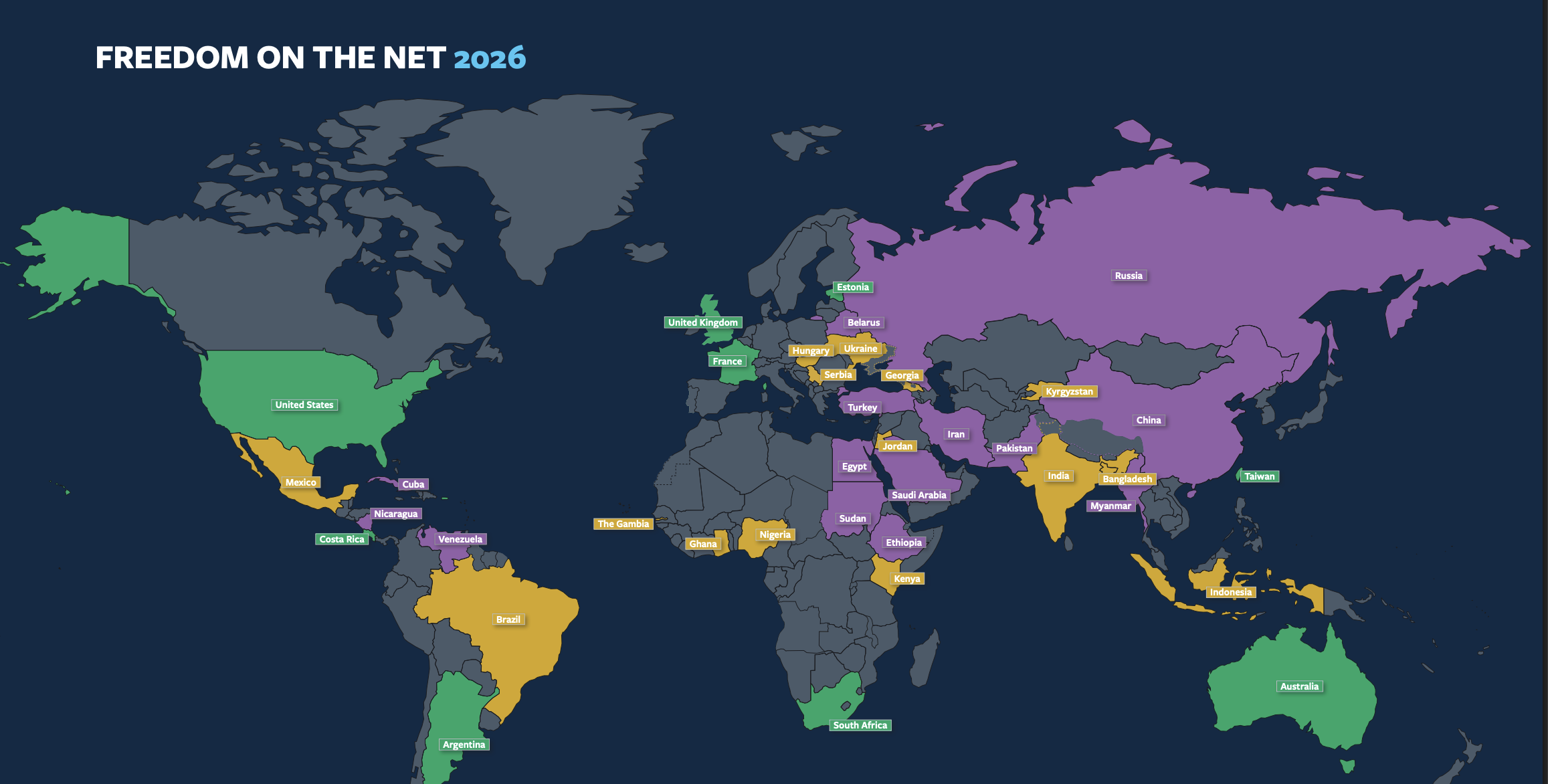
Georgia’s score fell by two points in Freedom House’s 2026 Freedom on the Net report, changing its status from “Free” to “Partly Free,” with the watchdog citing an “extended crackdown” by Georgian Dream authorities on activism and “retaliation” against ruling party-critical online journalists and social media users.
“Georgia’s status changed from Free to Partly Free, as authorities continued to suppress online activism and speech perceived to be critical of the ruling Georgian Dream party,” the report, covering June 1, 2025, to May 31, 2026, reads, assessing Georgia’s overall score at 68/100, down from 70/100 last year.
“Although the country’s internet penetration rate improved, authorities extended its crackdown on online and offline activism related to protests over the ruling Georgia Dream (GD) party’s decision not to pursue integration talks with the European Union,” the watchdog said in its separate, Georgia-focused overview. “Online journalists and social media users critical of the GD increasingly faced retaliation in the form of fines, raids, summons, and investigations.”
According to the report, Georgia lost points in the indicators of “Limits on Content” and “Violations of User Rights.”
The country’s score in Limits on Content decreased from 5 to 4 “because authorities increasingly restricted the space for online and offline mobilizing and used facial recognition technology to track protesters,” Freedom House said.
The score in the second indicator, Violations of User Rights, also fell from 5 to 4 because “an increasing number of fines, summons, raids, and other punitive measures were directed against internet users for their criticism of the government.”
According to Freedom House reports, Georgia’s internet freedom has declined for the past four years, gradually dropping from 78/100 in 2022 to 68/100 in 2026.
The drop in Freedom of Net score follows the Georgian government’s crackdown on public statements and social media posts that authorities and courts deem offensive.
Since early 2025, authorities have gradually increased restrictions on the public statements they consider “insulting,” including through legislative amendments and legal actions against critics.
It has intensified since the Interior Ministry established its Division for Combating Hate Speech in June. The unit monitors “hate speech” in public spaces, including social media, and files complaints with courts, often without a request from the person deemed to have been “insulted.” It has been involved in dozens of cases leading to fines of 1,500 to 6,000 GEL over social media posts and comments, as well as administrative detentions.
In the latest such case, Vakho Sanaia, the opposition-leaning Formula TV anchor and journalist, was sentenced to 30 days of administrative detention after the Interior Ministry filed another complaint against him over social media posts the Ministry deemed insulting to Georgian Dream figures.
Also Read:

