



Nik Dirga
Digital Explainer Editor
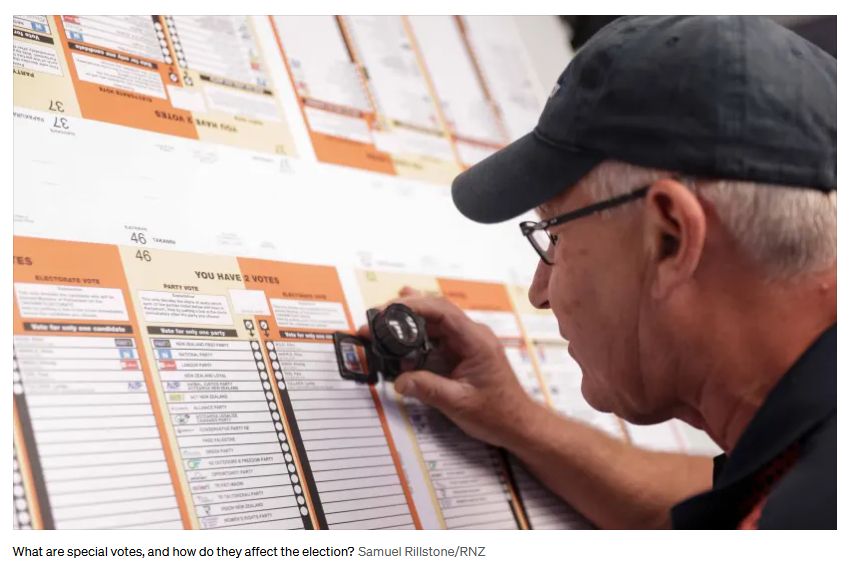
Explainer
– Election Day is coming up fast, but don’t expect complete
clarity on 7 November, thanks to special
votes.
Special votes, which are counted slower, have
shifted preliminary election results the last several times.
And they may well do it again in 2026.
Here’s what you
need to know about what makes a vote special, why they take
longer to sort and why some may end up getting
discarded.
What are special votes?
Special
votes are made by anyone who isn’t on their electoral roll
at their voting place, on the unpublished roll, lives
overseas or votes away from a polling place because they
can’t get to one.
When you cast a special vote, you
must also sign a declaration form that must be witnessed by
another enrolled person. (If you vote at a voting place,
that witness can be an Electoral Commission volunteer or
staff member.)
And if you have yet to enrol for this
year’s election – remember the absolute
latest you can do that is by midnight on Sunday, 25
October – you will be casting a special vote.
Advertisement – scroll to continue reading
The
printed roll for this year’s election closed on 4 October,
which was
Writ Day. Any voter who enrols after that must cast a
special vote.
“The number of special votes, and the
proportion they make up of the overall vote, have increased
in recent elections,” an Electoral Commission spokesperson
told RNZ.
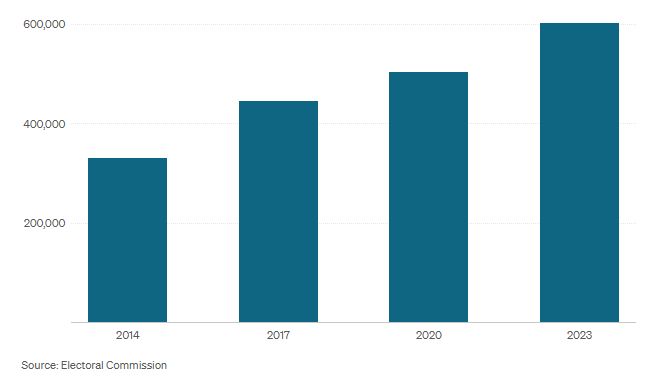
“Over 600,000 special votes were issued in
2023 – meaning 21 percent of voters cast a special
vote.”
Special votes over time
Special votes
recorded by the Electoral Commission in general elections
from 2014-2023
Richard
Shaw, professor of politics at Massey University, noted that
in the last election many people enrolled during the early
voting period – which will no longer be allowed due to the
government changing the
deadline so you must be enrolled 13 days before the
election.
In 2023, “450,000 people enrolled or updated
their enrolment during the voting period; 110,000 did so on
Election Day itself,” Shaw said.
Despite the changes
to enrolment, the Electoral Commission expects as many as
700,000 special votes this year.
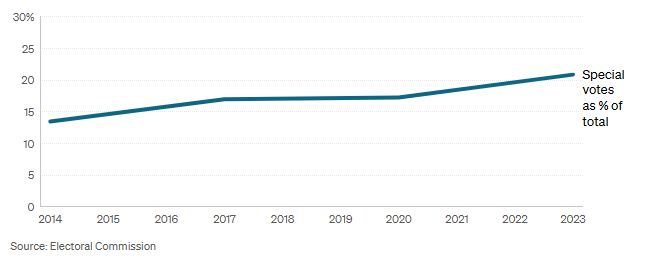
The number of special
votes has been steadily rising in recent elections, up from
13.5 percent of the overall total in 2014.
Special
votes returned out of overall vote
How special votes
have changed as a percentage of the overall votes cast from
2014-2023 in general elections
Have
special votes made a difference in past
elections?
They have. In the last three general
elections, the final
results including special votes have seen National lose
two party seats and some electorates have changed sides from
the preliminary tally.
It means that even after
Election Day on 7 November and preliminary results come in,
we may not know the final, final results for a couple
of weeks.
Special votes generally tend to benefit the
left-leaning parties.
Shaw said that tends to reflect
the demographics of those who cast them: “typically younger;
typically more mobile (eg renters); typically a little less
attached to institutional politics”.
“Those groups
don’t always break left, but they tend to. Or they tend not
to engage at all.”
In 2017, 2020 and 2023, National
lost two seats with special votes, while Labour gained one
in 2017 and 2020, Te Pāti Māori gained one in 2020 and two
in 2023, and the Greens gained one party seat in 2017 and
2023.
The Electoral Commission is predicting it will
take up to 20 days to total special votes. The commission
said it has found ways to improve the speed of its checks,
but it’s still a lengthy process.
“Our forecasts
indicate we could receive around 700,000 special votes,
which take up to ten times longer to check and count,” the
Electoral Commission spokesperson said.
“If our
forecast is right, then we will need 20 days to do all the
required checks and deliver final results.”
This
year’s election does away with being able to enrol to vote
and cast a ballot all the way up to Election Day.
That
change is likely to affect special votes, Shaw
said.
“There will almost certainly be a higher rate of
rejection of special votes this time round.”
“At this
point, of course, we have no way of knowing how many people
are going to show up and cast a special which won’t be
counted … some specials will be tallied, of course,
because they are overseas votes or people out of their
electorate or whatever, but plenty won’t.”
Why
do they take longer to count?
They have a stricter
checking procedure, and any overseas votes can also take
longer to process. In 2023 it took three weeks for special
votes to be counted to confirm the election
results.
By law, 10 days are allowed for votes to be
returned from overseas.
Special votes have to be
returned to the electorate they were cast for before they’re
counted. Every special vote declaration is checked to make
sure the voter is enrolled and eligible to vote.
“We
check the voter was enrolled in the electorate where they
voted, and check that the special declaration form has been
completed and witnessed,” the Electoral Commission
spokesperson said.
“Special votes that are allowed can
only be counted after these checks have been done. Votes are
tallied and quality assurance checks are made before we
release the results.”
Shaw said overseas votes, once
they’re counted, could also affect how the election shakes
out.
“The overseas voting population is interesting
this year: there are more of them than previously (and at
least some of them are presumably people who have left the
country while they might rather have remained, had the
economic conditions been better), so that might count
against the incumbent administration too.”
The
government pushed
for this year’s changes to enrolment deadlines and one
of the reasons it gave was to speed up vote
counting.
“I just think three weeks is way too long to
count special votes, I think that needs to be sped up,” Prime
Minister Christopher Luxon said in 2023.
However,
when those enrolment changes were still being considered
last year as part of the Electoral Amendment Bill, Chief
Electoral Officer Karl Le Quesne said
it ultimately wouldn’t make results arrive any
faster.
“We’re forecasting that there’ll still be
around 700,000 special votes we’ve got to run through all
these integrity checks,” he said then.
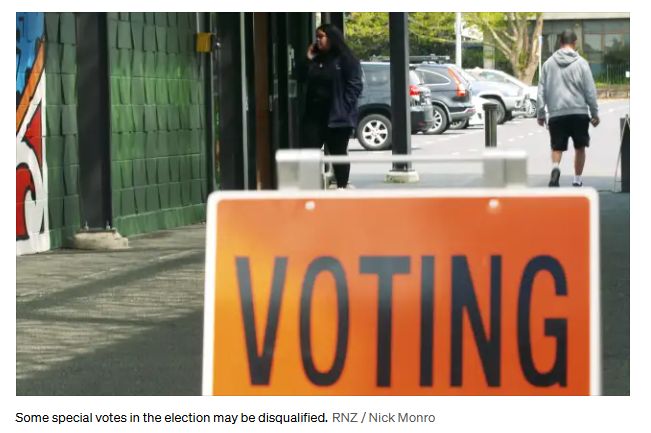
Why
can special votes be tossed out?
In the 2023 general
election, 15,555 special votes were
disqualified.
“Reasons special votes are disallowed
include if the voter is not enrolled, the vote received was
late, or the declaration was not signed by an authorised
witness or not signed by voter,” the Electoral Commission
spokesperson said.
The Electoral Commission has a full
breakdown of why special votes were disallowed broken down
by electorate on
their website.
By far the biggest reason was that
voters were not actually enrolled at all, with 10,566
discounted for that reason. Far behind was having a
declaration not being signed by an authorised witness, with
2384 rejections.
In last year’s Auckland local body
elections, nearly
half of the special votes were
disqualified.
Auckland Council said 4162 special
votes were deemed invalid, due to incorrect or missing
declaration details, or outdated enrolment details. Special
votes were only 1.68 percent of the total vote cast, it
said.
Similar high rates of disqualification were seen
in Kaipara’s
local council election.
However, it’s important to
note that local body elections are not run by the Electoral
Commission, but by local councils, and can have different
rules and procedures.
In a council post-mortem
on the Auckland local elections, it was found that “in
most cases the reason for the declaration not being in order
was the required ‘occupation’ field left blank, leading to
special votes being disallowed on what could be perceived as
a technicality.”
That occupation requirement is no
longer needed in parliamentary elections.
“For the
general election, the required fields on special voting
declaration forms are your name, the grounds (reason) for
casting a special vote, and your signature,” the Electoral
Commission spokesperson said.
“Some special voting
declaration forms may still include an occupation field.
This field is no longer required and can be left blank. We
are gradually phasing out older versions of the form that
include this field.”
The Auckland Council’s report
said that in the future “a similar amendment should be made
to remove the requirement to include occupation from the
special voting declaration for local elections”.
“Why
should providing your occupation determine whether your vote
is counted?” City Vision candidate Raphaela Rose asked The
Spinoff in a report on the invalidated local body
votes.
Only 29 percent of those eligible voted in
Auckland in 2025, and Auckland has moved to remove
postal voting at the next local body elections and
require in-person voting.
Shaw said the changes to
voter enrolment this year are a bit of an X-factor in trying
to figure out how important special votes will be in
November’s election.
“One possibility, given the new
policy settings, is that special votes are less, not
more, important as far as the final outcome is concerned, in
the sense that there may well be fewer of them that count
this time round.
“In another respect, they might be
more consequential – if there is a large number that
are disqualified, that may cast shadows over any
outcomes.”
New Zealand’s public broadcaster, providing comprehensive NZ news and current affairs, specialist audio features and documentaries.
Radio New Zealand is a Crown entity established under the Radio New Zealand Act 1995. Radio New Zealand News are vital elements in our programming, providing impartial news and information to New Zealanders every day. Radio New Zealand (RNZ) provides listeners with exciting and independent radio programmes in accordance with the Radio New Zealand Charter.

