

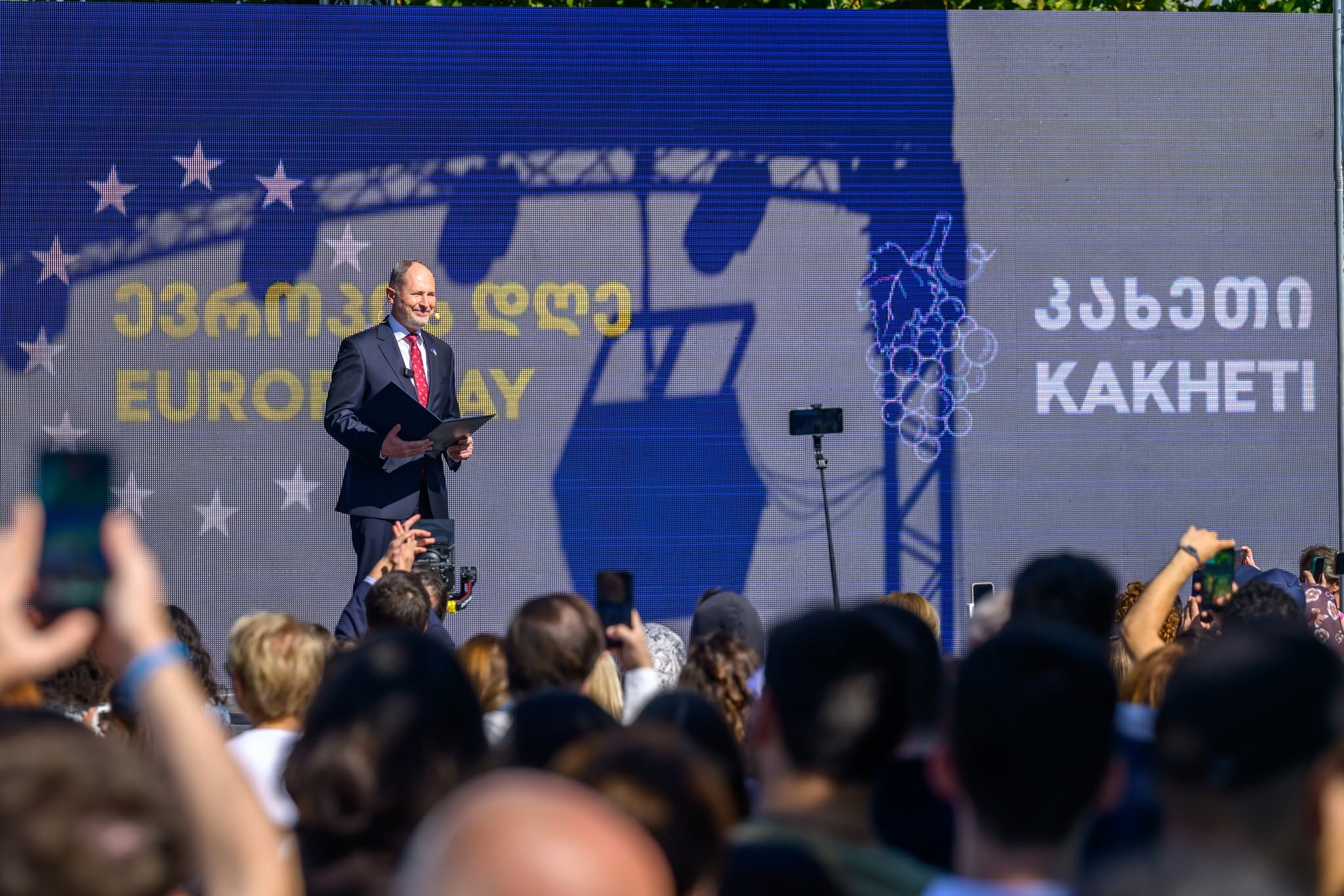
EU Ambassador to Georgia Pawel Herczynski announced plans for EUR 38 million in new EU-funded projects to support rural development, businesses, women’s empowerment, and environmental protection, hoping to sign the projects by the end of this year “in spite of the current challenges.”
“I also want to use this opportunity to announce the new projects financed by the European Union: 38 million euros of new projects that we hope to sign by the end of the year in order to support rural development, in order to support small and medium-sized businesses, in order to support women’s and girls’ empowerment, to support environmental protection, everything that the European Union has been doing for Georgia for over 30 years,” Herczynski said, speaking to journalists during the Europe Day celebration in Georgia’s eastern Kakheti region on October 10.
“We will continue in spite of the current challenges. Once again, everyone is warmly invited,” he noted.
The announcement comes amid continued strain in EU-Georgian relations, with the EU “de facto” halting Georgia’s integration in 2024 amid democratic concerns and reducing contacts with the Georgian Dream government. The EU officials have repeatedly stated that Georgia remains a candidate country “in name only,” while recent EU reports also noted that the bloc “continued to halt financial assistance directly benefiting Georgian authorities.”
The event was open to the public, with representatives of EU member state embassies, beneficiaries of EU-funded projects and journalists also invited.
Addressing participants in Georgian, Herczynski emphasized the longstanding relationship between Georgia and the EU, while acknowledging the deterioration in bilateral ties.
“While recent anti-European rhetoric severely damages this close bond, it cannot alter it,” Herczynski said. “The history built over decades cannot be rewritten or forgotten in just a few years. We will continue supporting Georgia’s democratic and European future.”
The plans for new projects come as Georgian Dream has continued to restrict foreign funding directed towards civil society and media support, including through a series of laws and amendments. It also follows the recent announcements by two German political foundations, the Friedrich Naumann Foundation for Freedom and the Konrad Adenauer Foundation, that they were exiting Georgia after Georgian authorities rejected their funding applications under stricter grant laws.
Also Read:

