

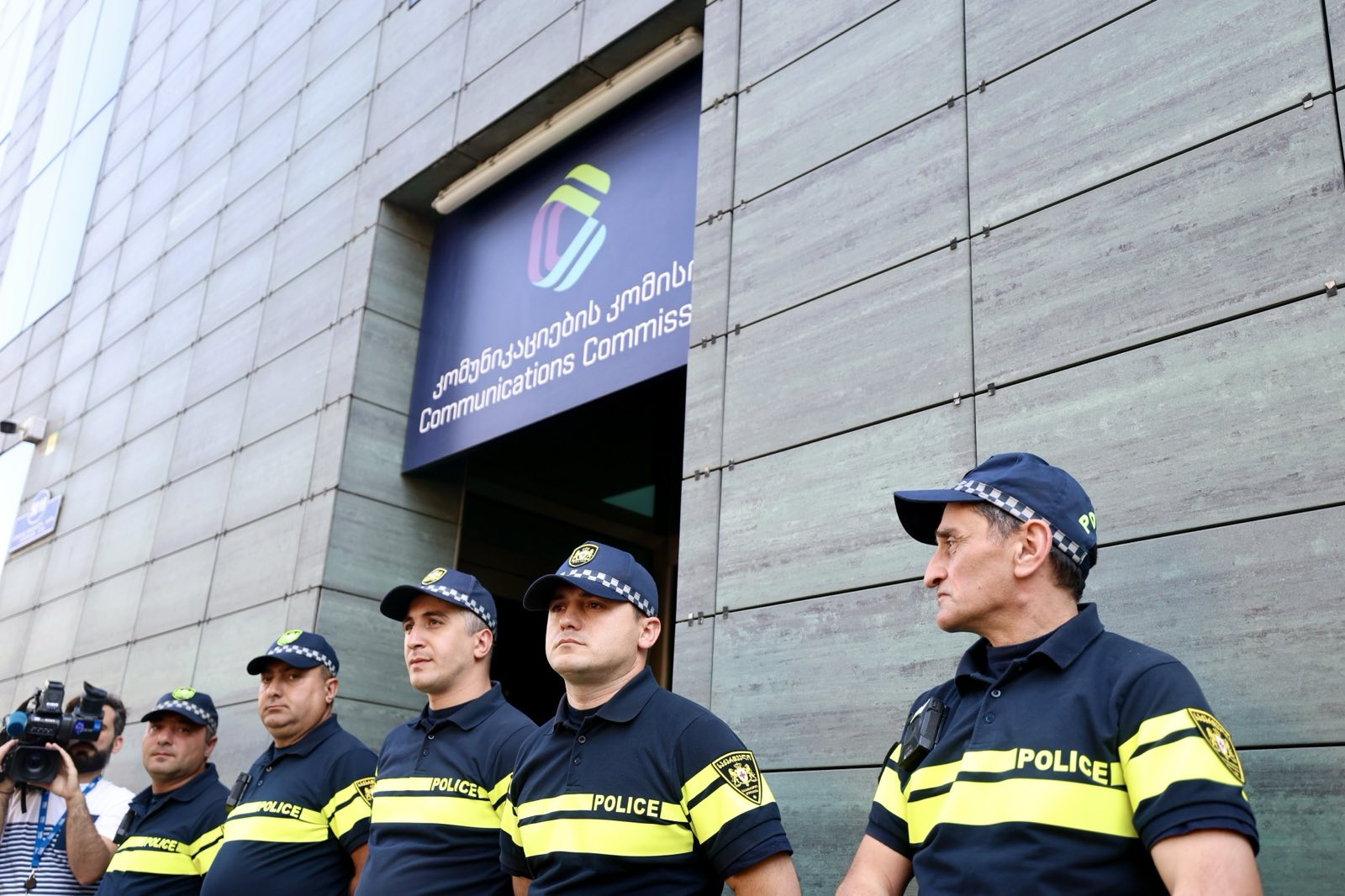
Transparency International (TI) Georgia, a local civil society organization, says it identified 93 distinct words and phrases that the Communications Commission, Georgia’s media regulator, “prohibited” government-critical broadcasters from using following last year’s amendments to broadcasting laws, which gave the regulator greater control over TV and radio content.
The watchdog said it identified the phrases after reviewing seven decisions issued by ComCom, a public agency chaired by a former ruling party MP, concerning government-critical broadcasters TV Pirveli and Formula. Both of these channels have been fined several times after the regulator found them in violation of amended broadcasting laws.
“The review found that the Commission prohibits critical broadcasters from using a total of 101 words and/or phrases: 33 in the case of TV Pirveli and 68 in the case of Formula,” TI Georgia said in its October 9 report. In some cases, the words and phrases prohibited for the two critical broadcasters overlap. Overall, the Commission prohibits the use of 93 distinct words and phrases.”
The list includes terms such as “regime,” “prisoners of conscience,” “oligarch,” “false-witness police officers,” “political prisoners,” “political hostages,” “repressive policy,” “Ivanishvili’s prime minister,” “the so-called education reform,” “Georgian Dream police,” “unlawful imprisonment,” “the Scroll-Screenshot Department,” “Georgian Dream government,” “repressive laws,” “the regime’s court,” “Ivanishvili’s president,” “Georgian Dream’s State Security Service,” “judicial clan,” among others, according to TI-Georgia.
In addition to prohibiting specific words and phrases, the watchdog argued that the regulator “requires critical broadcasters to report the news in a dry manner, stripped entirely of commentary and analysis.” According to TI Georgia, the memoranda also identify statements by journalists and presenters that the Commission considers unacceptable, citing several examples.
The watchdog emphasized that it is “deeply concerning” that ComCom “has the power to regulate broadcasters’ content and, on this basis, impose financial sanctions and suspend their broadcasting licenses.” It also argued that, amid what it described as “firmly established and clearly evident state capture in Georgia,” the Commission has for years been composed of commissioners “loyal to and affiliated with Georgian Dream.”
TI Georgia noted that questions remain over the Commission’s decisions and concerns persist that “it has acted to advance the interests of the ruling party and in a biased manner,” warning that “the Communications Commission should not operate as a censor, nor should it be used as a mechanism for punishing critical broadcasters.”
Citing “international practice,” the organization said that “disputed issues should instead be addressed through self-regulatory mechanisms,” and that “promoting and supporting self-regulation should be one of the Commission’s primary objectives — rather than serving the interests of Georgian Dream and penalizing broadcasters for criticizing and exposing representatives of the ruling party.”
The watchdog also warned that the ComCom “continues to act as a censor,” citing its October 1 decision to fine Formula TV GEL 10,000 (USD 3,850) over what the regulator described as violations of impartiality requirements, arguing that the broadcaster’s coverage was based on “personal views.”
“Overall, over the past six months, the Commission has issued formal reports against critical TV channels TV Pirveli and Formula on this same basis seven times – four times against Formula and three times against TV Pirveli,” TI Georgia said.
It added that “most likely,” the ComCom will continue what it called “this harmful practice,” and “will fine TV Pirveli for the same reason. This is because the Commission typically follows a predictable pattern, moving in a cycle and penalizing broadcasters one after another.”
“It is clear that, through this approach, the Communications Commission is seeking to cripple television channels that are already operating under severe financial constraints. The Commission also has the authority to suspend their broadcasting licenses, which is particularly alarming,” Ti-Georgia argued.
ComCom’s Enforcement Record
The findings come amid growing concerns over the expanded powers granted to ComCom to regulate broadcasters’ content under last year’s legislative amendments to the Law on Broadcasting. Critics have long accused ComCom, currently chaired by former ruling party lawmaker Goga Gulordava, of acting in line with the ruling party’s interests.
ComCom has imposed sanctions on both pro-government and opposition-leaning broadcasters over alleged content-related violations under the amended Law on Broadcasting.
The regulator issued a written warning to four television channels, including pro-government Imedi TV and POSTV, and TV Pirveli and Formula TV in April, citing “violations of principles of impartiality” which came shortly after ComCom said it would take a more proactive approach to enforcement, while criticizing the UK’s decision to sanction Imedi TV and POSTV over “Russian disinformation.”
In May, Formula TV was fined GEL 2,500 over alleged breaches related to “personal opinions,” “impartiality,” and “balance,” while in July, the regulator issued a GEL 5,000 fine on the TV channel.
TV Pirveli has been fined twice under the amended rules. In June, ComCom fined the broadcaster GEL 2,500 over its use of terms including “prisoners of conscience” and “oligarch.” In August, the Commission imposed a second fine of GEL 5,000 over language it said reflected the broadcaster’s personal opinions and violated requirements for accuracy.
ComCom issued a written warning to pro-government broadcaster Rustavi 2 in August, saying the channel had violated “impartiality principles” under the amended Law on Broadcasting.
Also in August, the pro-government POSTV was fined GEL 2,500 over coverage that the regulator said contained personal opinions and failed to report the facts with due accuracy.
While TI Georgia acknowledged that ComCom had also placed pro-government broadcasters under monitoring, it questioned whether the process is meaningful.
“Observing the process leaves the impression that this has been merely a formal exercise, intended to present the Commission to interested parties as an objective observer and arbiter,” it argued. “From the outset, it appeared clear that the Commission’s primary objective was to penalize critical media outlets and weaken them and/or force them out of business through financial fines.”
Also Read:

