



Phil
Pennington Reporter
The
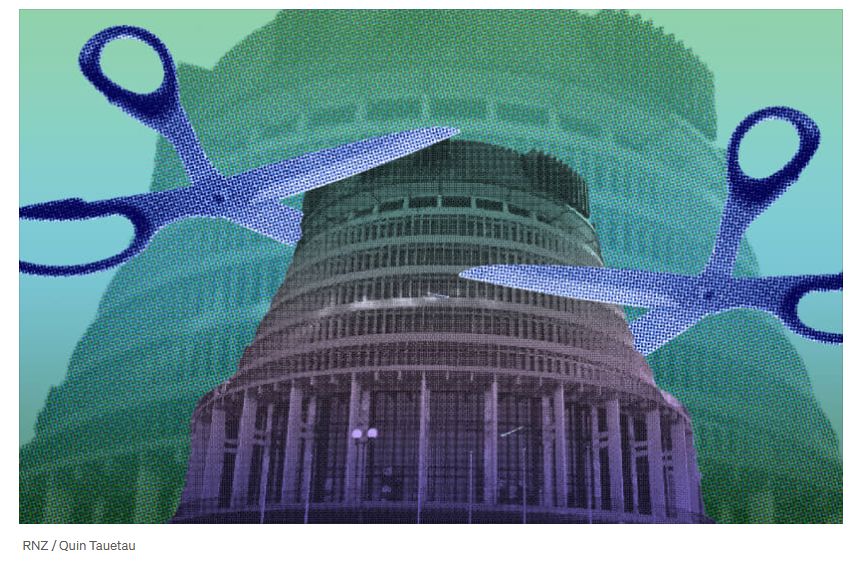
government’s recipe for cutting thousands more public sector
jobs demands using AI much more. RNZ looks through 16
documents that led up to
Nicola Willis’s announcement in May that 8700 jobs would
go.
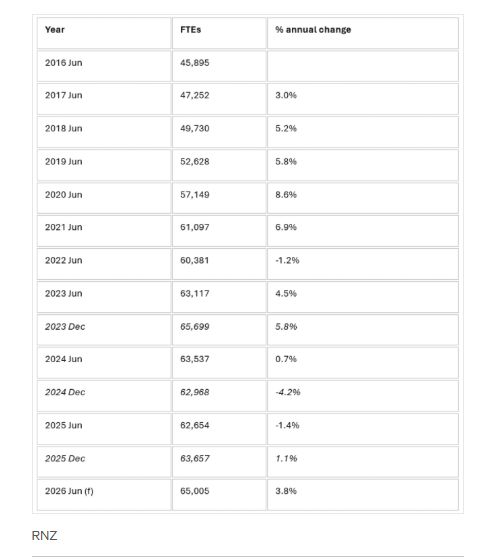
The core public sector workforce has proven
stubbornly hard to cut and earlier this year, at 64,500, was
larger than when the government came in.
In April,
officials were working on a new model and goal to trim it to
60,000 by 2029 when, three weeks out from the Budget Public
Service and Digitising Minister Paul Goldsmith told them to
“think about 55,000 as a starting point”.
Officials
came back to him saying 55,000 could exacerbate the risks to
performance.
“We would advise extending the
timeframe”, say, by another two years to 2031, they told
him.
Yet within days of that, the architect of the
sector changes, Public Service Commissioner Sir Brian Roche,
had backed the more aggressive 2029 timetable – and even
advocated cutting jobs further.
“We remain open to a
lower … number,” he wrote to Goldsmith in April, the
recently released documents show.
Advertisement – scroll to continue reading
As it was, 55,000
“will be challenging and will involve a higher risk
tolerance from both ministers and chief executives”, he told
the minister.
But it should be done.
“It
should be seen as a minimum so that as the transformation is
implemented the full impact and value of AI is
captured.”
It would require a shift from jobs to
technology, and reconsideration of how services were
delivered, said Roche.
“It will mean a much [more]
aggressive/targeted approach to AI.
“It will require
chief executives, with ministerial oversight, to identify
programmes that can be stopped. We have tried this before
with very limited success.”
But the payoff would be
transforming a fragmented system that imposed “massive”
costs on the economy into a streamlined, consolidated,
digitised public service that, crucially, delivered better
services, was the message.
It would be complex: Cuts
in some places would have to be deep enough to account for
growth in other service delivery – “front-line” –
roles.
It would also be “noisy” in the public and
media, said Roche, but he would strongly defend
it.
“If it was my business and my money this is what I
would do.”
Election issue
Public services and
how to afford them are being freshly debated in the election
campaign.
On Wednesday, Labour contended on Morning
Report’s political
panel that “fiscal restraint” had translated into public
service cuts pushing costs onto New Zealanders.
MP
Arena Williams said that though Treasury had already
factored in “big cuts” to come, not even the department
heads who had to make them knew what would
go.
Goldsmith responded, “I’ll tell you what we’ve
cut, we’ve cut waste and there was an enormous amount of
waste.”
‘This is what you have asked me to
do’
The documents chart the advice primarily from the
Public Service Commission to their minister, either Judith
Collins or later on Goldsmith, from August to just after
Budget 2026 in May.
RNZ had sought them since June but
its OIA request was transferred and delayed.
Back in
August 2025, Roche had been working for some time on a model
to reduce the core public sector from 42 agencies down to
15-20 over three to five years “underpinned by common
technology and a lot more AI”.
“This is what you have
asked me to do,” he said ahead of meeting PM Christopher
Luxon, Finance Minister Willis and associate minister Chris
Bishop.
Four
percent staffing growth was forecast for 2026, partly to
meet government priorities. Upward pressure was coming from
an expanding Corrections Department and other
“customer-facing” departments like IRD. MSD, MBIE and Oranga
Tamariki were others that had pushed up the headcount since
2017.
The non-core public sector had expansionist
tendencies too, especially at Health New Zealand,
“responsible for a large proportion of total expenditure”
with its 80,000-strong payroll.
“We are seeking
further assurance from Health NZ that they will not exceed
their annualised projections,” the Public Service Commission
told the government just after the Budget.
Days before
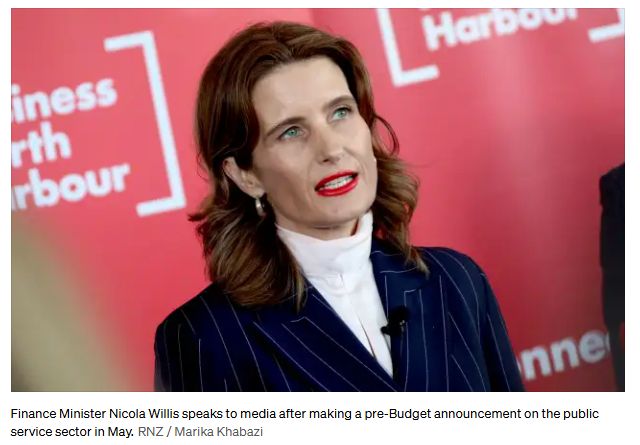
that, Willis had announced the cut in the core of 8700 roles
by 2029 to end “a period of largesse under the last
government”, and castigated the sector’s “dangerously slow
take-up of digital and AI technologies”.
Back to
front
The documents show officials had by early May
2026 adopted the 55,000 target – 1 percent of the
population, the same size as in 2017 – as well as a cap on
core numbers.
A lot of debate and advice about the
numbers and how to cut led up to this.
In November,
officials discussed a cut to 57,400.
“However, this
level of reduction in workforce size has not happened since
the reform period [of the early 90s] and would entail risks
to front-line services.”
A
cap sent a clear signal of intent but “a cap-only approach
could lead to a reduction in the quality of public services,
and potential regulatory failures”. Robust fiscal levers
were a better tool for shrinking things.
Other advice
about the why and wherefore of cutting to 60,000 or 55,000
fill scores of pages over the months, though there is little
detailed modelling of implementation, savings or the costs
of using more AI.
Since 2024, the key message from
government to the public has been that the cuts would target
the back-office – managers, policy analysts, information
professionals, ICT professionals and technicians, legal, HR
and finance professionals – and not impact the front
line.
The documents state by late 2025 the back office
outnumbered the front line by 4500.
“However, many of
these roles support frontline services indirectly,” the
Public Service Commission told ministers.
“Back-office
reductions could therefore impact service delivery and the
uptake of new technology if not carefully
managed.”
‘Enabling deeper …
transformation’
A key part of the ‘recipe’ – a 4 May
document about managing back-office cuts and implementing
the transformation – was mostly blanked out on the grounds
of protecting the confidentiality of advice.
It was
written to ask Cabinet to agree to the 55,000 target by
mid-2029.
In unredacted bits it said, “Meeting these
milestones is ambitious … It will require difficult
choices and trade-offs to ensure these investments into
service delivery are effectively offset by reductions in
other areas.
“Altering targets in departments with
substantial service delivery elements (such as Corrections
and Oranga Tamariki) would have an outsized effect across
the Public Service, which creates a significant risk to
achieving the cap.”
It said a medium-term plan was
required.
“We also need to establish a process for
enabling deeper public service
transformation.”
Figuring the savings
Willis
in May gave an explicit forecast of the 8700 job cuts saving
$597m a year or $2.4b by 2029.
That figure does not
occur in the 16 documents.
These major on saving $103m
a year for every 1000 jobs shed, minus $52,500 per
redundancy – or half a billion dollars total.
While
the redundancies are a one-off cost, the savings from
sticking at 55,000 would continue on, as long as spending
externally on contractors and consultants did not reverse
its slide, to compensate.
The papers do not model how
many jobs AI might remove or enhance services while they do
that.
They do not delve into how much the AI rollout
will eat out of savings – some commentators have warned
AI developers will likely ramp up the price of tokens
and licensing once competition sifts out the
winners.
Rather, officials said the exact savings were
still to be determined following detailed decisions on
implementing the transformational
elements.
New Zealand’s public broadcaster, providing comprehensive NZ news and current affairs, specialist audio features and documentaries.
Radio New Zealand is a Crown entity established under the Radio New Zealand Act 1995. Radio New Zealand News are vital elements in our programming, providing impartial news and information to New Zealanders every day. Radio New Zealand (RNZ) provides listeners with exciting and independent radio programmes in accordance with the Radio New Zealand Charter.

