

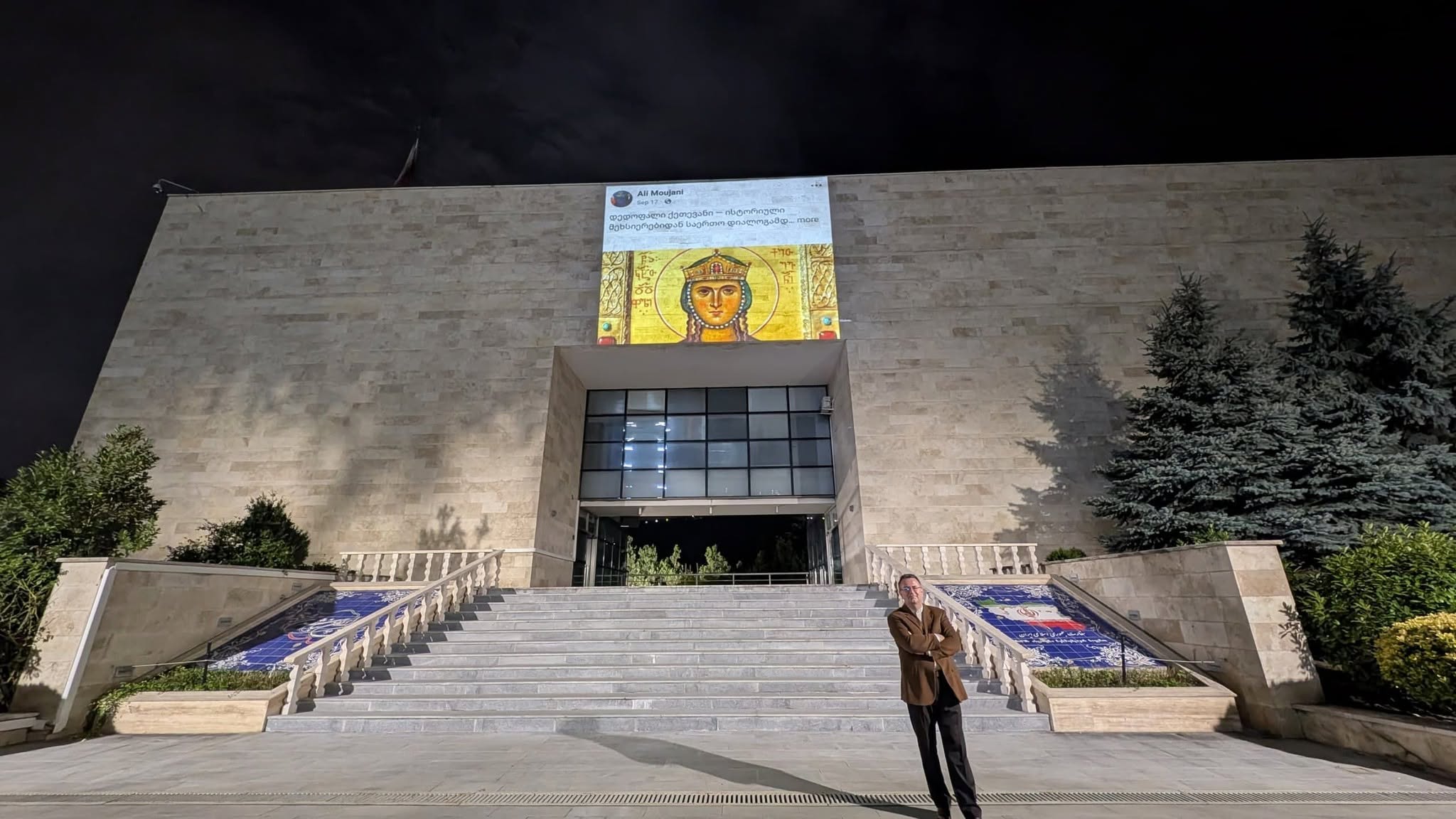
The Georgian Ministry of Foreign Affairs (MFA) summoned Iranian Ambassador Seyed Ali Moujani after his controversial remarks about offering to share his research and pointing to “differing histories” regarding Queen Ketevan, a canonized Georgian monarch tortured to death at the Persian hands in the 17th century after refusing to convert to Islam.
The remarks, which followed earlier controversial statements by the ambassador regarding Georgian history and the country’s foreign policy stances, drew ire in Georgia, including from government-critical voices but also from otherwise cautious ruling party lawmakers and Georgian Orthodox Church representatives.
According to MFA’s September 30 press release, Deputy Foreign Minister Aleksandre Khvtisiashvili “explained to the Iranian Ambassador that the statements he had made on social media went beyond the bounds of diplomatic activity.”
The Ministry also cited Khvtisiashvili as saying that similar statements “negatively affect public attitudes,” hoping that “the Iranian side will take proper measures to ensure that similar incidents do not repeat, so that it would not become necessary for the Georgian side to take additional measures.”
The deputy foreign minister also explained during the meeting that “diplomatic representatives accredited in Georgia should conduct their activities within the scope of their diplomatic mandate and competence, observe established norms of diplomatic relations, and refrain from interpreting the history and domestic affairs of the host country,” according to the press release.
Remarks on Queen Ketevan the Martyr
In a September 25 Facebook post, the Iranian Ambassador uploaded his picture standing against the background of the Iranian embassy, with what appeared to be his own Facebook post featuring Georgian medieval queen-regent and martyr Ketevan projected onto the building’s facade.
Moujani said the queen’s projection was a symbol of the “historic memory” over which “multiple differing histories [narratives]” exist to this day, and pledged to share the “preliminary results” of his research “concerning Queen Ketevan, as well as documents and historical sources preserved in Iran and Georgia.”
While comments by Georgian users initially appeared under the post thanking the ambassador for his efforts, the remarks gradually attracted widespread backlash. The ire first came from figures critical of the Georgian Dream government over its perceived soft stance toward Iran, before spreading to ruling party and Church members.
Queen Ketevan, the 17th-century queen consort of Kakheti, was tortured and executed in Shiraz (Iran) in 1624 after refusing to renounce Christianity and convert to Islam. Canonized by the Georgian Orthodox Church, Ketevan the Martyr occupies an important place both in Georgian history, shaped by tense relations with Persia, and in Georgian Orthodox Christian theology.
St. Ketevan’s day is marked on September 26, an occasion apparently used by the Iranian ambassador to make his statement.
The ambassador stressed that his publication would represent neither an “official account” nor an attempt to establish a definitive version of Ketevan’s history, “rather, it will be a historian’s personal perspective and assessment at this stage of the research.”
“Perhaps rethinking such histories can serve as a way for us to know one another better and more deeply today rather than to return to the past,” he concluded.
Moujani Advised to Remain ‘Within Diplomatic Bounds’
Historian Beka Kobakhidze, a professor at Ilia State University, questioned what Moujani meant by “differing stories” of Ketevan’s fate.
“This man says that there are different views on the matter and that he intends to discuss them. What does he mean by ‘different views’?” Kobakhidze told opposition-leaning channel TV Pirveli.
“It is a firmly established historical fact that Ketevan the Martyr was tortured and put to death by Shah Abbas [the Safavid ruler of Persia] and that is precisely why Ketevan the Martyr was canonized as a saint,” he said. “What ‘different views’ are we even talking about?”
Defying their own earlier restraint in commenting on Moujani’s statements, ruling Georgian Dream party representatives also weighed in, with Nikoloz Samkharadze, chairman of the disputed Parliament’s Foreign Relations Committee, advising Moujani to “remain within the bounds of diplomatic protocol and refrain from delving into historical interpretations.”
Georgian Orthodox Church clergy also expressed their dissatisfaction, with Protopresbyter Giorgi Zviadadze telling TV Pirveli that “any attempt to alter history, to give it some other interpretation or find some other basis for it, is absolutely unacceptable.”
“Queen Ketevan is a luminary of the Georgian Church and a Great Martyr, and naturally the Church’s position on this matter is unequivocal: she was martyred, of course,” Zviadadze said.
Bishop Anton, the Metropolitan of Vani and Baghdati, also suggested the ambassador’s initiative would not go unanswered.
“One thing I know for certain is that we will not leave this without a response,” he said. “It may be some kind of provocation; perhaps they want to escalate the situation. If the Patriarchate determines that a response is necessary, it will definitely respond.”
More to follow…
Also Read:

