

Georgia’s State Audit Office started studying the funding of the Tbilisi School of Political Studies, a popular seminar project running since 1999, over a possible breach of Georgian grant laws, after pro-government media and Georgian Dream officials suggested that the Council of Europe may be funding the project by bypassing the law requiring government approval before grants can be disbursed.
The review, the first such public case since the agency absorbed the functions of enforcing restrictive foreign funding laws following the dismantling of Georgia’s Anti-Corruption Bureau, follows days of attention from Georgian Dream officials and pro-government media over a recent session of the school held in Bakhmaro, a mountain resort in western Georgia.
“Monitoring regarding possible receipt of a grant by N(N)LP [Non-entrepreneurial (Non-commercial) Legal Person] Tbilisi School of Political Studies without the consent of the Georgian government has been launched by the Department of Transparency of Funds of the State Audit Office,” the agency said on September 21, noting that it will act within Georgian legislation, including the Law on Grants.
For decades, the Tbilisi School of Political Studies has run seminars that have attracted political and civic leaders and professionals. The school has long been led by Armaz Akhvlediani, who served as an opposition lawmaker in 2021-2024. Initially running on the European Georgia party list in the 2020 elections, Akhvlediani later split with the party to become one of the opposition MPs who signed the EU-brokered April 19, 2021 agreement to end the parliamentary boycott.
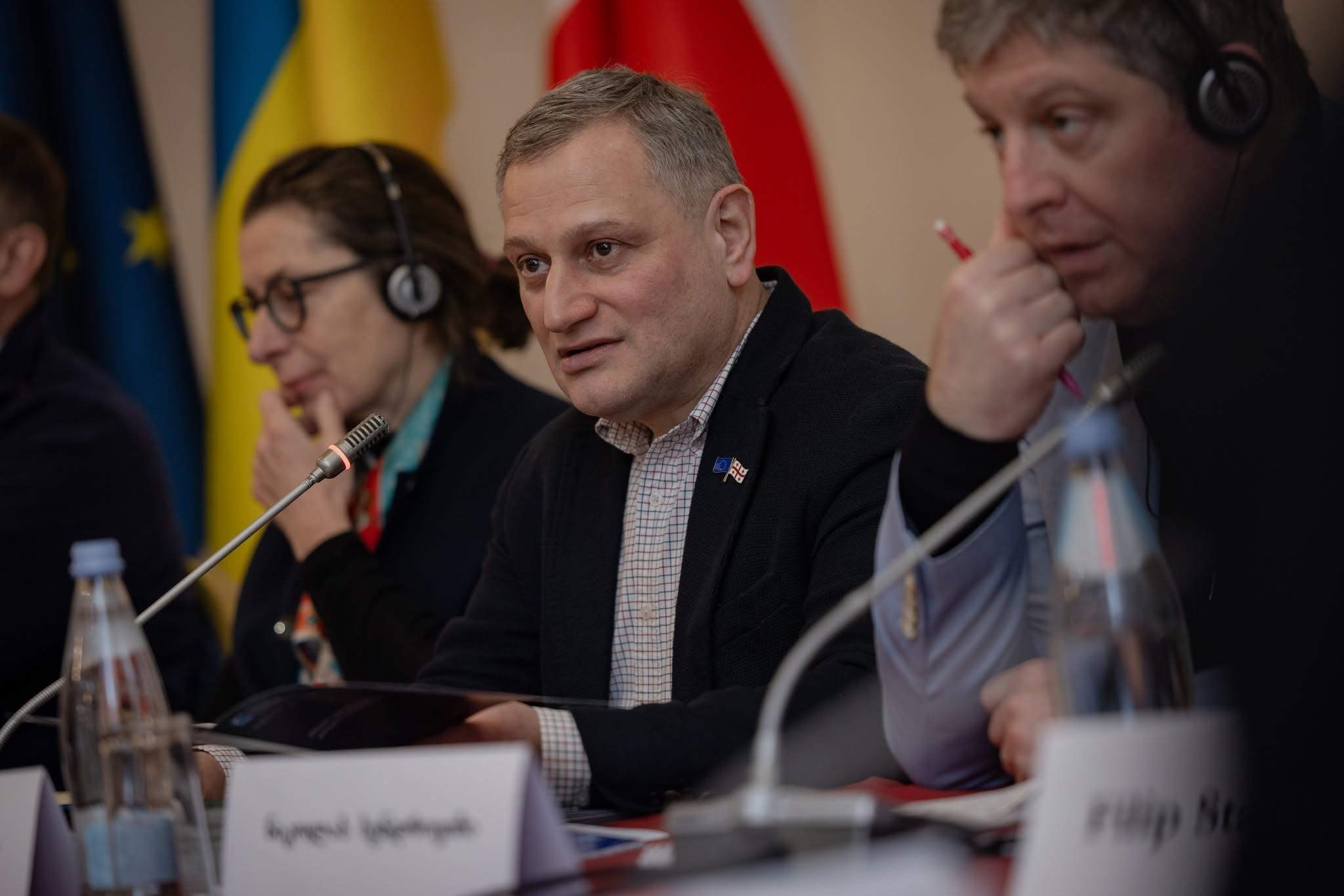
In its September 18 report, pro-government Imedi TV scrutinised the seminar over a possible breach of the grants law, with its crew arriving in Bakhmaro and putting questions to participants and diplomats attending the event, including EU Ambassador Pawel Herczynski.
Akhvlediani was seen telling an Imedi TV journalist, “As for your laws, which are inherently unjust and unlawful, I must tell you that the time will come when all of this will be reviewed, and many of you will be ashamed.” He added that the gathering was organized by the Council of Europe and focused on civil dialogue.
On the same day, Shalva Papuashvili, Speaker of the disputed Parliament who has said he himself had participated in the school’s program in 2007, demanded clarity over who financed what he described as a project of “absolutely political content.” He said there was a “suspicion that the political project is funded by bypassing Georgian people and their laws.”
Papuashvili reiterated his questions during the September 21 briefing, suggesting the Council of Europe’s local office was potentially circumventing Georgian legislation and describing Akhvlediani as a “radical opposition politician.”
Papuashvili said he suspected the Council of Europe may have changed the way it financed the school’s activities to avoid requirements under the grants law. Based on explanations about the Bakhmaro seminar, he said, the organization may not have formally issued a grant but instead directly paid for the hotel, transportation, meals, and speakers.
“If that is the case, it is clear that we are dealing with circumvention of the law,” Papuashvili said. “It all looks like a very thinly disguised attempt to circumvent the law.”
He said Georgian legislation allows an arrangement to be treated as a grant if it is formally structured as a service contract but constitutes a grant in substance.
“We are a member state of the Council of Europe; the Council of Europe is not just any organization,” Papuashvili added. “If the Council of Europe violates the laws of a member state and tries to circumvent them, that would be a catastrophic scandal for the Council of Europe’s local office.”
“If that turns out to be the case, it may also be necessary to review the legislation,” he continued. “This would amount to an absolute trampling of our people’s laws.”
In separate remarks from September 18, GD Prime Minister Irakli Kobakhidze has also commented on the Bakhmaro seminar, saying authorities would examine whether Georgian law had been violated and that any established violation would receive an “appropriate legal response.”
Restrictive Foreign Funding Laws
Since 2024, Georgian Dream has restricted access to foreign funding for media, civil society organizations, and individuals through a series of laws, including the Georgian version of the Foreign Agents Registration Act (FARA) and a repeatedly amended Law on Grants. Under the current versions, both laws carry criminal penalties, including several years in prison, for certain violations related to foreign funding.
That includes failure to seek government consent for certain foreign grants under the Law on Grants, punishable by up to six years in prison, and failure to register as a foreign agent under FARA, punishable by up to five years in prison.
While dozens of civil society organizations have reported inspections by the now-abolished Anti-Corruption Bureau over the past year, the cases never grew into criminal prosecutions. However, local and international watchdogs have repeatedly pointed to the chilling effects of what they consider vague and arbitrary legislation, leading many organizations either to shut down or scale back their activities.
Also Read:

