



Susana
Suisuiki Pacific Waves presenter
A
New Zealand traveller planning to visit Fiji on a
promotional trip in November says she is waiting for more
information after the country declared
a national HIV emergency on Tuesday.
The New
Zealand government website SafeTravel has warned people
travelling to Fiji to avoid activities that could increase
their risk of infection.
The traveller, who RNZ
Pacific has agreed not to name, said she contacted the
organisers of the trip but had yet to receive a
response.
She said she is not considering cancelling
her trip but wants more information so she can make an
informed decision.
“I hope this trip goes ahead
without issue,” she said.
“But hey, how will we know
that someone isn’t going to play roulette with our
lives?”
RNZ Pacific has sought comment from MediaWorks
NZ, which is involved in the promotional
trip.
Declaration impact on
travellers
University of Canterbury senior health
lecturer Dr Jalal Mohammed said the declaration would not be
a significant issue for most New Zealanders travelling to
Fiji.
Advertisement – scroll to continue reading
However, he told Pacific Waves that it
provided a way to reinforce basic health
messages.
“Should we be concerned as New Zealanders? I
mean, we do have strong familial ties with Fiji. A number of
our citizens have connections to Fiji, a large number go to
Fiji and travel.”
“There is a few tourists that will
engage in risky behaviours. So I think there is an
opportunity to provide key messaging around Fiji is
undergoing a HIV epidemic – don’t share needles, don’t have
unprotected sex, those sorts of key messaging.”
HIV
emergency declaration a ‘positive step’
Mohammed said
the declaration is a “positive step” in helping the country
to tackle the epidemic.
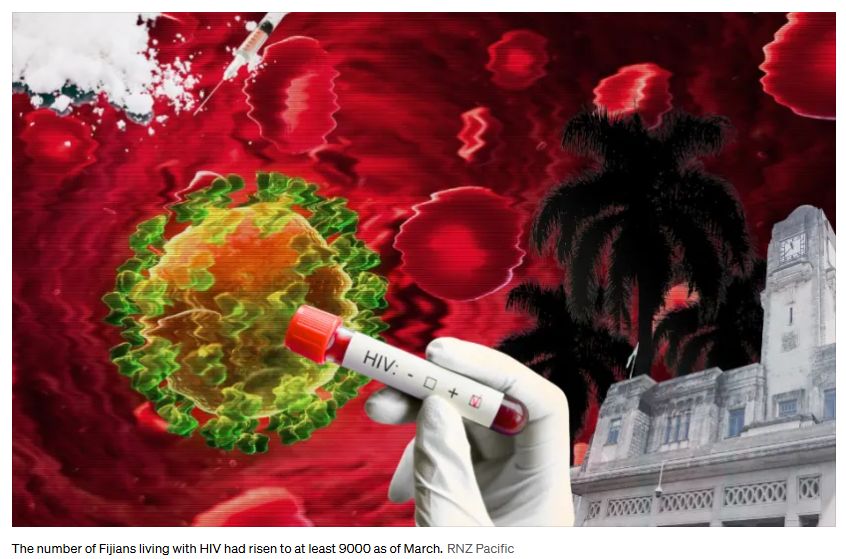
Fiji’s government current
estimates indicate that one in every 60 adults in Fiji is
living with HIV.
Speaking to Pacific Waves,
Mohammed said in the past five years the number of HIV cases
has increased by 1400 percent.
He said the epidemic is
affecting all communites across Fiji, with the pattern of
transmission changing as cases continue to
climb.
“It’s becoming a more generalised outbreak,”
Mohammed said.
“It is impacting other segments of
society so we are seeing sexual transmissions, we are seeing
mother-to-child transmissions. So what this declaration does
is that it recognises the seriousness of this
issue.”
Fragile health system
Mohammed said a
large portion of Fiji’s budget is spent on the country’s
health system, but that the infrastructure is ailing. He
added that discussions of safe needle exchanges need to be
actioned.
He added that stigma plays a role in
preventing people from accessing treatment.
“There are
elements of society that are saying, that if you provide
safe needle exchanges, you are promoting drug use – that is
not the case.”
“We know from evidence that providing
safe needle exchanges does not increase drug use but it will
certainly decrease the number of cases.”
Fiji’s
development partners could also do a lot more to help the
country in its response, Mohammed said.
In July last
year, New Zealand gave
NZD$4 million to Fiji, but Mohammed said the support
should go beyond funding.
He said New Zealand’s
experience in managing HIV could provide Fiji with technical
expertise to help strengthen its response.
The focus,
he said, should be on helping Fiji expand prevention,
treatment and public health
measures.
New Zealand’s public broadcaster, providing comprehensive NZ news and current affairs, specialist audio features and documentaries.
Radio New Zealand is a Crown entity established under the Radio New Zealand Act 1995. Radio New Zealand News are vital elements in our programming, providing impartial news and information to New Zealanders every day. Radio New Zealand (RNZ) provides listeners with exciting and independent radio programmes in accordance with the Radio New Zealand Charter.

